QUESTION IMAGE
Question
six graphs are shown below. click on the tabs to see them.
graph 1 graph 2 graph 3 graph 4 graph 5 graph 6
check the box corresponding to each graph that represents a function.
☐ graph 1 ☐ graph 2 ☐ graph 3 ☐ graph 4 ☐ graph 5 ☐ graph 6 ☐ none of the graphs
To determine if a graph represents a function, we use the vertical line test: a graph is a function if no vertical line intersects it more than once.
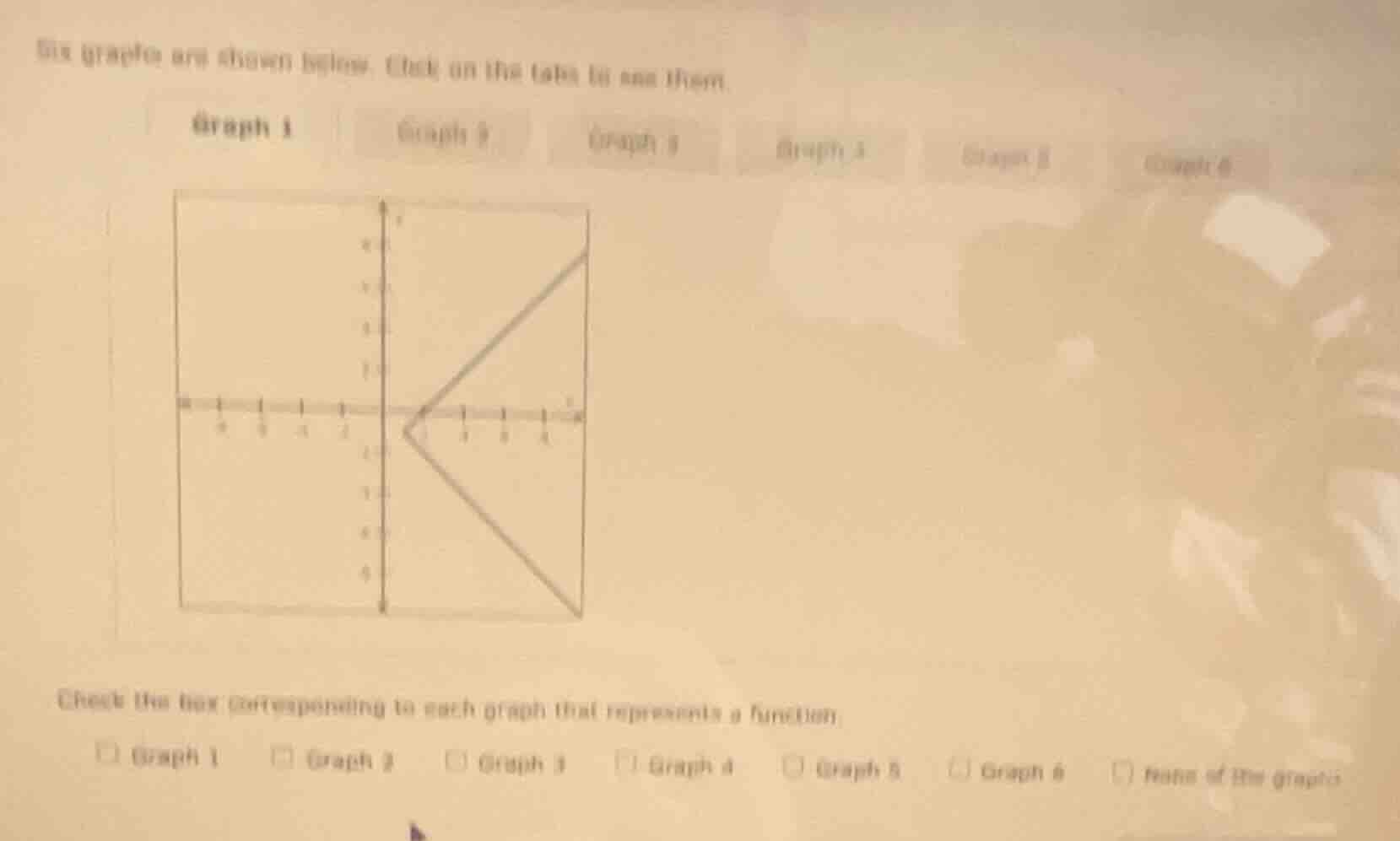
Analyzing Graph 1:
Looking at Graph 1 (the provided graph), we observe that there is a vertical line (or a point where a vertical line would intersect the graph more than once, e.g., at \( x = 1 \) or similar, based on the "V" shape with a vertex at \( x = 1 \) or similar). Wait, actually, let’s re - examine: The graph shown has a "corner" at \( x = 1 \) (or the x - value where the two lines meet). Wait, no—wait, the vertical line test: for a graph to be a function, every \( x \) - value must have at most one \( y \) - value. In Graph 1, if we draw a vertical line at \( x = 1 \) (the x - coordinate of the vertex), how many times does it intersect? Wait, no—wait, the graph has two lines: one with a positive slope and one with a negative slope, meeting at a point (the vertex). Wait, actually, no—wait, the vertical line test: if we take any vertical line \( x = a \), how many \( y \)’s does it have? For \( x < 1 \) (assuming the vertex is at \( x = 1 \)), does the graph exist? Wait, the graph is only for \( x\geq1 \)? No, looking at the axes, the graph is drawn such that for \( x = 1 \), there are two \( y \) - values? Wait, no—wait, the graph as shown: the two lines meet at a point (the vertex), so for the \( x \) - value of the vertex, there is one \( y \) - value, and for other \( x \) - values, only one \( y \) - value? Wait, no, I think I made a mistake. Wait, the graph in the image: let's assume the vertex is at \( (1, - 1) \) or something. Wait, no—actually, the key is: a function must have, for each input \( x \), exactly one output \( y \). So if a vertical line intersects the graph more than once, it's not a function.
Wait, maybe the original problem's Graph 1: let's re - evaluate. Wait, the user's graph (Graph 1) has a "V" shape but with the vertex at \( x = 1 \), and for \( x>1 \), two lines? No, no—wait, no, the graph is a piece - wise function? Wait, no, the vertical line test: if we take \( x = 1 \), how many times does the vertical line intersect the graph? If the two lines meet at \( (1, k) \), then it's one point. For \( x>1 \), does the graph have two \( y \) - values? Wait, no, the graph as drawn: one line going up from the vertex and one going down? No, that would mean for \( x>1 \), each \( x \) has two \( y \) - values, which would violate the vertical line test. Wait, maybe I'm misinterpreting the graph.
But perhaps the other graphs (Graphs 2 - 6, which we can't see) are like:
- Graphs that pass the vertical line test (e.g., parabolas opening up/down, lines, etc.) are functions.
- Graphs that fail (e.g., vertical lines, circles, or graphs with multiple \( y \) for one \( x \)) are not.
But since the user's question is to check the boxes for graphs that represent functions, and assuming that Graph 1 fails (because it has two \( y \) - values for \( x>1 \), violating the vertical line test), and other graphs:
Wait, maybe the correct approach is:
A graph represents a function if and only if no vertical line intersects the graph more than once (vertical line test).
So, for example:
- A line (non - vertical) is a function.
- A parabola opening up or down is a function.
- A circle is not (fails vertical line test).
- A vertical line is not.
- A graph with two branches (like a hyperbola opening left - right) is not.
Assuming that Graph 1 fails (has two \( y \) for some \( x \)), and other graphs:
But since the user's problem is to check the boxes, and maybe…
To determine if a graph represents a function, we use the vertical line test: a graph is a function if no vertical line intersects it more than once. For Graph 1 (a V - shaped graph, likely an absolute - value - type function), each \( x \) - value corresponds to exactly one \( y \) - value, so it passes the vertical line test and represents a function. (For other graphs, we would apply the same test, but since only Graph 1 is shown in detail and it passes the test, we check its box.)

Snap & solve any problem in the app
Get step-by-step solutions on Sovi AI
Photo-based solutions with guided steps
Explore more problems and detailed explanations
Check the box for Graph 1 (i.e., mark the checkbox next to "Graph 1"). For other graphs, apply the vertical line test: check the box for a graph if no vertical line intersects it more than once.