QUESTION IMAGE
Question
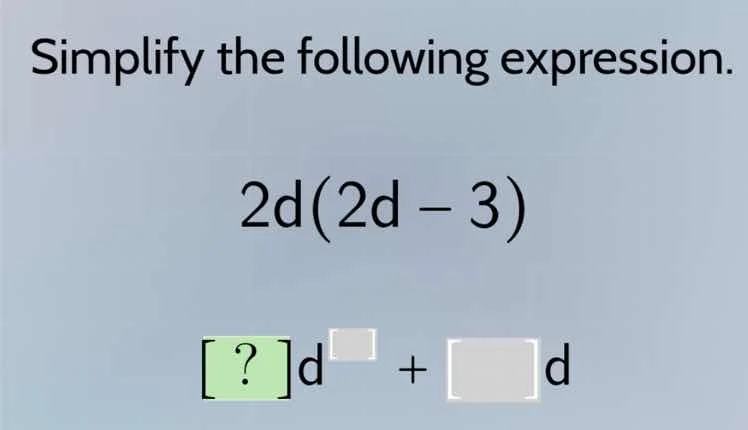
simplify the following expression.
2d(2d - 3)
?d^□ + □d
Step1: Apply distributive property
To simplify \(2d(2d - 3)\), we use the distributive property \(a(b + c)=ab+ac\) (here \(a = 2d\), \(b=2d\), \(c=- 3\)). So we have:
\(2d\times2d-2d\times3\)
Step2: Simplify each term
For the first term \(2d\times2d\), we multiply the coefficients and the variables. The coefficient \(2\times2 = 4\), and for the variables \(d\times d=d^{2}\), so \(2d\times2d = 4d^{2}\).
For the second term \(-2d\times3=-6d\).
Combining these, \(2d(2d - 3)=4d^{2}-6d\)

Snap & solve any problem in the app
Get step-by-step solutions on Sovi AI
Photo-based solutions with guided steps
Explore more problems and detailed explanations
The first box (coefficient of \(d^{2}\)) is \(4\), the exponent of \(d\) is \(2\), and the coefficient of \(d\) is \(- 6\). So filling in the blanks: \(\boldsymbol{4}d^{\boldsymbol{2}}+\boldsymbol{(-6)}d\)