Sovi.AI - AI Math Tutor

Scan to solve math questions

QUESTION IMAGE

shade some or all of the grids to show that 2 ones is the same as 20 te…

Question

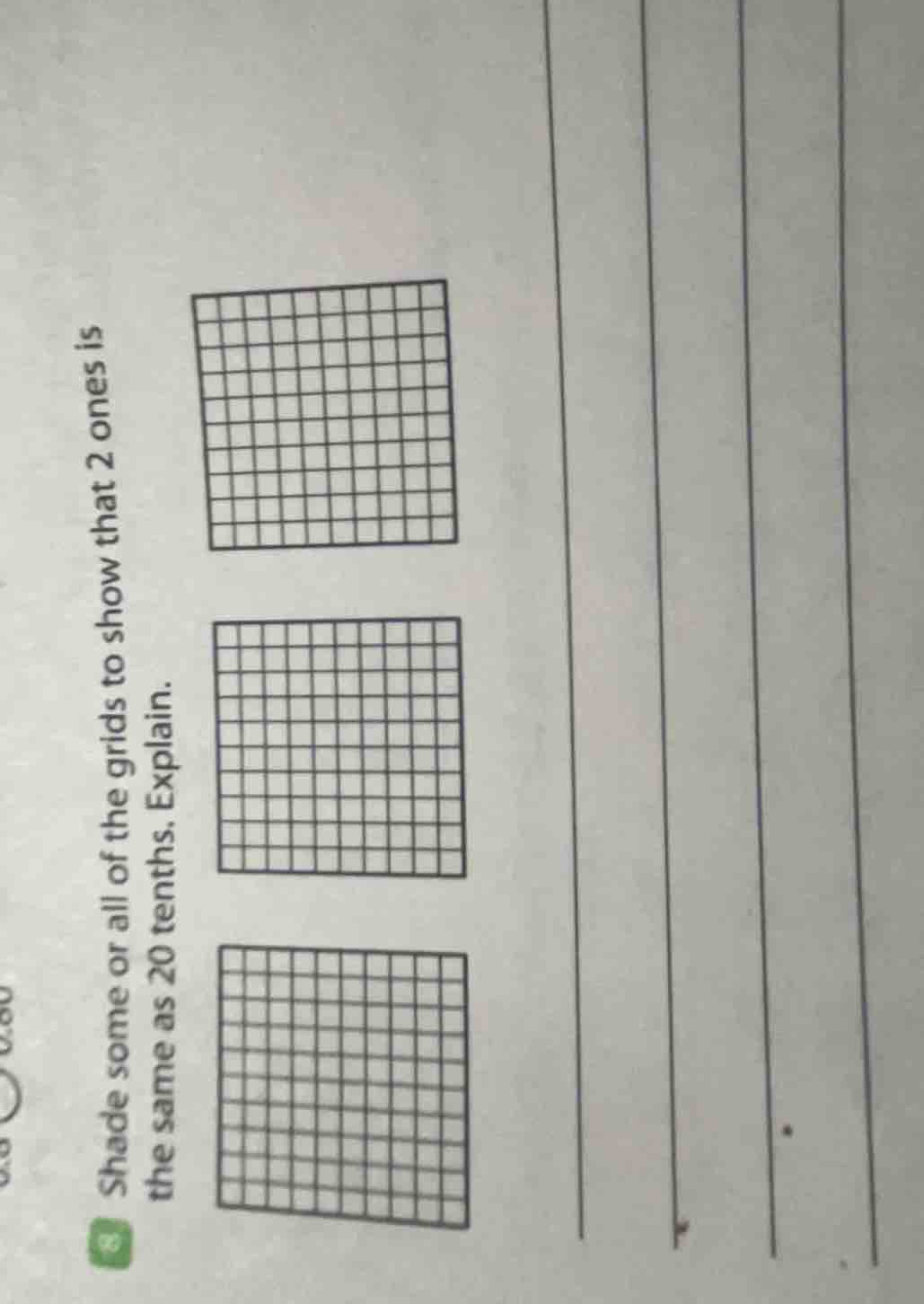
shade some or all of the grids to show that 2 ones is the same as 20 tenths. explain.

Explanation:

Response

<pre_analysis>
{
"quality": "clear",
"question_count": 1,
"skills_matched": [
"step_cot",
"explain_then_answer",
"tutor"
],
"needs_drawing": false,
"concepts_used": [],
"new_concepts": [
"Decimal Place Value",
"Visualizing Decimals"
],
"current_concepts": [
"Decimal Place Value",
"Visualizing Decimals",
"Fraction Equivalence"
]
}
</pre_analysis>

<reasoning>

Analyze the grid representation

Each grid is a \(10 \times 10\) square containing 100 small squares.
One whole grid represents 1 whole unit ("one").
Each column or row of 10 small squares represents 1 tenth (\(0.1\)).

Represent 2 ones

To represent 2 ones, we must shade 2 complete grids.
Shading 2 complete grids means shading all 100 squares in the first grid and all 100 squares in the second grid.

Represent 20 tenths

One tenth is represented by 1 column of 10 squares.
Therefore, 20 tenths is represented by shading 20 columns of 10 squares.
Since each grid has 10 columns, shading 20 columns requires shading 10 columns in the first grid and 10 columns in the second grid.
This completely fills 2 grids.

Explain the equivalence

Since shading 2 ones and shading 20 tenths both result in completely shading exactly 2 whole grids, they represent the same value.
Mathematically, \(20 \text{ tenths} = \frac{20}{10} = 2 \text{ ones}\).
</reasoning>

<answer>
To show that 2 ones is the same as 20 tenths:

  1. Shading the grids:
  • Shade 2 entire grids completely.
  • Each fully shaded grid represents 1 one, so shading 2 entire grids represents 2 ones.
  1. Explanation:
  • Each grid is divided into 10 columns, where each column represents 1 tenth (\(\frac{1}{10}\)).
  • Shading 20 tenths means shading 20 columns.
  • Since each grid has 10 columns, shading 20 columns fills exactly 2 whole grids (\(10 + 10 = 20\)).
  • Because both descriptions fill exactly 2 whole grids, 2 ones is equal to 20 tenths (\(\frac{20}{10} = 2\)).

</answer>

<post_analysis>
{
"subject": "Mathematics",
"question_type": "Free Response",
"knowledge_point": [
"Mathematics",
"Arithmetic",
"Decimal Place Value"
]
}
</post_analysis>

Answer:

<pre_analysis>
{
"quality": "clear",
"question_count": 1,
"skills_matched": [
"step_cot",
"explain_then_answer",
"tutor"
],
"needs_drawing": false,
"concepts_used": [],
"new_concepts": [
"Decimal Place Value",
"Visualizing Decimals"
],
"current_concepts": [
"Decimal Place Value",
"Visualizing Decimals",
"Fraction Equivalence"
]
}
</pre_analysis>

<reasoning>

Analyze the grid representation

Each grid is a \(10 \times 10\) square containing 100 small squares.
One whole grid represents 1 whole unit ("one").
Each column or row of 10 small squares represents 1 tenth (\(0.1\)).

Represent 2 ones

To represent 2 ones, we must shade 2 complete grids.
Shading 2 complete grids means shading all 100 squares in the first grid and all 100 squares in the second grid.

Represent 20 tenths

One tenth is represented by 1 column of 10 squares.
Therefore, 20 tenths is represented by shading 20 columns of 10 squares.
Since each grid has 10 columns, shading 20 columns requires shading 10 columns in the first grid and 10 columns in the second grid.
This completely fills 2 grids.

Explain the equivalence

Since shading 2 ones and shading 20 tenths both result in completely shading exactly 2 whole grids, they represent the same value.
Mathematically, \(20 \text{ tenths} = \frac{20}{10} = 2 \text{ ones}\).
</reasoning>

<answer>
To show that 2 ones is the same as 20 tenths:

  1. Shading the grids:
  • Shade 2 entire grids completely.
  • Each fully shaded grid represents 1 one, so shading 2 entire grids represents 2 ones.
  1. Explanation:
  • Each grid is divided into 10 columns, where each column represents 1 tenth (\(\frac{1}{10}\)).
  • Shading 20 tenths means shading 20 columns.
  • Since each grid has 10 columns, shading 20 columns fills exactly 2 whole grids (\(10 + 10 = 20\)).
  • Because both descriptions fill exactly 2 whole grids, 2 ones is equal to 20 tenths (\(\frac{20}{10} = 2\)).

</answer>

<post_analysis>
{
"subject": "Mathematics",
"question_type": "Free Response",
"knowledge_point": [
"Mathematics",
"Arithmetic",
"Decimal Place Value"
]
}
</post_analysis>