QUESTION IMAGE
Question
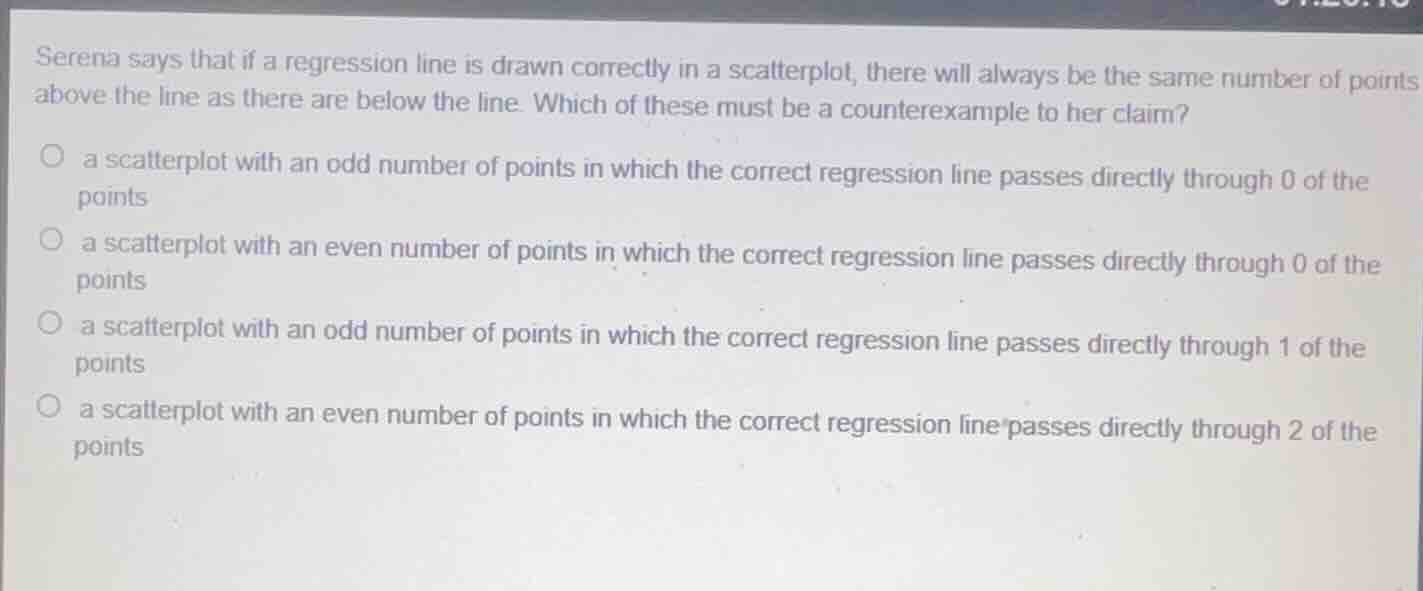
serena says that if a regression line is drawn correctly in a scatterplot, there will always be the same number of points above the line as there are below the line. which of these must be a counterexample to her claim?
a scatterplot with an odd number of points in which the correct regression line passes directly through 0 of the points
a scatterplot with an even number of points in which the correct regression line passes directly through 0 of the points
a scatterplot with an odd number of points in which the correct regression line passes directly through 1 of the points
a scatterplot with an even number of points in which the correct regression line passes directly through 2 of the points
Analyze Serena's claim
Using the Scatterplot Analysis and Line of Best Fit knowledge points
Serena claims that a correctly drawn regression line (line of best fit) in a scatterplot will always have the same number of points above the line as below the line. Let \(N\) be the total number of points in the scatterplot, \(A\) be the number of points above the line, \(B\) be the number of points below the line, and \(O\) be the number of points directly on the line. Thus, the total number of points is:
Serena's claim is that \(A = B\) must always hold true. A counterexample must be a scenario where \(A
eq B\) is guaranteed to occur.
Evaluate an odd number of points with zero points on the line
Using the Scatterplot Analysis knowledge point
Let's test the first option: a scatterplot with an odd number of points (\(N\) is odd) where the regression line passes through 0 points (\(O = 0\)).
Since \(N\) is an odd integer, the sum of two integers \(A\) and \(B\) is odd. An odd number cannot be divided into two equal integers:
Therefore, it is mathematically impossible for the number of points above the line to equal the number of points below the line. This scenario must be a counterexample to Serena's claim.
Evaluate other options for consistency
Using the Scatterplot Analysis knowledge point
Let's check why the other options do not guarantee a counterexample:
- Even points, 0 on the line: \(N\) is even, \(O = 0\). We can have \(A + B = N\). Since \(N\) is even, \(A = B = \frac{N}{2}\) is possible.
- Odd points, 1 on the line: \(N\) is odd, \(O = 1\). We have \(A + B = N - 1\). Since \(N\) is odd, \(N - 1\) is even, so \(A = B = \frac{N-1}{2}\) is possible.
- Even points, 2 on the line: \(N\) is even, \(O = 2\). We have \(A + B = N - 2\). Since \(N\) is even, \(N - 2\) is even, so \(A = B = \frac{N-2}{2}\) is possible.

Snap & solve any problem in the app
Get step-by-step solutions on Sovi AI
Photo-based solutions with guided steps
Explore more problems and detailed explanations
- (A) a scatterplot with an odd number of points in which the correct regression line passes directly through 0 of the points (Correct answer)
- (B) a scatterplot with an even number of points in which the correct regression line passes directly through 0 of the points
- (C) a scatterplot with an odd number of points in which the correct regression line passes directly through 1 of the points
- (D) a scatterplot with an even number of points in which the correct regression line passes directly through 2 of the points