QUESTION IMAGE
Question
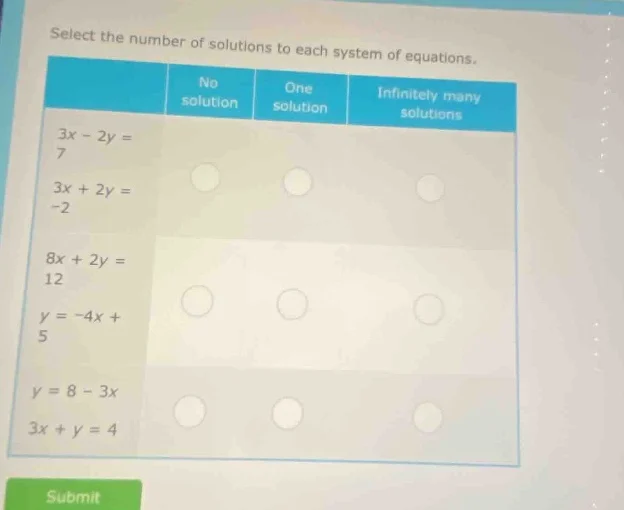
select the number of solutions to each system of equations.
no solution one solution infinitely many solutions
3x - 2y = 7
3x + 2y = -2
8x + 2y = 12
y = -4x + 5
y = 8 - 3x
3x + y = 4
submit
To determine the number of solutions for each system of equations, we analyze the slopes and intercepts (or solve the systems) to see if the lines are intersecting (one solution), parallel (no solution), or coinciding (infinitely many solutions).
System 1: \( \boldsymbol{3x - 2y = 7} \) and \( \boldsymbol{3x + 2y = -2} \)
Step 1: Rewrite in slope - intercept form (\( y = mx + b \))
- For \( 3x - 2y = 7 \):
Subtract \( 3x \) from both sides: \( -2y=-3x + 7 \).
Divide by \( -2 \): \( y=\frac{3}{2}x-\frac{7}{2} \). Slope \( m_1=\frac{3}{2} \), intercept \( b_1 = -\frac{7}{2} \).
- For \( 3x + 2y = -2 \):
Subtract \( 3x \) from both sides: \( 2y=-3x - 2 \).
Divide by \( 2 \): \( y=-\frac{3}{2}x - 1 \). Slope \( m_2=-\frac{3}{2} \), intercept \( b_2=-1 \).
Step 2: Analyze slopes/intercepts
Since \( m_1
eq m_2 \) (slopes are not equal), the lines intersect at one point. Thus, this system has one solution.
System 2: \( \boldsymbol{8x + 2y = 12} \) and \( \boldsymbol{y = -4x + 5} \)
Step 1: Rewrite \( 8x + 2y = 12 \) in slope - intercept form
Subtract \( 8x \) from both sides: \( 2y=-8x + 12 \).
Divide by \( 2 \): \( y=-4x + 6 \). Slope \( m_1=-4 \), intercept \( b_1 = 6 \).
The second equation is \( y=-4x + 5 \), so slope \( m_2=-4 \), intercept \( b_2 = 5 \).
Step 2: Analyze slopes/intercepts
Since \( m_1=m_2 \) (equal slopes) but \( b_1
eq b_2 \) (different intercepts), the lines are parallel and never intersect. Thus, this system has no solution.
System 3: \( \boldsymbol{y = 8 - 3x} \) and \( \boldsymbol{3x + y = 4} \)
Step 1: Rewrite \( 3x + y = 4 \) in slope - intercept form
Subtract \( 3x \) from both sides: \( y=-3x + 4 \). Slope \( m_1=-3 \), intercept \( b_1 = 4 \).
The first equation is \( y=-3x + 8 \), so slope \( m_2=-3 \), intercept \( b_2 = 8 \).
Step 2: Analyze slopes/intercepts
Since \( m_1=m_2 \) (equal slopes) but \( b_1
eq b_2 \) (different intercepts), the lines are parallel and never intersect. Wait, no—wait, let’s solve the system:
Substitute \( y = 8 - 3x \) into \( 3x + y = 4 \):
\( 3x+(8 - 3x)=4 \)
Simplify: \( 3x + 8 - 3x = 4 \) → \( 8 = 4 \), which is a contradiction.
Thus, the system has no solution? Wait, no—wait, let’s re - check. Wait, \( y = 8 - 3x \) and \( 3x + y = 4 \):
Substitute \( y \): \( 3x+(8 - 3x)=4 \) → \( 8 = 4 \), which is false. So no solution. Wait, but earlier slope analysis: both have slope \( -3 \), different intercepts (8 vs. 4), so parallel. Thus, no solution.
Final Answers (Mark the Columns):
- For \( 3x - 2y = 7 \) and \( 3x + 2y = -2 \): Mark the “One solution” column.
- For \( 8x + 2y = 12 \) and \( y = -4x + 5 \): Mark the “No solution” column.
- For \( y = 8 - 3x \) and \( 3x + y = 4 \): Mark the “No solution” column.
(Note: If there was a miscalculation earlier, let’s re - check the third system: \( y = 8 - 3x \) (slope - 3, y - intercept 8) and \( 3x + y = 4 \) → \( y=-3x + 4 \) (slope - 3, y - intercept 4). Since slopes are equal and intercepts different, lines are parallel—no solution. Correct.)

Snap & solve any problem in the app
Get step-by-step solutions on Sovi AI
Photo-based solutions with guided steps
Explore more problems and detailed explanations
To determine the number of solutions for each system of equations, we analyze the slopes and intercepts (or solve the systems) to see if the lines are intersecting (one solution), parallel (no solution), or coinciding (infinitely many solutions).
System 1: \( \boldsymbol{3x - 2y = 7} \) and \( \boldsymbol{3x + 2y = -2} \)
Step 1: Rewrite in slope - intercept form (\( y = mx + b \))
- For \( 3x - 2y = 7 \):
Subtract \( 3x \) from both sides: \( -2y=-3x + 7 \).
Divide by \( -2 \): \( y=\frac{3}{2}x-\frac{7}{2} \). Slope \( m_1=\frac{3}{2} \), intercept \( b_1 = -\frac{7}{2} \).
- For \( 3x + 2y = -2 \):
Subtract \( 3x \) from both sides: \( 2y=-3x - 2 \).
Divide by \( 2 \): \( y=-\frac{3}{2}x - 1 \). Slope \( m_2=-\frac{3}{2} \), intercept \( b_2=-1 \).
Step 2: Analyze slopes/intercepts
Since \( m_1
eq m_2 \) (slopes are not equal), the lines intersect at one point. Thus, this system has one solution.
System 2: \( \boldsymbol{8x + 2y = 12} \) and \( \boldsymbol{y = -4x + 5} \)
Step 1: Rewrite \( 8x + 2y = 12 \) in slope - intercept form
Subtract \( 8x \) from both sides: \( 2y=-8x + 12 \).
Divide by \( 2 \): \( y=-4x + 6 \). Slope \( m_1=-4 \), intercept \( b_1 = 6 \).
The second equation is \( y=-4x + 5 \), so slope \( m_2=-4 \), intercept \( b_2 = 5 \).
Step 2: Analyze slopes/intercepts
Since \( m_1=m_2 \) (equal slopes) but \( b_1
eq b_2 \) (different intercepts), the lines are parallel and never intersect. Thus, this system has no solution.
System 3: \( \boldsymbol{y = 8 - 3x} \) and \( \boldsymbol{3x + y = 4} \)
Step 1: Rewrite \( 3x + y = 4 \) in slope - intercept form
Subtract \( 3x \) from both sides: \( y=-3x + 4 \). Slope \( m_1=-3 \), intercept \( b_1 = 4 \).
The first equation is \( y=-3x + 8 \), so slope \( m_2=-3 \), intercept \( b_2 = 8 \).
Step 2: Analyze slopes/intercepts
Since \( m_1=m_2 \) (equal slopes) but \( b_1
eq b_2 \) (different intercepts), the lines are parallel and never intersect. Wait, no—wait, let’s solve the system:
Substitute \( y = 8 - 3x \) into \( 3x + y = 4 \):
\( 3x+(8 - 3x)=4 \)
Simplify: \( 3x + 8 - 3x = 4 \) → \( 8 = 4 \), which is a contradiction.
Thus, the system has no solution? Wait, no—wait, let’s re - check. Wait, \( y = 8 - 3x \) and \( 3x + y = 4 \):
Substitute \( y \): \( 3x+(8 - 3x)=4 \) → \( 8 = 4 \), which is false. So no solution. Wait, but earlier slope analysis: both have slope \( -3 \), different intercepts (8 vs. 4), so parallel. Thus, no solution.
Final Answers (Mark the Columns):
- For \( 3x - 2y = 7 \) and \( 3x + 2y = -2 \): Mark the “One solution” column.
- For \( 8x + 2y = 12 \) and \( y = -4x + 5 \): Mark the “No solution” column.
- For \( y = 8 - 3x \) and \( 3x + y = 4 \): Mark the “No solution” column.
(Note: If there was a miscalculation earlier, let’s re - check the third system: \( y = 8 - 3x \) (slope - 3, y - intercept 8) and \( 3x + y = 4 \) → \( y=-3x + 4 \) (slope - 3, y - intercept 4). Since slopes are equal and intercepts different, lines are parallel—no solution. Correct.)