QUESTION IMAGE
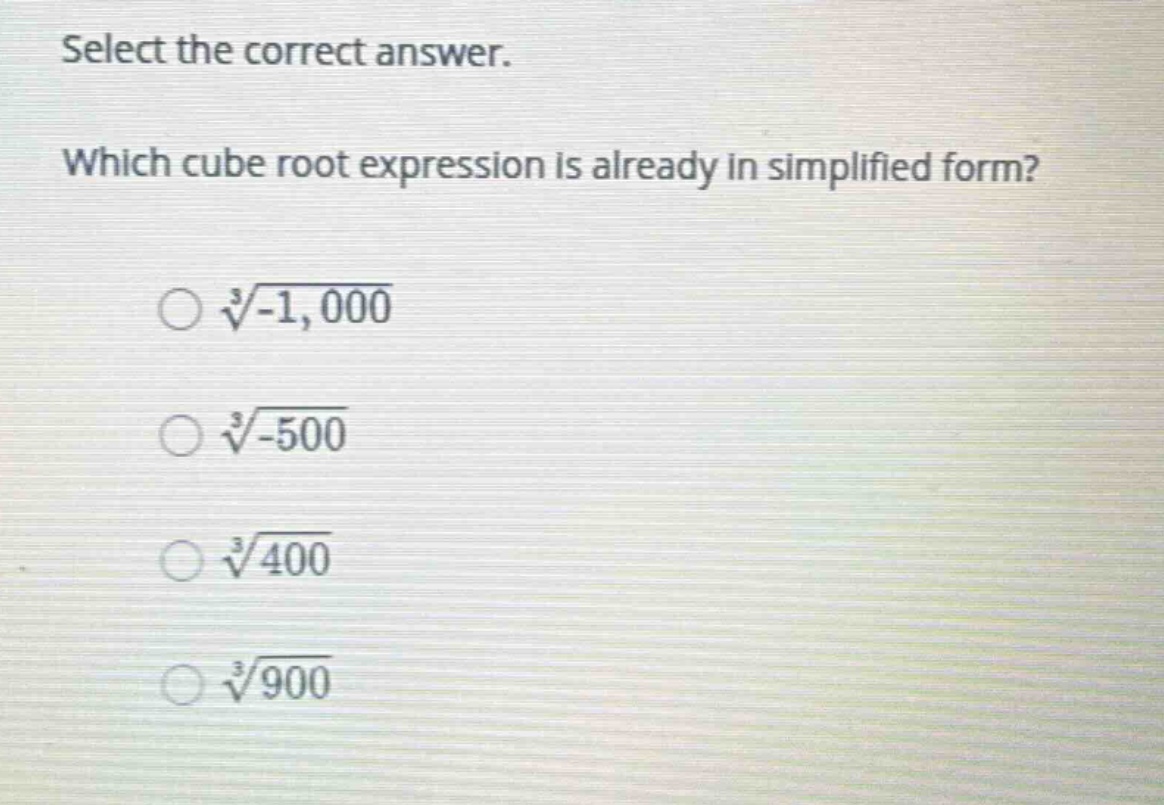
Question
select the correct answer.
which cube root expression is already in simplified form?
\\(\sqrt3{-1,000}\\)
\\(\sqrt3{-500}\\)
\\(\sqrt3{400}\\)
\\(\sqrt3{900}\\)
⚡ Using what you learned: simplifying radical expressions
Step 1: Define simplified form for cube roots
A cube root expression \(\sqrt[3]{x}\) is in its simplest form if the radicand \(x\) contains no perfect cube factors other than \(1\) or \(-1\).
The smallest positive perfect cubes are:
We need to test each option to see if its radicand is divisible by any of these perfect cubes (other than \(1\)).
Step 2: Analyze each option
- Option 1: \(\sqrt[3]{-1,000}\)
Since \(-1,000 = (-10)^3\), this is a perfect cube and simplifies completely to \(-10\). It is not in simplified radical form.
- Option 2: \(\sqrt[3]{-500}\)
We look for perfect cube factors of \(500\). Since \(500 = 125 \times 4\), and \(125 = 5^3\) is a perfect cube:
This can be simplified, so it is not already in simplified form.
- Option 3: \(\sqrt[3]{400}\)
We look for perfect cube factors of \(400\). Since \(400 = 8 \times 50\), and \(8 = 2^3\) is a perfect cube:
This can be simplified, so it is not already in simplified form.
- Option 4: \(\sqrt[3]{900}\)
We find the prime factorization of \(900\):
None of the prime factors have an exponent of \(3\) or greater. Therefore, \(900\) has no perfect cube factors other than \(1\). This expression cannot be simplified further.

Snap & solve any problem in the app
Get step-by-step solutions on Sovi AI
Photo-based solutions with guided steps
Explore more problems and detailed explanations
\(\sqrt[3]{900}\)