QUESTION IMAGE
Question
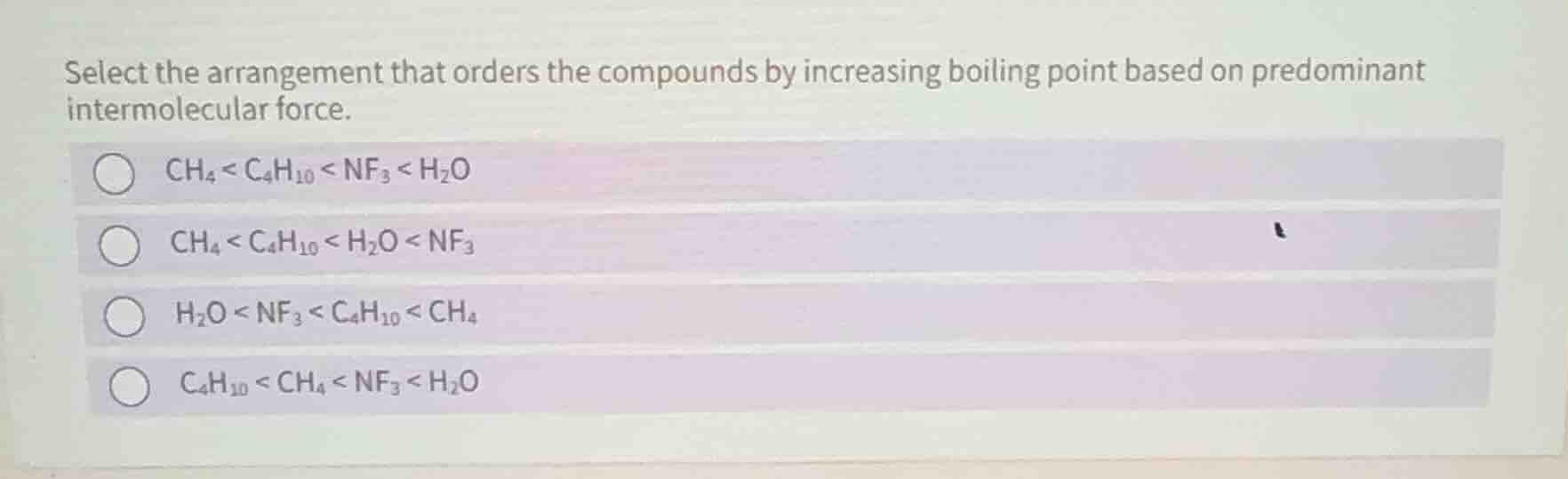
select the arrangement that orders the compounds by increasing boiling point based on predominant intermolecular force.
\\(\text{ch}_4 < \text{c}_4\text{h}_{10} < \text{nf}_3 < \text{h}_2\text{o}\\)
\\(\text{ch}_4 < \text{c}_4\text{h}_{10} < \text{h}_2\text{o} < \text{nf}_3\\)
\\(\text{h}_2\text{o} < \text{nf}_3 < \text{c}_4\text{h}_{10} < \text{ch}_4\\)
\\(\text{c}_4\text{h}_{10} < \text{ch}_4 < \text{nf}_3 < \text{h}_2\text{o}\\)
Identify predominant intermolecular forces
Using the Intermolecular Forces knowledge point
- \(\text{CH}_4\): Nonpolar molecule, predominant force is London Dispersion Forces.
- \(\text{C}_4\text{H}_{10}\): Nonpolar molecule, predominant force is London Dispersion Forces.
- \(\text{NF}_3\): Polar molecule, predominant force is Dipole-Dipole Interactions.
- \(\text{H}_2\text{O}\): Polar molecule with \(\text{O-H}\) bonds, predominant force is Hydrogen Bonding.
Compare dispersion forces by molecular size
Using the London Dispersion Forces knowledge point
- Both \(\text{CH}_4\) and \(\text{C}_4\text{H}_{10}\) exhibit dispersion forces.
- \(\text{C}_4\text{H}_{10}\) has a larger molar mass and electron cloud than \(\text{CH}_4\).
- Larger electron clouds are more polarizable, leading to stronger dispersion forces.
- Therefore, the boiling point of \(\text{CH}_4\) is lower than that of \(\text{C}_4\text{H}_{10}\):
Rank by relative strength of force types
Using the Dipole-Dipole Interactions and Hydrogen Bonding knowledge points
- London Dispersion Forces (in small/medium molecules) < Dipole-Dipole Interactions < Hydrogen Bonding.
- \(\text{NF}_3\) (dipole-dipole) has stronger forces than the nonpolar hydrocarbons.
- \(\text{H}_2\text{O}\) (hydrogen bonding) has the strongest intermolecular forces among the group.
- This yields the relative order:
Establish the final increasing order
Using the Boiling Point Trends knowledge point
- Combining the individual comparisons:

Snap & solve any problem in the app
Get step-by-step solutions on Sovi AI
Photo-based solutions with guided steps
Explore more problems and detailed explanations
- (A) \(\text{CH}_4 < \text{C}_4\text{H}_{10} < \text{NF}_3 < \text{H}_2\text{O}\) (Correct answer)
- (B) \(\text{CH}_4 < \text{C}_4\text{H}_{10} < \text{H}_2\text{O} < \text{NF}_3\)
- (C) \(\text{H}_2\text{O} < \text{NF}_3 < \text{C}_4\text{H}_{10} < \text{CH}_4\)
- (D) \(\text{C}_4\text{H}_{10} < \text{CH}_4 < \text{NF}_3 < \text{H}_2\text{O}\)