QUESTION IMAGE
Question
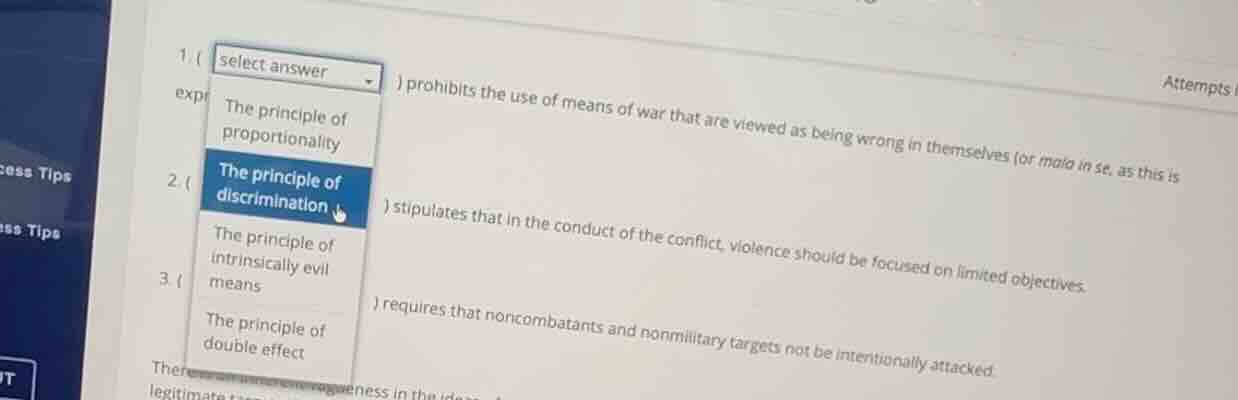
- ( select answer ) prohibits the use of means of war that are viewed as being wrong in themselves (or mala in se, as this is expressed).
options:
- the principle of proportionality
- the principle of discrimination
- the principle of intrinsically evil means
- the principle of double effect
- ( ) stipulates that in the conduct of the conflict, violence should be focused on limited objectives.
- ( ) requires that noncombatants and nonmilitary targets not be intentionally attacked.
<pre_analysis>
{
"quality": "clear",
"question_count": 3,
"skills_matched": [
"direct_cot",
"multiple_choice_formatter",
"explain_then_answer",
"quick"
],
"needs_drawing": false,
"concepts_used": [],
"new_concepts": [
"Jus in bello principles",
"Mala in se in war",
"Principle of double effect"
],
"current_concepts": [
"Jus in bello",
"The principle of proportionality",
"The principle of discrimination",
"The principle of intrinsically evil means",
"The principle of double effect"
]
}
</pre_analysis>
<reasoning>
Analyze the first definition
The first statement describes a rule prohibiting means of war that are "wrong in themselves (or mala in se)". This corresponds directly to the principle of intrinsically evil means (mala in se).
Analyze the second definition
The second statement stipulates that in the conduct of conflict, violence should be focused on limited objectives. This represents the principle of proportionality, which balances the military necessity of an action against its expected collateral damage or overall destruction.
Analyze the third definition
The third statement requires that noncombatants and nonmilitary targets not be intentionally attacked. This is the definition of the principle of discrimination (or distinction), which separates combatants from noncombatants.
</reasoning>
<answer>
Question 1
<mcq-option>(A) The principle of proportionality</mcq-option>
<mcq-option>(B) The principle of discrimination</mcq-option>
<mcq-correct>(C) The principle of intrinsically evil means</mcq-correct>
<mcq-option>(D) The principle of double effect</mcq-option>
Question 2
<mcq-correct>(A) The principle of proportionality</mcq-correct>
<mcq-option>(B) The principle of discrimination</mcq-option>
<mcq-option>(C) The principle of intrinsically evil means</mcq-option>
<mcq-option>(D) The principle of double effect</mcq-option>
Question 3
<mcq-option>(A) The principle of proportionality</mcq-option>
<mcq-correct>(B) The principle of discrimination</mcq-correct>
<mcq-option>(C) The principle of intrinsically evil means</mcq-option>
<mcq-option>(D) The principle of double effect</mcq-option>
</answer>
<post_analysis>
{
"subject": "Social Science",
"question_type": "Multiple Choice",
"knowledge_point": [
"Social Science",
"Political Science",
"Just War Theory"
]
}
</post_analysis>
Snap & solve any problem in the app
Get step-by-step solutions on Sovi AI
Photo-based solutions with guided steps
Explore more problems and detailed explanations
<pre_analysis>
{
"quality": "clear",
"question_count": 3,
"skills_matched": [
"direct_cot",
"multiple_choice_formatter",
"explain_then_answer",
"quick"
],
"needs_drawing": false,
"concepts_used": [],
"new_concepts": [
"Jus in bello principles",
"Mala in se in war",
"Principle of double effect"
],
"current_concepts": [
"Jus in bello",
"The principle of proportionality",
"The principle of discrimination",
"The principle of intrinsically evil means",
"The principle of double effect"
]
}
</pre_analysis>
<reasoning>
Analyze the first definition
The first statement describes a rule prohibiting means of war that are "wrong in themselves (or mala in se)". This corresponds directly to the principle of intrinsically evil means (mala in se).
Analyze the second definition
The second statement stipulates that in the conduct of conflict, violence should be focused on limited objectives. This represents the principle of proportionality, which balances the military necessity of an action against its expected collateral damage or overall destruction.
Analyze the third definition
The third statement requires that noncombatants and nonmilitary targets not be intentionally attacked. This is the definition of the principle of discrimination (or distinction), which separates combatants from noncombatants.
</reasoning>
<answer>
Question 1
<mcq-option>(A) The principle of proportionality</mcq-option>
<mcq-option>(B) The principle of discrimination</mcq-option>
<mcq-correct>(C) The principle of intrinsically evil means</mcq-correct>
<mcq-option>(D) The principle of double effect</mcq-option>
Question 2
<mcq-correct>(A) The principle of proportionality</mcq-correct>
<mcq-option>(B) The principle of discrimination</mcq-option>
<mcq-option>(C) The principle of intrinsically evil means</mcq-option>
<mcq-option>(D) The principle of double effect</mcq-option>
Question 3
<mcq-option>(A) The principle of proportionality</mcq-option>
<mcq-correct>(B) The principle of discrimination</mcq-correct>
<mcq-option>(C) The principle of intrinsically evil means</mcq-option>
<mcq-option>(D) The principle of double effect</mcq-option>
</answer>
<post_analysis>
{
"subject": "Social Science",
"question_type": "Multiple Choice",
"knowledge_point": [
"Social Science",
"Political Science",
"Just War Theory"
]
}
</post_analysis>