QUESTION IMAGE
Question
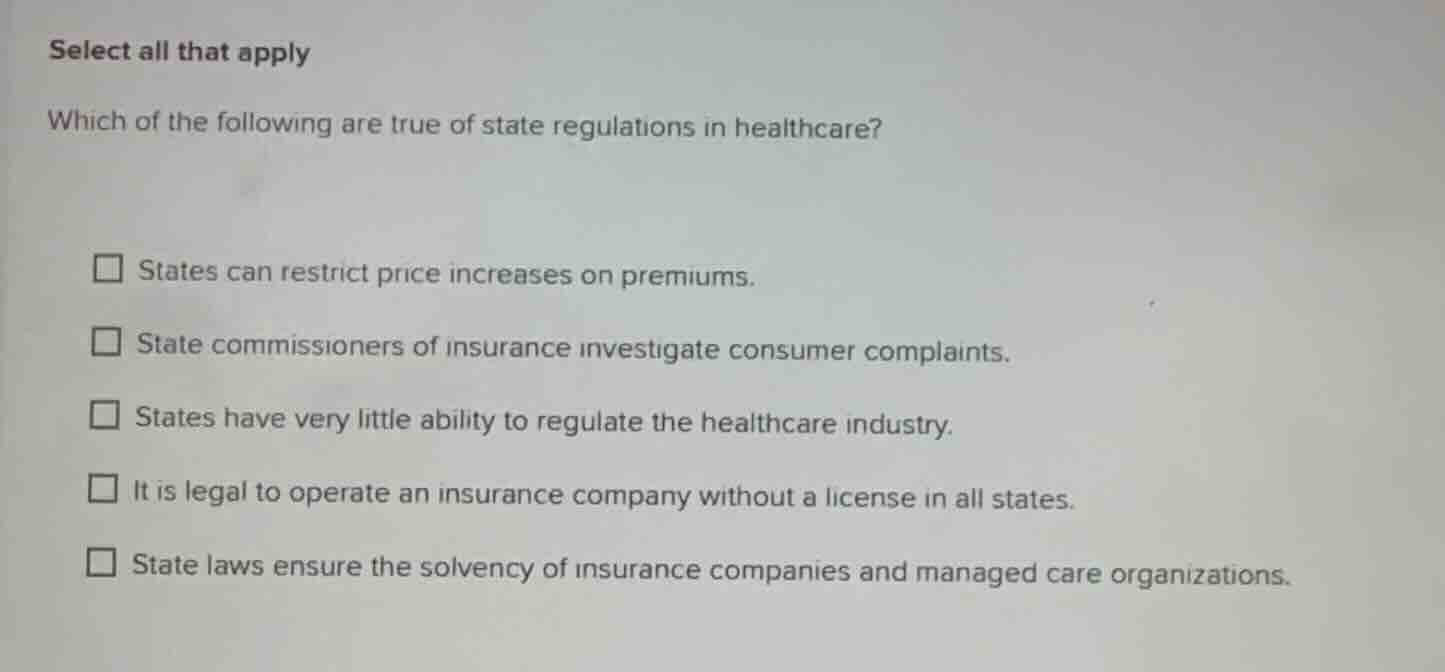
select all that apply
which of the following are true of state regulations in healthcare?
states can restrict price increases on premiums.
state commissioners of insurance investigate consumer complaints.
states have very little ability to regulate the healthcare industry.
it is legal to operate an insurance company without a license in all states.
state laws ensure the solvency of insurance companies and managed care organizations.
<pre_analysis>
{
"quality": "clear",
"question_count": 1,
"skills_matched": [
"direct_cot",
"multiple_choice_formatter",
"explain_then_answer",
"tutor",
"mastery_adaptive_brevity"
],
"needs_drawing": false,
"concepts_used": [
"State Insurance Regulation",
"Insurance Commissioners"
],
"new_concepts": [],
"current_concepts": [
"State Insurance Regulation",
"Insurance Commissioners"
]
}
</pre_analysis>
<reasoning>
Analyze premium rate regulation
Using the State Insurance Regulation knowledge point
States have the authority to review and approve or restrict premium rate increases proposed by health insurance companies to protect consumers from excessive costs.
Evaluate consumer complaint investigation
Using the Insurance Commissioners knowledge point
State commissioners of insurance are responsible for overseeing the insurance market, which includes investigating consumer complaints against insurance companies.
Assess overall state regulatory power
Using the State Insurance Regulation knowledge point
States have significant authority to regulate the healthcare industry, including licensing professionals, regulating facilities, and overseeing insurance markets. Therefore, the statement that they have "very little ability" is false.
Examine licensing requirements
Using the State Insurance Regulation knowledge point
It is illegal to operate an insurance company without a license; states strictly require licensure to conduct insurance business.
Analyze financial solvency regulations
Using the State Insurance Regulation knowledge point
State laws and regulations establish financial requirements and monitor insurance companies and managed care organizations to ensure their financial solvency so they can pay future claims.
</reasoning>
<answer>
<mcq-correct>States can restrict price increases on premiums.</mcq-correct>
<mcq-correct>State commissioners of insurance investigate consumer complaints.</mcq-correct>
<mcq-option>States have very little ability to regulate the healthcare industry.</mcq-option>
<mcq-option>It is legal to operate an insurance company without a license in all states.</mcq-option>
<mcq-correct>State laws ensure the solvency of insurance companies and managed care organizations.</mcq-correct>
</answer>
<post_analysis>
{
"subject": "Business",
"question_type": "Multiple Choice",
"knowledge_point": [
"Business",
"Healthcare Administration",
"State Insurance Regulation"
]
}
</post_analysis>
Snap & solve any problem in the app
Get step-by-step solutions on Sovi AI
Photo-based solutions with guided steps
Explore more problems and detailed explanations
<pre_analysis>
{
"quality": "clear",
"question_count": 1,
"skills_matched": [
"direct_cot",
"multiple_choice_formatter",
"explain_then_answer",
"tutor",
"mastery_adaptive_brevity"
],
"needs_drawing": false,
"concepts_used": [
"State Insurance Regulation",
"Insurance Commissioners"
],
"new_concepts": [],
"current_concepts": [
"State Insurance Regulation",
"Insurance Commissioners"
]
}
</pre_analysis>
<reasoning>
Analyze premium rate regulation
Using the State Insurance Regulation knowledge point
States have the authority to review and approve or restrict premium rate increases proposed by health insurance companies to protect consumers from excessive costs.
Evaluate consumer complaint investigation
Using the Insurance Commissioners knowledge point
State commissioners of insurance are responsible for overseeing the insurance market, which includes investigating consumer complaints against insurance companies.
Assess overall state regulatory power
Using the State Insurance Regulation knowledge point
States have significant authority to regulate the healthcare industry, including licensing professionals, regulating facilities, and overseeing insurance markets. Therefore, the statement that they have "very little ability" is false.
Examine licensing requirements
Using the State Insurance Regulation knowledge point
It is illegal to operate an insurance company without a license; states strictly require licensure to conduct insurance business.
Analyze financial solvency regulations
Using the State Insurance Regulation knowledge point
State laws and regulations establish financial requirements and monitor insurance companies and managed care organizations to ensure their financial solvency so they can pay future claims.
</reasoning>
<answer>
<mcq-correct>States can restrict price increases on premiums.</mcq-correct>
<mcq-correct>State commissioners of insurance investigate consumer complaints.</mcq-correct>
<mcq-option>States have very little ability to regulate the healthcare industry.</mcq-option>
<mcq-option>It is legal to operate an insurance company without a license in all states.</mcq-option>
<mcq-correct>State laws ensure the solvency of insurance companies and managed care organizations.</mcq-correct>
</answer>
<post_analysis>
{
"subject": "Business",
"question_type": "Multiple Choice",
"knowledge_point": [
"Business",
"Healthcare Administration",
"State Insurance Regulation"
]
}
</post_analysis>