QUESTION IMAGE
Question
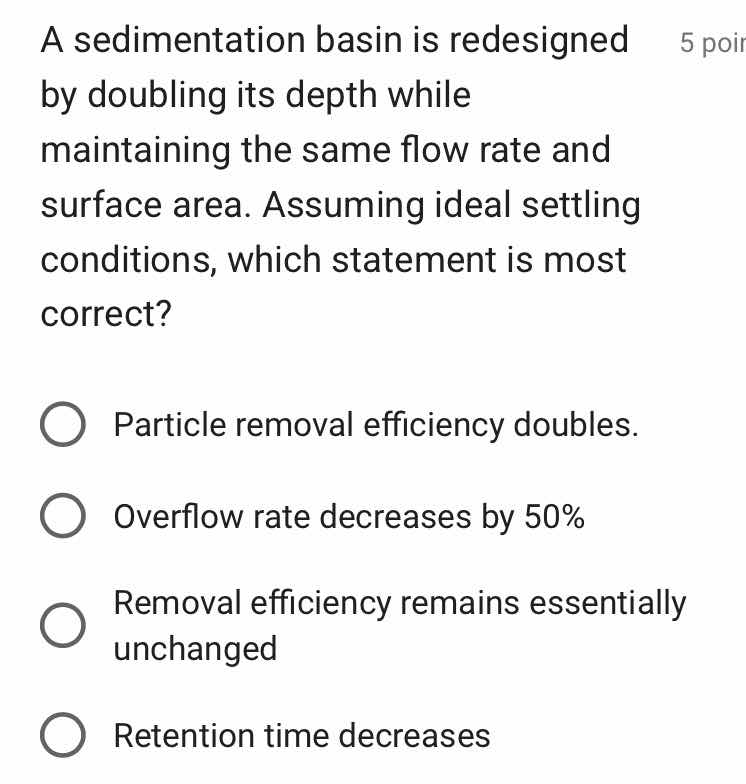
a sedimentation basin is redesigned by doubling its depth while maintaining the same flow rate and surface area. assuming ideal settling conditions, which statement is most correct?
particle removal efficiency doubles.
overflow rate decreases by 50%
removal efficiency remains essentially unchanged
retention time decreases
🆕 New Concept Discovered: Sedimentation Basin Design
How depth affects settling efficiency
Step 1: Define overflow rate (surface loading rate)
The overflow rate \( v_0 \) of a sedimentation basin is defined as the flow rate \( Q \) divided by the surface area \( A_s \):
Since both the flow rate \( Q \) and the surface area \( A_s \) remain unchanged, the overflow rate \( v_0 \) remains constant.
Step 2: Analyze particle removal efficiency
Under ideal settling conditions (Type I settling), the removal efficiency of particles with a settling velocity \( v_p \) is determined by the ratio of their settling velocity to the overflow rate:
And \( 100\% \) removal for \( v_p \ge v_0 \).
Because the overflow rate \( v_0 \) is independent of the depth of the basin \( H \), changing the depth does not alter the critical settling velocity or the overall removal efficiency of the particles.
Step 3: Evaluate the given options
- Particle removal efficiency doubles: Incorrect, because efficiency is independent of depth.
- Overflow rate decreases by 50%: Incorrect, because \( v_0 = \frac{Q}{A_s} \) remains unchanged.
- Removal efficiency remains essentially unchanged: Correct, as shown in Step 2.
- Retention time decreases: Incorrect, because retention time \( \theta = \frac{V}{Q} = \frac{A_s \cdot H}{Q} \) actually increases (doubles) when depth \( H \) is doubled.

Snap & solve any problem in the app
Get step-by-step solutions on Sovi AI
Photo-based solutions with guided steps
Explore more problems and detailed explanations
Removal efficiency remains essentially unchanged