QUESTION IMAGE
Question
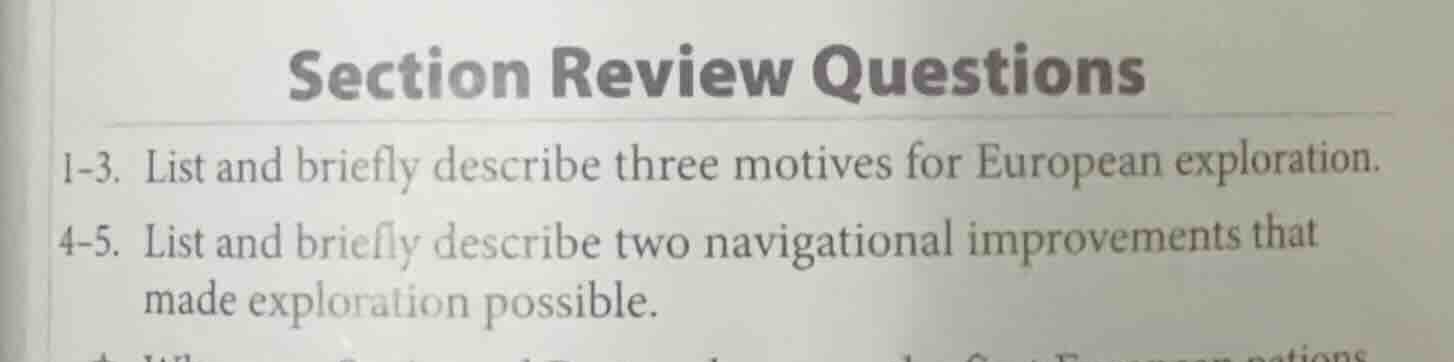
section review questions
1-3. list and briefly describe three motives for european exploration.
4-5. list and briefly describe two navigational improvements that made exploration possible.
1 - 3. Motives for European Exploration
1. Economic Motive (Mercantilism and Trade)
European nations sought new trade routes to access valuable goods like spices (pepper, cinnamon, cloves) from Asia, which were highly profitable. The Ottoman Empire's control of traditional land routes to Asia led to a search for sea routes. Also, the desire to establish colonies to exploit resources (e.g., gold, silver in the Americas) and create markets for European goods drove exploration. Colonies would provide raw materials and be forced to buy finished products from the mother country, boosting wealth.
2. Religious Motive (Spread of Christianity)
Many European explorers and nations were motivated by the desire to spread Christianity. Missionaries accompanied expeditions to convert indigenous peoples in newly discovered lands. The idea of saving souls and expanding the influence of the Christian faith, especially against the backdrop of the Reformation and Counter - Reformation, was a strong driver. For example, Spanish and Portuguese explorers saw it as their duty to convert native populations in the Americas and Asia.
3. Political Motive (National Glory and Power)
European monarchs wanted to increase their nation's power and prestige. By claiming new territories, they could expand their empires, gain more resources, and outdo rival nations. The competition between countries like Spain, Portugal, England, France, and the Netherlands led to a race for colonies and trade routes. A larger empire meant more influence in international affairs, more tax revenue, and a stronger military base.
4 - 5. Navigational Improvements
1. Astrolabe
The astrolabe was an instrument that could be used to determine the altitude of celestial bodies (like the sun or stars). This helped sailors calculate their latitude, which is their distance north or south of the equator. By knowing their latitude, they could better navigate across the oceans and stay on a desired course. It was especially useful in the open seas where there were no landmarks, as it allowed for more accurate positioning compared to earlier methods.
2. Caravel
The caravel was a new type of ship design. It had a more streamlined hull, multiple masts with a combination of square and lateen sails. The square sails were good for catching wind on long ocean voyages, while the lateen sails (triangular) allowed for better maneuverability, especially when sailing against the wind (tacking). It was also more seaworthy, with a shallower draft that allowed it to navigate near coasts as well as in the open ocean. This made long - distance exploration, such as the voyages of Portuguese explorers down the African coast and across the Atlantic, more feasible.

Snap & solve any problem in the app
Get step-by-step solutions on Sovi AI
Photo-based solutions with guided steps
Explore more problems and detailed explanations
1 - 3. Motives for European Exploration
1. Economic Motive (Mercantilism and Trade)
European nations sought new trade routes to access valuable goods like spices (pepper, cinnamon, cloves) from Asia, which were highly profitable. The Ottoman Empire's control of traditional land routes to Asia led to a search for sea routes. Also, the desire to establish colonies to exploit resources (e.g., gold, silver in the Americas) and create markets for European goods drove exploration. Colonies would provide raw materials and be forced to buy finished products from the mother country, boosting wealth.
2. Religious Motive (Spread of Christianity)
Many European explorers and nations were motivated by the desire to spread Christianity. Missionaries accompanied expeditions to convert indigenous peoples in newly discovered lands. The idea of saving souls and expanding the influence of the Christian faith, especially against the backdrop of the Reformation and Counter - Reformation, was a strong driver. For example, Spanish and Portuguese explorers saw it as their duty to convert native populations in the Americas and Asia.
3. Political Motive (National Glory and Power)
European monarchs wanted to increase their nation's power and prestige. By claiming new territories, they could expand their empires, gain more resources, and outdo rival nations. The competition between countries like Spain, Portugal, England, France, and the Netherlands led to a race for colonies and trade routes. A larger empire meant more influence in international affairs, more tax revenue, and a stronger military base.
4 - 5. Navigational Improvements
1. Astrolabe
The astrolabe was an instrument that could be used to determine the altitude of celestial bodies (like the sun or stars). This helped sailors calculate their latitude, which is their distance north or south of the equator. By knowing their latitude, they could better navigate across the oceans and stay on a desired course. It was especially useful in the open seas where there were no landmarks, as it allowed for more accurate positioning compared to earlier methods.
2. Caravel
The caravel was a new type of ship design. It had a more streamlined hull, multiple masts with a combination of square and lateen sails. The square sails were good for catching wind on long ocean voyages, while the lateen sails (triangular) allowed for better maneuverability, especially when sailing against the wind (tacking). It was also more seaworthy, with a shallower draft that allowed it to navigate near coasts as well as in the open ocean. This made long - distance exploration, such as the voyages of Portuguese explorers down the African coast and across the Atlantic, more feasible.