Sovi.AI - AI Math Tutor

Scan to solve math questions

QUESTION IMAGE

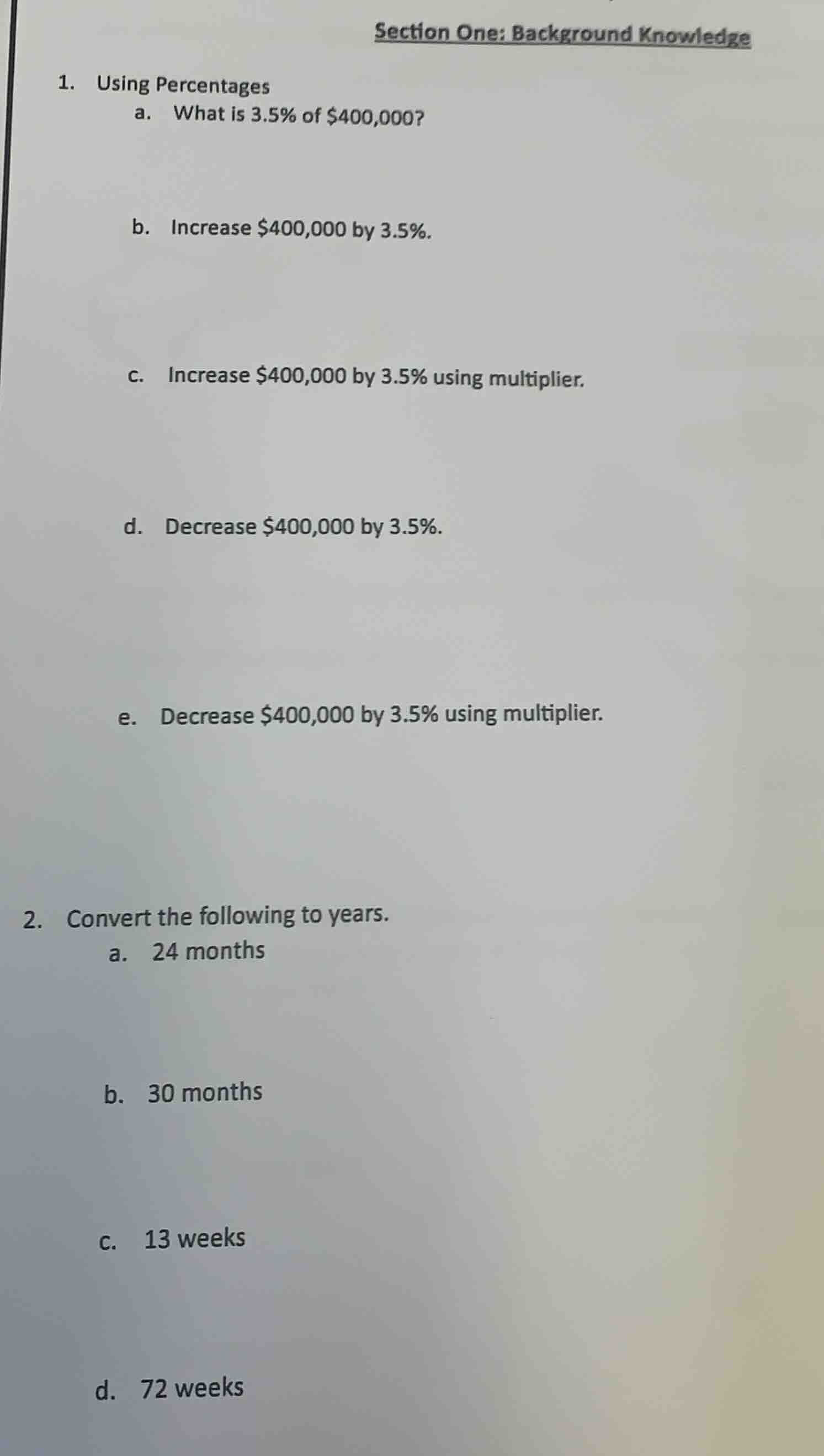
section one: background knowledge 1. using percentages a. what is 3.5% …

Question

section one: background knowledge

  1. using percentages

a. what is 3.5% of $400,000?
b. increase $400,000 by 3.5%.
c. increase $400,000 by 3.5% using multiplier.
d. decrease $400,000 by 3.5%.
e. decrease $400,000 by 3.5% using multiplier.

  1. convert the following to years.

a. 24 months
b. 30 months
c. 13 weeks
d. 72 weeks

Explanation:

Response

<pre_analysis>
{
"quality": "clear",
"question_count": 2,
"skills_matched": [
"step_cot",
"explain_then_answer",
"tutor"
],
"needs_drawing": false,
"concepts_used": [],
"new_concepts": [
"Percentage Calculations",
"Percentage Multipliers",
"Time Unit Conversion"
],
"current_concepts": [
"Percentage Calculations",
"Percentage Multipliers",
"Time Unit Conversion"
]
}
</pre_analysis>

<reasoning>

Calculate percentage values

We find \(3.5\%\) of \(\$400,000\).
Convert percentage to decimal:
\[3.5\% = 0.035\]
Multiply by the base value:
\[0.035 \times 400,000 = 14,000\]
Thus, \(3.5\%\) of \(\$400,000\) is \(\$14,000\).

Apply percentage increases

For part (b), add the calculated increase to the original amount:
\[400,000 + 14,000 = 414,000\]
For part (c), use the multiplier method.
The multiplier for a \(3.5\%\) increase is:
\[1 + 0.035 = 1.035\]
Multiply the base value:
\[400,000 \times 1.035 = 414,000\]

Apply percentage decreases

For part (d), subtract the calculated decrease from the original amount:
\[400,000 - 14,000 = 386,000\]
For part (e), use the multiplier method.
The multiplier for a \(3.5\%\) decrease is:
\[1 - 0.035 = 0.965\]
Multiply the base value:
\[400,000 \times 0.965 = 386,000\]

Convert months to years

There are 12 months in a year. Divide the number of months by 12.
For part (a):
\[\frac{24}{12} = 2\text{ years}\]
For part (b):
\[\frac{30}{12} = 2.5\text{ years}\]

Convert weeks to years

There are 52 weeks in a year. Divide the number of weeks by 52.
For part (c):
\[\frac{13}{52} = 0.25\text{ years}\]
For part (d):
\[\frac{72}{52} \approx 1.38\text{ years}\]
</reasoning>

<answer>

Question 1

a. \(\$14,000\)
b. \(\$414,000\)
c. \(\$400,000 \times 1.035 = \$414,000\)
d. \(\$386,000\)
e. \(\$400,000 \times 0.965 = \$386,000\)

Question 2

a. \(2\text{ years}\)
b. \(2.5\text{ years}\)
c. \(0.25\text{ years}\) (or \(\frac{1}{4}\text{ year}\))
d. \(\approx 1.38\text{ years}\) (or \(\frac{18}{13}\text{ years}\))
</answer>

<post_analysis>
{
"subject": "Mathematics",
"question_type": "Multi-part",
"knowledge_point": [
"Mathematics",
"Algebra",
"Percentage Calculations"
]
}
</post_analysis>

Answer:

<pre_analysis>
{
"quality": "clear",
"question_count": 2,
"skills_matched": [
"step_cot",
"explain_then_answer",
"tutor"
],
"needs_drawing": false,
"concepts_used": [],
"new_concepts": [
"Percentage Calculations",
"Percentage Multipliers",
"Time Unit Conversion"
],
"current_concepts": [
"Percentage Calculations",
"Percentage Multipliers",
"Time Unit Conversion"
]
}
</pre_analysis>

<reasoning>

Calculate percentage values

We find \(3.5\%\) of \(\$400,000\).
Convert percentage to decimal:
\[3.5\% = 0.035\]
Multiply by the base value:
\[0.035 \times 400,000 = 14,000\]
Thus, \(3.5\%\) of \(\$400,000\) is \(\$14,000\).

Apply percentage increases

For part (b), add the calculated increase to the original amount:
\[400,000 + 14,000 = 414,000\]
For part (c), use the multiplier method.
The multiplier for a \(3.5\%\) increase is:
\[1 + 0.035 = 1.035\]
Multiply the base value:
\[400,000 \times 1.035 = 414,000\]

Apply percentage decreases

For part (d), subtract the calculated decrease from the original amount:
\[400,000 - 14,000 = 386,000\]
For part (e), use the multiplier method.
The multiplier for a \(3.5\%\) decrease is:
\[1 - 0.035 = 0.965\]
Multiply the base value:
\[400,000 \times 0.965 = 386,000\]

Convert months to years

There are 12 months in a year. Divide the number of months by 12.
For part (a):
\[\frac{24}{12} = 2\text{ years}\]
For part (b):
\[\frac{30}{12} = 2.5\text{ years}\]

Convert weeks to years

There are 52 weeks in a year. Divide the number of weeks by 52.
For part (c):
\[\frac{13}{52} = 0.25\text{ years}\]
For part (d):
\[\frac{72}{52} \approx 1.38\text{ years}\]
</reasoning>

<answer>

Question 1

a. \(\$14,000\)
b. \(\$414,000\)
c. \(\$400,000 \times 1.035 = \$414,000\)
d. \(\$386,000\)
e. \(\$400,000 \times 0.965 = \$386,000\)

Question 2

a. \(2\text{ years}\)
b. \(2.5\text{ years}\)
c. \(0.25\text{ years}\) (or \(\frac{1}{4}\text{ year}\))
d. \(\approx 1.38\text{ years}\) (or \(\frac{18}{13}\text{ years}\))
</answer>

<post_analysis>
{
"subject": "Mathematics",
"question_type": "Multi-part",
"knowledge_point": [
"Mathematics",
"Algebra",
"Percentage Calculations"
]
}
</post_analysis>