QUESTION IMAGE
Question
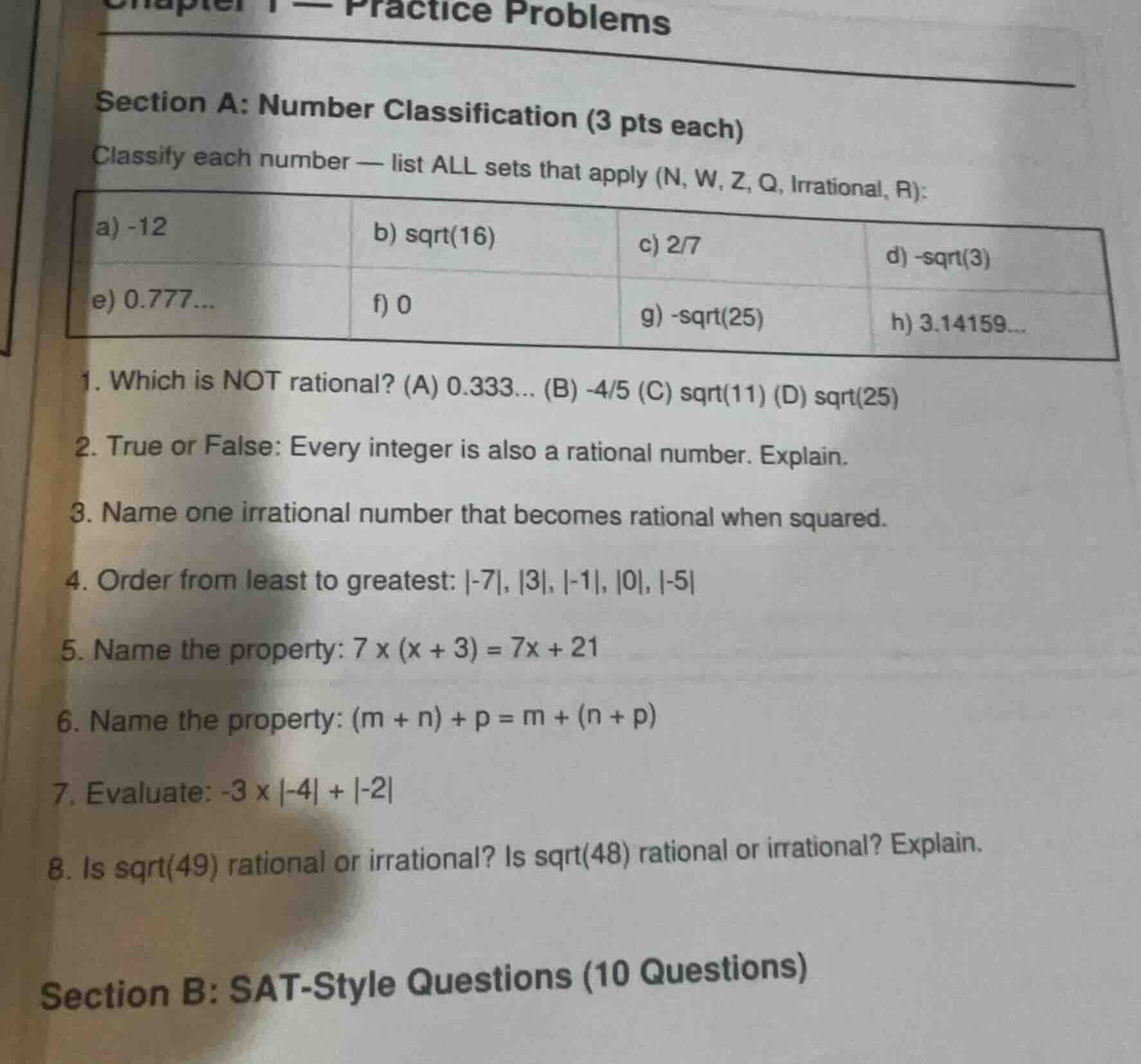
section a: number classification (3 pts each)
classify each number — list all sets that apply (n, w, z, q, irrational, r):
a) -12
b) \\(\sqrt{16}\\)
c) \\(\frac{2}{7}\\)
d) \\(-\sqrt{3}\\)
e) 0.777...
f) 0
g) \\(-\sqrt{25}\\)
h) 3.14159...
- which is not rational? (a) 0.333... (b) -4/5 (c) \\(\sqrt{11}\\) (d) \\(\sqrt{25}\\)
- true or false: every integer is also a rational number. explain.
- name one irrational number that becomes rational when squared.
- order from least to greatest: \\(|-7|\\), \\(|3|\\), \\(|-1|\\), \\(|0|\\), \\(|-5|\\)
- name the property: \\(7 \times (x + 3) = 7x + 21\\)
- name the property: \\((m + n) + p = m + (n + p)\\)
- evaluate: \\(-3 \times |-4| + |-2|\\)
- is \\(\sqrt{49}\\) rational or irrational? is \\(\sqrt{48}\\) rational or irrational? explain.
Classify the numbers in Section A
We classify each given number into the standard sets: Natural numbers \(\mathbb{N}\), Whole numbers \(\mathbb{W}\), Integers \(\mathbb{Z}\), Rational numbers \(\mathbb{Q}\), Irrational numbers, and Real numbers \(\mathbb{R}\).
- a) \(-12\): An integer, rational, and real. Sets: \(\mathbb{Z}, \mathbb{Q}, \mathbb{R}\).
- b) \(\sqrt{16} = 4\): A natural, whole, integer, rational, and real. Sets: \(\mathbb{N}, \mathbb{W}, \mathbb{Z}, \mathbb{Q}, \mathbb{R}\).
- c) \(\frac{2}{7}\): A rational and real. Sets: \(\mathbb{Q}, \mathbb{R}\).
- d) \(-\sqrt{3}\): An irrational and real. Sets: Irrational, \(\mathbb{R}\).
- e) \(0.777\dots = \frac{7}{9}\): A repeating decimal, which is rational and real. Sets: \(\mathbb{Q}, \mathbb{R}\).
- f) \(0\): A whole number, integer, rational, and real. Sets: \(\mathbb{W}, \mathbb{Z}, \mathbb{Q}, \mathbb{R}\).
- g) \(-\sqrt{25} = -5\): An integer, rational, and real. Sets: \(\mathbb{Z}, \mathbb{Q}, \mathbb{R}\).
- h) \(3.14159\dots = \pi\): A non-repeating, non-terminating decimal, which is irrational and real. Sets: Irrational, \(\mathbb{R}\).
Solve Questions 1 to 3
- Question 1: Identify which number is NOT rational.
- (A) \(0.333\dots = \frac{1}{3}\) (Rational)
- (B) \(-\frac{4}{5}\) (Rational)
- (C) \(\sqrt{11}\) (Irrational, since 11 is not a perfect square)
- (D) \(\sqrt{25} = 5\) (Rational)
Therefore, the answer is (C).
- Question 2: "Every integer is also a rational number."
- This is True. Any integer \(a\) can be written as a fraction \(\frac{a}{1}\), which fits the definition of a rational number \(\frac{p}{q}\) where \(p, q \in \mathbb{Z}\) and \(q
eq 0\).
- Question 3: Name one irrational number that becomes rational when squared.
- Consider \(\sqrt{2}\). It is irrational, but \((\sqrt{2})^2 = 2\), which is rational.
Solve Questions 4 to 6
- Question 4: Order from least to greatest: \(|-7|, |3|, |-1|, |0|, |-5|\).
- First, evaluate the absolute values:
- Order the values: \(0 < 1 < 3 < 5 < 7\).
- Write in original form: \(|0| < |-1| < |3| < |-5| < |-7|\).
- Question 5: Name the property: \(7 \times (x + 3) = 7x + 21\).
- This is the Distributive Property of Multiplication over Addition.
- Question 6: Name the property: \((m + n) + p = m + (n + p)\).
- This is the Associative Property of Addition.
Solve Questions 7 and 8
- Question 7: Evaluate \(-3 \times |-4| + |-2|\).
- Simplify absolute values: \(|-4| = 4\) and \(|-2| = 2\).
- Substitute and compute:
- Question 8: Is \(\sqrt{49}\) rational or irrational? Is \(\sqrt{48}\) rational or irrational? Explain.
- \(\sqrt{49} = 7\), which is a terminating integer, so it is rational.
- \(\sqrt{48} = 4\sqrt{3}\). Since 48 is not a perfect square, its square root is a non-terminating, non-repeating decimal, so it is irrational.

Snap & solve any problem in the app
Get step-by-step solutions on Sovi AI
Photo-based solutions with guided steps
Explore more problems and detailed explanations
Section A: Number Classification
- a) \(\mathbb{Z}, \mathbb{Q}, \mathbb{R}\)
- b) \(\mathbb{N}, \mathbb{W}, \mathbb{Z}, \mathbb{Q}, \mathbb{R}\)
- c) \(\mathbb{Q}, \mathbb{R}\)
- d) Irrational, \(\mathbb{R}\)
- e) \(\mathbb{Q}, \mathbb{R}\)
- f) \(\mathbb{W}, \mathbb{Z}, \mathbb{Q}, \mathbb{R}\)
- g) \(\mathbb{Z}, \mathbb{Q}, \mathbb{R}\)
- h) Irrational, \(\mathbb{R}\)
Question 1
- (A) 0.333...
- (B) -4/5
- (C) sqrt(11) (Correct answer)
- (D) sqrt(25)
Question 2
True. Every integer \(a\) can be expressed as the fraction \(\frac{a}{1}\), which satisfies the definition of a rational number.
Question 3
\(\sqrt{2}\) (since \((\sqrt{2})^2 = 2\), which is rational).
Question 4
\(|0|, |-1|, |3|, |-5|, |-7|\)
Question 5
Distributive Property
Question 6
Associative Property of Addition
Question 7
\(-10\)
Question 8
\(\sqrt{49}\) is rational because \(\sqrt{49} = 7\), which is an integer. \(\sqrt{48}\) is irrational because 48 is not a perfect square, so its square root cannot be written as a simple fraction.