QUESTION IMAGE
Question
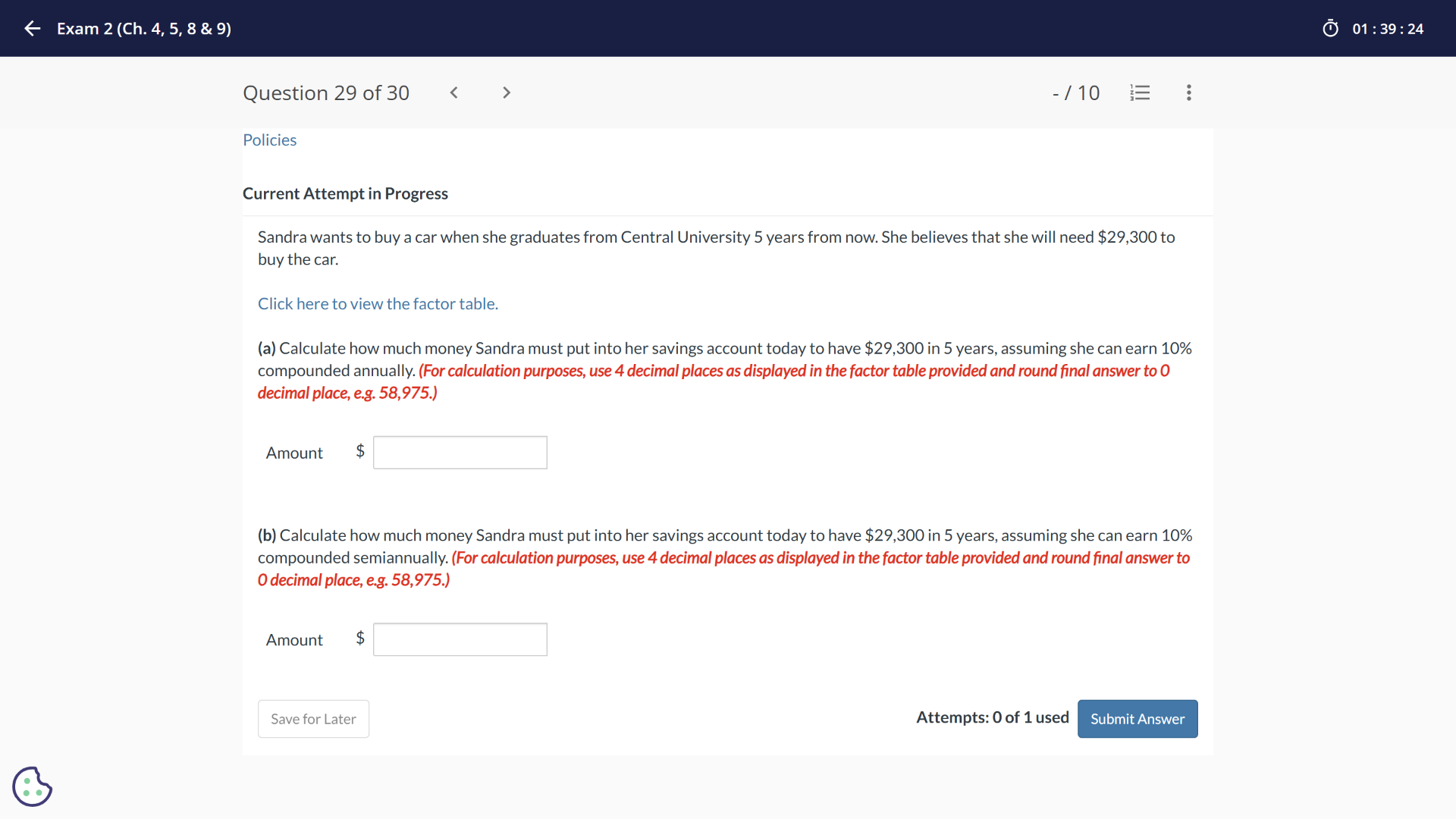
sandra wants to buy a car when she graduates from central university 5 years from now. she believes that she will need \\$29,300 to buy the car.
(a) calculate how much money sandra must put into her savings account today to have \\$29,300 in 5 years, assuming she can earn 10\\% compounded annually. (for calculation purposes, use 4 decimal places as displayed in the factor table provided and round final answer to 0 decimal place, e.g. 58,975.)
amount \\$
(b) calculate how much money sandra must put into her savings account today to have \\$29,300 in 5 years, assuming she can earn 10\\% compounded semiannually. (for calculation purposes, use 4 decimal places as displayed in the factor table provided and round final answer to 0 decimal place, e.g. 58,975.)
amount \\$
🆕 New Concept Discovered: Present Value of a Single Sum
Finding today's value of a future amount.
Step 1: Identify the variables for part (a)
To find how much Sandra must invest today (Present Value, or \( \text{PV} \)) to have a future amount (\( \text{FV} \)) of \( \$29,300 \) in 5 years with annual compounding:
- Future Value (\( \text{FV} \)) = \( \$29,300 \)
- Number of periods (\( n \)) = \( 5 \) years
- Annual interest rate (\( i \)) = \( 10\% \)
The formula for the Present Value is:
Where \( \text{PVF}_{i, n} \) is the Present Value Factor for a single sum at interest rate \( i \) for \( n \) periods:
Using the standard 4-decimal place factor table value:
Step 2: Calculate the amount for part (a)
Multiply the future value by the present value factor:
Rounding to the nearest whole dollar (0 decimal places):
Step 3: Identify the variables for part (b)
When interest is compounded semiannually (twice a year), we must adjust the interest rate per period (\( i \)) and the total number of compounding periods (\( n \)):
- Number of periods (\( n \)) = \( 5 \text{ years} \times 2 = 10 \text{ periods} \)
- Interest rate per period (\( i \)) = \( \frac{10\%}{2} = 5\% \text{ per period} \)
The Present Value Factor for a single sum at \( 5\% \) for \( 10 \) periods is:
Using the standard 4-decimal place factor table value:
Step 4: Calculate the amount for part (b)
Multiply the future value by the adjusted present value factor:
Rounding to the nearest whole dollar (0 decimal places):

Snap & solve any problem in the app
Get step-by-step solutions on Sovi AI
Photo-based solutions with guided steps
Explore more problems and detailed explanations
(a) Amount: $18,192
(b) Amount: $17,987