QUESTION IMAGE
Question
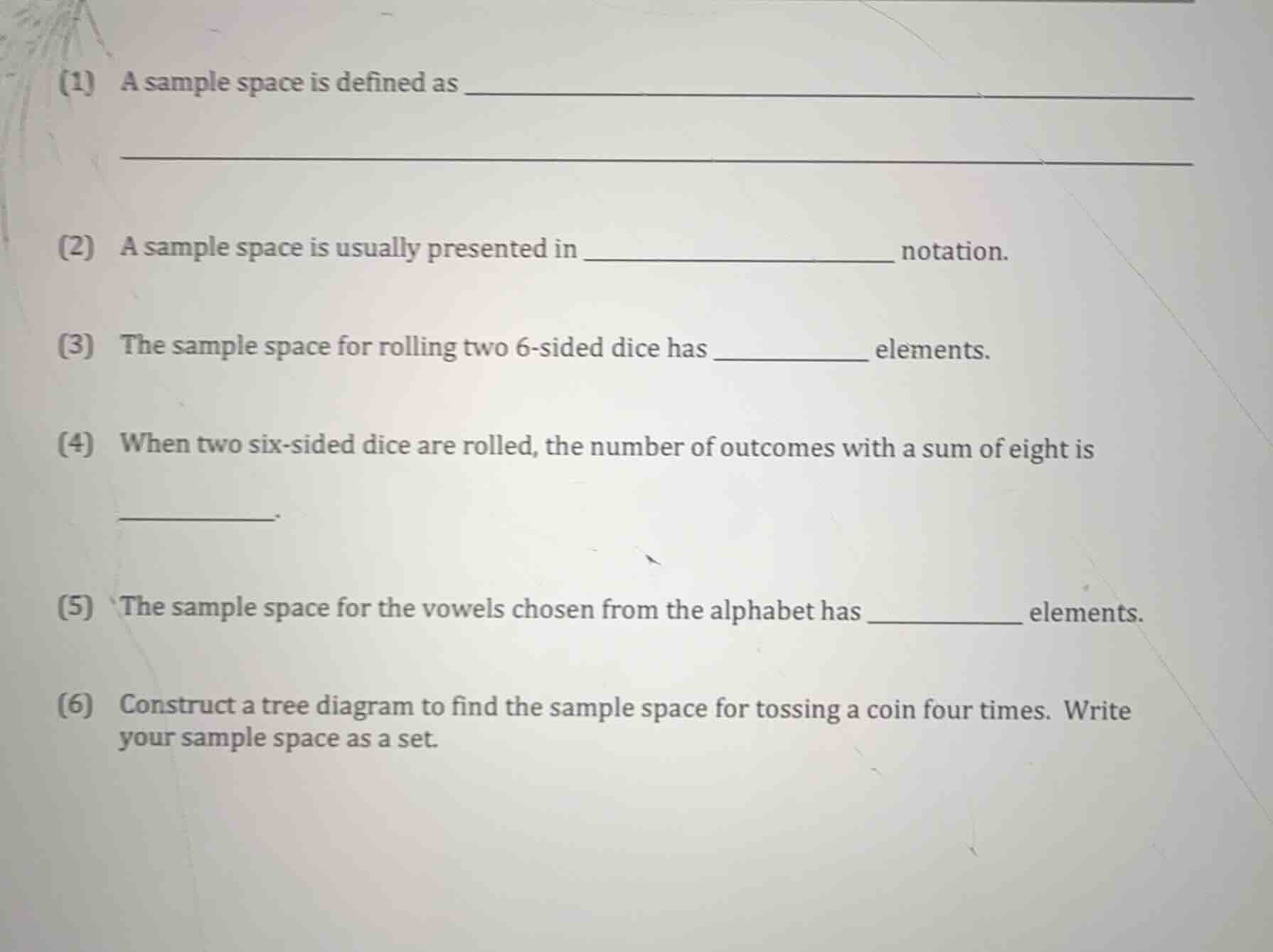
(1) a sample space is defined as \\_\\_\\_\\_\\_\\_\\_\\_\\_\\_\\_\\_\\_\\_\\_\\_\\_\\_\\_\\_\\_\\_\\_\\_\\_\\_\\_\\_\\_\\_\\_\\_\\_\\_\\_\\_\\_\\_\\_\\_\\_\\_\\_\\_\\_\\_\\_\\_\\_\\_\\_\\_\\_\\_\\_\\_\\_\\_\\_\\_\\_
(2) a sample space is usually presented in \\_\\_\\_\\_\\_\\_\\_\\_\\_\\_\\_\\_\\_\\_\\_\\_\\_\\_\\_\\_\\_\\_\\_\\_\\_\\_\\_ notation.
(3) the sample space for rolling two 6-sided dice has \\_\\_\\_\\_\\_\\_\\_\\_\\_\\_\\_\\_\\_\\_\\_ elements.
(4) when two six-sided dice are rolled, the number of outcomes with a sum of eight is \\_\\_\\_\\_\\_\\_\\_\\_\\_\\_.
(5) the sample space for the vowels chosen from the alphabet has \\_\\_\\_\\_\\_\\_\\_\\_\\_\\_ elements.
(6) construct a tree diagram to find the sample space for tossing a coin four times. write your sample space as a set.
🆕 New Concept Discovered: Sample Space and Outcomes
The set of all possible results of an experiment
Step 1: Define a Sample Space
In probability theory, a sample space is the set of all possible outcomes of a random experiment.
Step 2: Identify Sample Space Notation
A sample space is a collection of distinct outcomes, which is mathematically represented as a set. Therefore, it is usually presented in set notation (using curly braces, e.g., \( S = \{ \dots \} \)).
Step 3: Calculate Elements for Rolling Two Dice
Using the Fundamental Counting Principle, since each 6-sided die has \( 6 \) possible outcomes, rolling two dice yields:
Step 4: Find Outcomes with a Sum of Eight
We list the pairs \( (d_1, d_2) \) from the sample space of two dice that add up to \( 8 \):
- \( (2, 6) \)
- \( (3, 5) \)
- \( (4, 4) \)
- \( (5, 3) \)
- \( (6, 2) \)
There are \( 5 \) such outcomes.
Step 5: Count Vowels in the Alphabet
The vowels in the English alphabet are \( \{a, e, i, o, u\} \). The number of elements in this sample space is \( 5 \).
Step 6: Construct Tree Diagram and Set for Tossing a Coin Four Times
Each toss has two possible outcomes: Heads (\( \text{H} \)) or Tails (\( \text{T} \)).
A tree diagram branches out at each of the four steps:
- Toss 1: Branches into \( \text{H} \) and \( \text{T} \).
- Toss 2: Each previous branch splits into \( \text{H} \) and \( \text{T} \) (4 branches).
- Toss 3: Each branch splits again (8 branches).
- Toss 4: Each branch splits a final time (16 branches).
Following every path from the start to the end of the tree yields the \( 16 \) elements of the sample space.

Snap & solve any problem in the app
Get step-by-step solutions on Sovi AI
Photo-based solutions with guided steps
Explore more problems and detailed explanations
(1) A sample space is defined as the set of all possible outcomes of a probability experiment.
(2) A sample space is usually presented in set notation.
(3) The sample space for rolling two 6-sided dice has 36 elements.
(4) When two six-sided dice are rolled, the number of outcomes with a sum of eight is 5.
(5) The sample space for the vowels chosen from the alphabet has 5 elements.
(6)
- Tree Diagram Structure:
                  /--- H --- HHHH
            /--- H
           |      \--- T --- HHHT
     /--- H
    |      |      /--- H --- HHTH
    |       \--- T
    |             \--- T --- HHTT
 ---|
    |             /--- H --- HTHH
    |       /--- H
    |      |      \--- T --- HTHT
     \--- T
           |      /--- H --- HTTH
            \--- T
                  \--- T --- HTTT

                  /--- H --- THHH
            /--- H
           |      \--- T --- THHT
     /--- H
    |      |      /--- H --- THTH
    |       \--- T
    |             \--- T --- THTT
 ---|
    |             /--- H --- TTHH
    |       /--- H
    |      |      \--- T --- TTHT
     \--- T
           |      /--- H --- TTTH
            \--- T
\--- T --- TTTT- Sample Space Set: