QUESTION IMAGE
Question
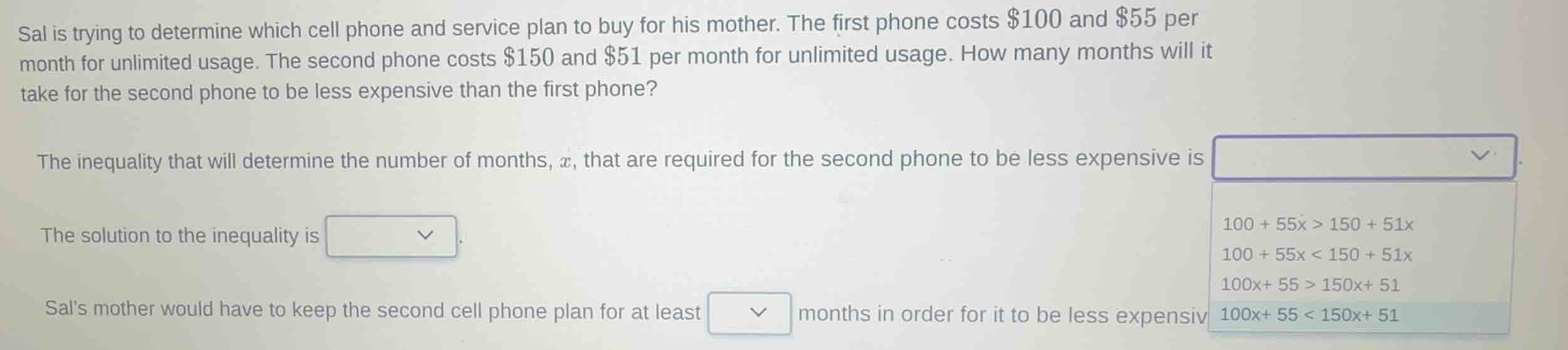
sal is trying to determine which cell phone and service plan to buy for his mother. the first phone costs \\$100 and \\$55 per month for unlimited usage. the second phone costs \\$150 and \\$51 per month for unlimited usage. how many months will it take for the second phone to be less expensive than the first phone?
the inequality that will determine the number of months, \\(x\\), that are required for the second phone to be less expensive is drop-down menu
the solution to the inequality is drop-down menu
sals mother would have to keep the second cell phone plan for at least drop-down menu months in order for it to be less expensive.
options in drop-down:
\\(100 + 55x > 150 + 51x\\)
\\(100 + 55x < 150 + 51x\\)
\\(100x + 55 > 150x + 51\\)
\\(100x + 55 < 150x + 51\\)
Write the cost expressions
We define the total cost for each plan over \(x\) months.
First phone cost:
Second phone cost:
Set up the inequality
Using the Writing Linear Inequalities concept, we want the second phone to be less expensive than the first phone:
This is equivalent to:
Solve the inequality
Using the Solving Linear Inequalities concept, we solve for \(x\):
Apply real-world constraints
Using the Real-world Inequality Constraints concept, since \(x\) represents the number of months, it must be a whole number.
For \(x > 12.5\), the smallest integer number of months is \(13\).
Thus, she must keep the plan for at least \(13\) months.

Snap & solve any problem in the app
Get step-by-step solutions on Sovi AI
Photo-based solutions with guided steps
Explore more problems and detailed explanations
Question 1
The inequality that will determine the number of months, \(x\), that are required for the second phone to be less expensive is:
Question 2
The solution to the inequality is:
Question 3
Sal's mother would have to keep the second cell phone plan for at least: