QUESTION IMAGE
Question
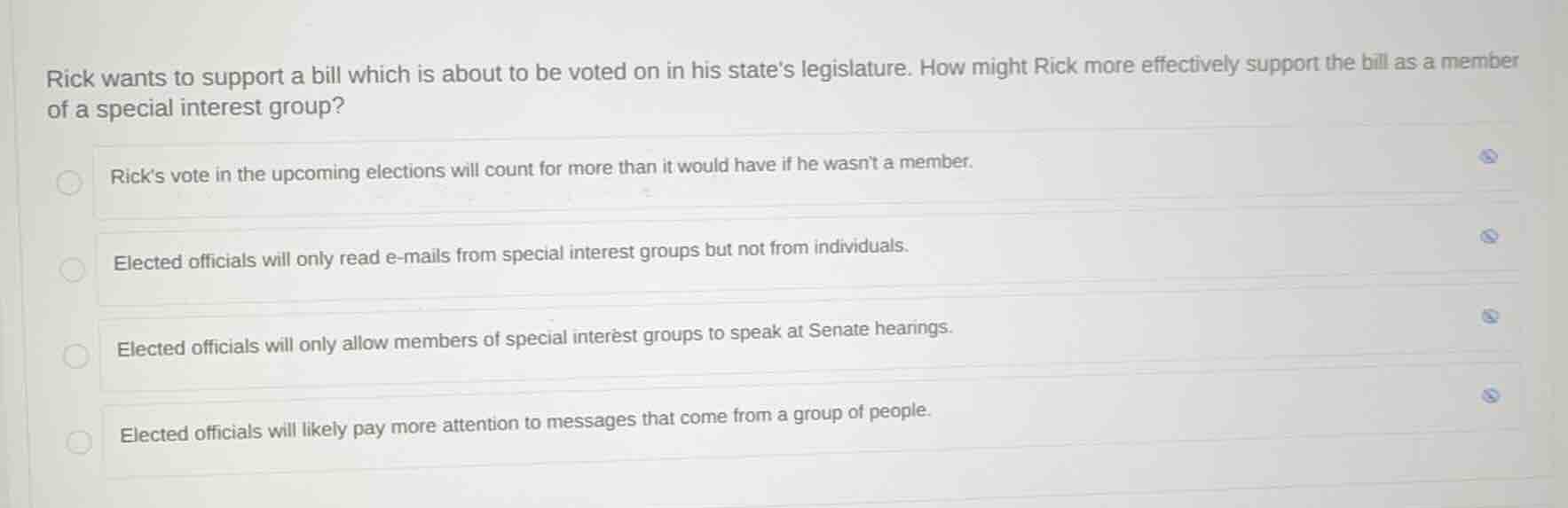
rick wants to support a bill which is about to be voted on in his states legislature. how might rick more effectively support the bill as a member of a special interest group?
ricks vote in the upcoming elections will count for more than it would have if he wasnt a member.
elected officials will only read e-mails from special interest groups but not from individuals.
elected officials will only allow members of special interest groups to speak at senate hearings.
elected officials will likely pay more attention to messages that come from a group of people.
<pre_analysis>
{
"quality": "clear",
"question_count": 1,
"skills_matched": [
"direct_cot",
"multiple_choice_formatter",
"explain_then_answer",
"tutor"
],
"needs_drawing": false,
"concepts_used": [],
"new_concepts": [
"Special Interest Groups",
"Lobbying Methods",
"Collective Action"
],
"current_concepts": [
"Special Interest Groups",
"Lobbying Methods",
"Collective Action"
]
}
</pre_analysis>
<reasoning>
Analyze the role of special interest groups
Special interest groups organize individuals with shared policy goals to influence legislative outcomes. By combining resources, voices, and efforts, these groups amplify the influence of individual citizens, making their advocacy more visible and impactful to lawmakers.
Evaluate individual vote weight
The first option suggests that a member's individual vote counts for more in an election. In a democratic system, the principle of "one person, one vote" applies. Joining an interest group does not legally increase the mathematical weight or value of an individual's ballot.
Evaluate communication exclusivity
The second and third options claim that elected officials only read emails or only allow testimony from interest group members. These statements are absolute and incorrect. Citizens retain the constitutional right to petition their government individually, and lawmakers regularly receive individual correspondence and public testimony.
Evaluate collective voice impact
The fourth option states that elected officials will likely pay more attention to messages coming from a group of people. This aligns with the concept of collective action. Lawmakers are highly responsive to organized groups because they represent a concentrated block of voters, shared resources, and coordinated public opinion, making collective messaging far more influential than isolated individual efforts.
</reasoning>
<answer>
<mcq-option>(A) Rick's vote in the upcoming elections will count for more than it would have if he wasn't a member.</mcq-option>
<mcq-option>(B) Elected officials will only read e-mails from special interest groups but not from individuals.</mcq-option>
<mcq-option>(C) Elected officials will only allow members of special interest groups to speak at Senate hearings.</mcq-option>
<mcq-correct>(D) Elected officials will likely pay more attention to messages that come from a group of people.</mcq-correct>
</answer>
<post_analysis>
{
"subject": "Social Science",
"question_type": "Multiple Choice",
"knowledge_point": [
"Social Science",
"Political Science",
"Special Interest Groups"
]
}
</post_analysis>
Snap & solve any problem in the app
Get step-by-step solutions on Sovi AI
Photo-based solutions with guided steps
Explore more problems and detailed explanations
<pre_analysis>
{
"quality": "clear",
"question_count": 1,
"skills_matched": [
"direct_cot",
"multiple_choice_formatter",
"explain_then_answer",
"tutor"
],
"needs_drawing": false,
"concepts_used": [],
"new_concepts": [
"Special Interest Groups",
"Lobbying Methods",
"Collective Action"
],
"current_concepts": [
"Special Interest Groups",
"Lobbying Methods",
"Collective Action"
]
}
</pre_analysis>
<reasoning>
Analyze the role of special interest groups
Special interest groups organize individuals with shared policy goals to influence legislative outcomes. By combining resources, voices, and efforts, these groups amplify the influence of individual citizens, making their advocacy more visible and impactful to lawmakers.
Evaluate individual vote weight
The first option suggests that a member's individual vote counts for more in an election. In a democratic system, the principle of "one person, one vote" applies. Joining an interest group does not legally increase the mathematical weight or value of an individual's ballot.
Evaluate communication exclusivity
The second and third options claim that elected officials only read emails or only allow testimony from interest group members. These statements are absolute and incorrect. Citizens retain the constitutional right to petition their government individually, and lawmakers regularly receive individual correspondence and public testimony.
Evaluate collective voice impact
The fourth option states that elected officials will likely pay more attention to messages coming from a group of people. This aligns with the concept of collective action. Lawmakers are highly responsive to organized groups because they represent a concentrated block of voters, shared resources, and coordinated public opinion, making collective messaging far more influential than isolated individual efforts.
</reasoning>
<answer>
<mcq-option>(A) Rick's vote in the upcoming elections will count for more than it would have if he wasn't a member.</mcq-option>
<mcq-option>(B) Elected officials will only read e-mails from special interest groups but not from individuals.</mcq-option>
<mcq-option>(C) Elected officials will only allow members of special interest groups to speak at Senate hearings.</mcq-option>
<mcq-correct>(D) Elected officials will likely pay more attention to messages that come from a group of people.</mcq-correct>
</answer>
<post_analysis>
{
"subject": "Social Science",
"question_type": "Multiple Choice",
"knowledge_point": [
"Social Science",
"Political Science",
"Special Interest Groups"
]
}
</post_analysis>