QUESTION IMAGE
Question
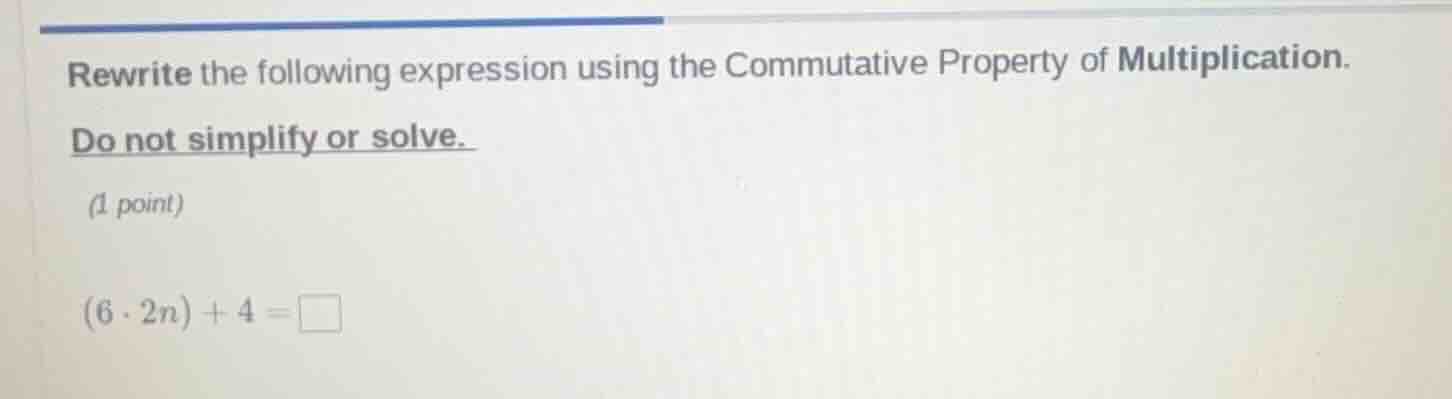
rewrite the following expression using the commutative property of multiplication. do not simplify or solve. (1 point) (6·2n)+4 = \square
Step1: Recall Commutative Property of Multiplication
The Commutative Property of Multiplication states that for any two numbers \(a\) and \(b\), \(a \cdot b = b \cdot a\). In the expression \((6 \cdot 2n)+4\), we focus on the multiplication part \(6 \cdot 2n\). Here, \(a = 6\) and \(b = 2n\) (or we can also consider \(2n\) as \(2 \cdot n\) and apply the property to \(6\) and \(2\) first, but since we just need to rewrite using the property on the multiplication within the parentheses, we can swap \(6\) and \(2n\) or swap \(6\) and \(2\) in the multiplication). Let's apply the property to \(6\) and \(2n\) first. So \(6 \cdot 2n=2n \cdot 6\).
Step2: Rewrite the expression
Substituting back into the original expression, we get \((2n \cdot 6)+4\). Alternatively, if we consider \(2n = 2\times n\), and apply the commutative property to \(6\) and \(2\) (since multiplication is associative and commutative, we can reorder the factors in the multiplication), we can also write it as \((2 \cdot 6n)+4\) or \((2n \cdot 6)+4\) or \((6n \cdot 2)+4\) etc. But the most direct application on the \(6 \cdot 2n\) part is swapping \(6\) and \(2n\) to get \((2n \cdot 6)+4\).

Snap & solve any problem in the app
Get step-by-step solutions on Sovi AI
Photo-based solutions with guided steps
Explore more problems and detailed explanations
\((2n\cdot6) + 4\) (or other equivalent forms like \((2\cdot6n)+4\) etc. based on how we apply the commutative property, but the key is reordering the factors in the multiplication part)