QUESTION IMAGE
Question
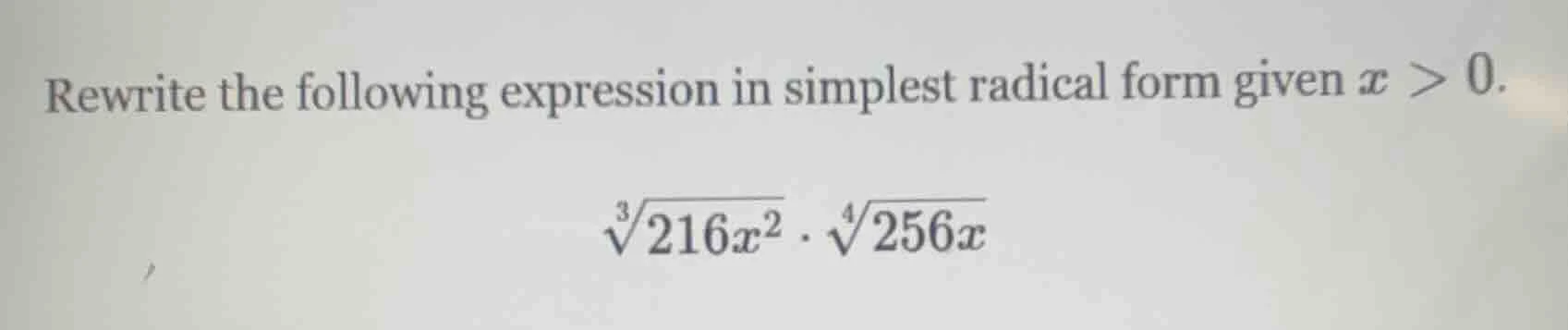
rewrite the following expression in simplest radical form given $x > 0$.
\\(\sqrt3{216x^2} \cdot \sqrt4{256x}\\)
Step1: Simplify each radical separately
First, simplify \(\sqrt[3]{216x^{2}}\). We know that \(216 = 6^{3}\), so \(\sqrt[3]{216x^{2}}=\sqrt[3]{6^{3}x^{2}} = 6\sqrt[3]{x^{2}}\) (since \(\sqrt[3]{a^{3}}=a\) for any real number \(a\)).
Next, simplify \(\sqrt[4]{256x}\). We know that \(256 = 4^{4}\) (or \(256=2^{8}\), but \(4^{4}=256\) is more straightforward here), so \(\sqrt[4]{256x}=\sqrt[4]{4^{4}x}=4\sqrt[4]{x}\) (since \(\sqrt[4]{a^{4}} = a\) for \(a\geq0\), and here \(x>0\) so we can apply this).
Step2: Multiply the simplified radicals
Now, multiply \(6\sqrt[3]{x^{2}}\) and \(4\sqrt[4]{x}\). First, multiply the coefficients: \(6\times4 = 24\).
Then, we need to multiply the radicals \(\sqrt[3]{x^{2}}\) and \(\sqrt[4]{x}\). To multiply radicals with different indices, we can use the property \(a^{m}\cdot a^{n}=a^{m + n}\) by converting them to exponential form. Recall that \(\sqrt[n]{a}=a^{\frac{1}{n}}\), so \(\sqrt[3]{x^{2}}=x^{\frac{2}{3}}\) and \(\sqrt[4]{x}=x^{\frac{1}{4}}\).
Now, multiply \(x^{\frac{2}{3}}\cdot x^{\frac{1}{4}}\). Using the exponent rule \(a^{m}\cdot a^{n}=a^{m + n}\), we add the exponents: \(\frac{2}{3}+\frac{1}{4}=\frac{8 + 3}{12}=\frac{11}{12}\). So \(x^{\frac{2}{3}}\cdot x^{\frac{1}{4}}=x^{\frac{11}{12}}\).
But we want to write this back in radical form. Since \(x^{\frac{11}{12}}=\sqrt[12]{x^{11}}\) (because \(a^{\frac{m}{n}}=\sqrt[n]{a^{m}}\)).
Wait, but maybe we made a mistake here. Let's check again. Wait, actually, when multiplying \(\sqrt[3]{x^{2}}\) and \(\sqrt[4]{x}\), another way is to find a common index. The least common multiple of 3 and 4 is 12. So:
\(\sqrt[3]{x^{2}}=x^{\frac{2}{3}}=x^{\frac{8}{12}}=\sqrt[12]{x^{8}}\)
\(\sqrt[4]{x}=x^{\frac{1}{4}}=x^{\frac{3}{12}}=\sqrt[12]{x^{3}}\)
Then, \(\sqrt[12]{x^{8}}\cdot\sqrt[12]{x^{3}}=\sqrt[12]{x^{8 + 3}}=\sqrt[12]{x^{11}}\)
So putting it all together, the product is \(24\sqrt[12]{x^{11}}\)? Wait, no, wait. Wait, actually, let's re - examine the initial simplification.
Wait, maybe we should simplify the radicals first by factoring the radicands into perfect powers for their respective indices.
Wait, let's start over.
First, \(\sqrt[3]{216x^{2}}\): \(216 = 6^{3}\), so \(\sqrt[3]{216x^{2}}=6\sqrt[3]{x^{2}}\) (correct).
\(\sqrt[4]{256x}\): \(256 = 2^{8}\), so \(\sqrt[4]{256x}=\sqrt[4]{2^{8}x}=2^{2}\sqrt[4]{x}=4\sqrt[4]{x}\) (since \(2^{8}=(2^{2})^{4}=4^{4}\), so \(\sqrt[4]{4^{4}x}=4\sqrt[4]{x}\), correct).
Now, multiplying \(6\sqrt[3]{x^{2}}\times4\sqrt[4]{x}=24\sqrt[3]{x^{2}}\sqrt[4]{x}\). Now, to combine these radicals, we use the formula \(\sqrt[n]{a}\cdot\sqrt[m]{b}=\sqrt[nm]{a^{m}b^{n}}\) (when \(n\) and \(m\) are positive integers).
So for \(\sqrt[3]{x^{2}}\) and \(\sqrt[4]{x}\), \(n = 3\), \(m = 4\), \(a=x^{2}\), \(b = x\). Then:
\(\sqrt[3]{x^{2}}\cdot\sqrt[4]{x}=\sqrt[12]{(x^{2})^{4}\cdot x^{3}}=\sqrt[12]{x^{8}\cdot x^{3}}=\sqrt[12]{x^{11}}\)
So the entire expression is \(24\sqrt[12]{x^{11}}\)? Wait, no, wait. Wait, let's check the exponents again.
Wait, \((x^{2})^{4}=x^{8}\) and \(x^{3}=x^{3}\), so \(x^{8}\cdot x^{3}=x^{11}\), so \(\sqrt[12]{x^{11}}\). So the product is \(24\sqrt[12]{x^{11}}\). But let's verify with another approach.
Alternatively, let's convert both radicals to exponent form first:
\(\sqrt[3]{216x^{2}}=(216x^{2})^{\frac{1}{3}}=(6^{3}x^{2})^{\frac{1}{3}}=6^{3\times\frac{1}{3}}x^{2\times\frac{1}{3}}=6x^{\frac{2}{3}}\)
\(\sqrt[4]{256x}=(256x)^{\frac{1}{4}}=(4^{4}x)^{\frac{1}{4}}=4^{4\times\frac{1}{4}}x^{\frac{1}{4}}=4x^{\frac{1}{4}}\)
Now, multiply them: \(6x^{\frac{2}{3}}\times4x^{\frac{1}{4}}=(6\times4)…

Snap & solve any problem in the app
Get step-by-step solutions on Sovi AI
Photo-based solutions with guided steps
Explore more problems and detailed explanations
\(24\sqrt[12]{x^{11}}\)