QUESTION IMAGE
Question
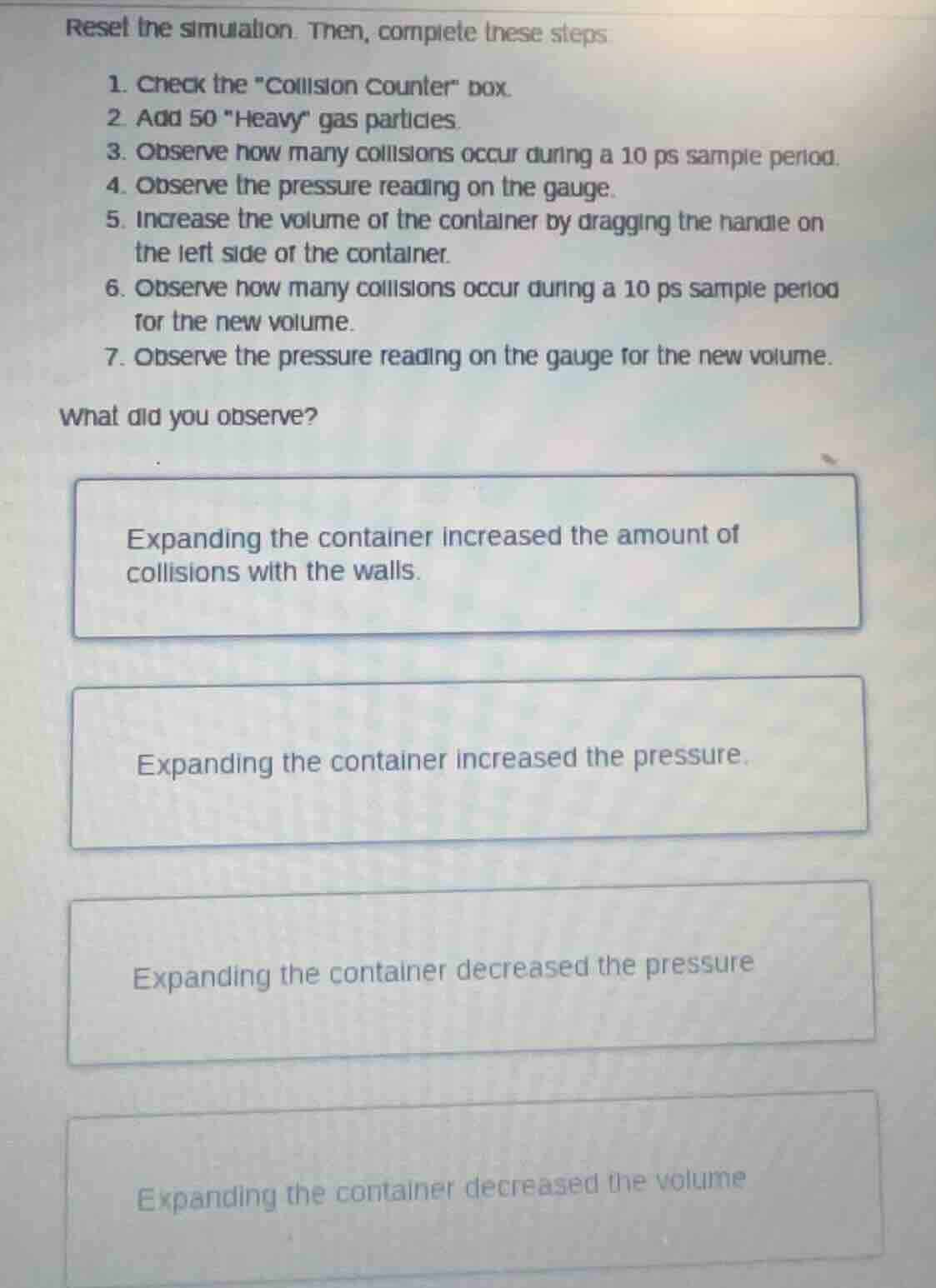
reset the simulation. then, complete these steps:
- check the \collision counter\ box.
- add 50 \heavy\ gas particles.
- observe how many collisions occur during a 10 ps sample period.
- observe the pressure reading on the gauge.
- increase the volume of the container by dragging the handle on the left side of the container.
- observe how many collisions occur during a 10 ps sample period for the new volume.
- observe the pressure reading on the gauge for the new volume.
what did you observe?
- expanding the container increased the amount of collisions with the walls.
- expanding the container increased the pressure.
- expanding the container decreased the pressure.
- expanding the container decreased the volume.
Analyze the simulation steps
Using the Gas Laws and Pressure-Volume-Temperature Relationships knowledge points
The simulation instructions describe increasing the volume of a container holding a fixed amount of gas (50 "Heavy" particles) at a constant temperature. According to Boyle's Law, the pressure of a given mass of an ideal gas is inversely proportional to its volume when the temperature is kept constant:
Therefore, expanding the container (increasing the volume \(V\)) will result in a decrease in pressure \(P\).
Evaluate the microscopic behavior
Using the Wall Collisions knowledge point
When the volume of the container is increased, the gas particles have more space to move around. Consequently, they will collide with the walls of the container less frequently. Since gas pressure is a macroscopic measure of the frequency and force of these particle collisions with the container walls, a lower rate of wall collisions directly corresponds to a decrease in pressure.
Evaluate the given options
- Option 1: "Expanding the container increased the amount of collisions with the walls." (Incorrect, larger volume decreases collision frequency).
- Option 2: "Expanding the container increased the pressure." (Incorrect, pressure decreases when volume increases).
- Option 3: "Expanding the container decreased the pressure." (Correct, as volume increases, pressure decreases).
- Option 4: "Expanding the container decreased the volume." (Incorrect, expanding means increasing the volume).

Snap & solve any problem in the app
Get step-by-step solutions on Sovi AI
Photo-based solutions with guided steps
Explore more problems and detailed explanations
- Expanding the container increased the amount of collisions with the walls.
- Expanding the container increased the pressure.
- Expanding the container decreased the pressure. (Correct answer)
- Expanding the container decreased the volume.