QUESTION IMAGE
Question
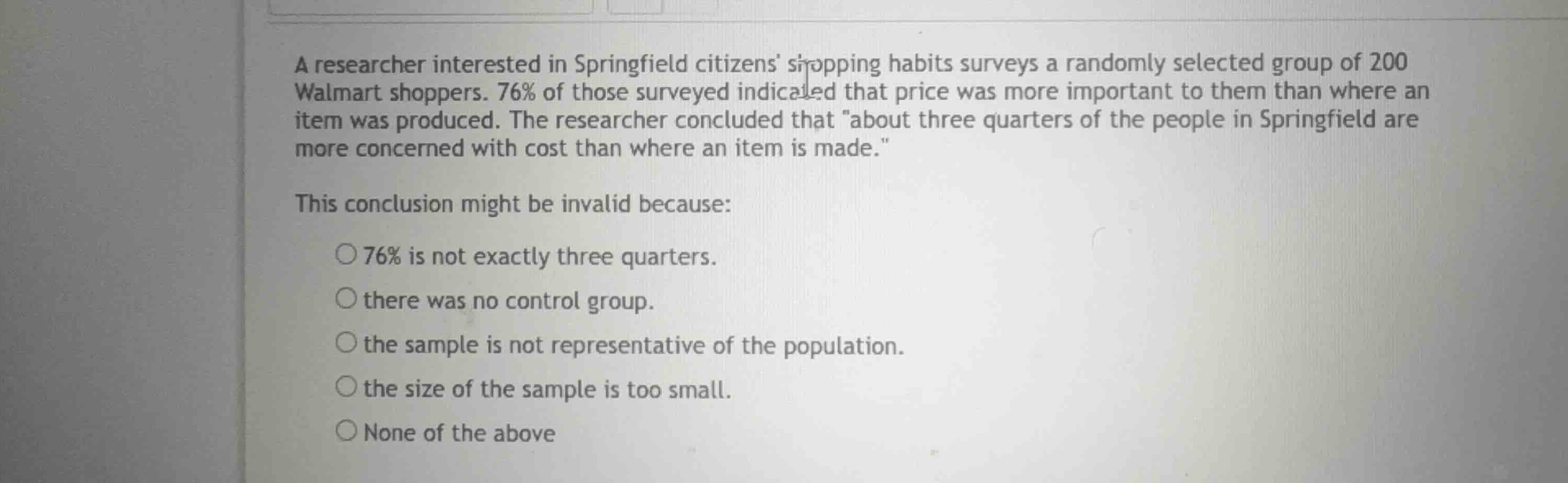
a researcher interested in springfield citizens shopping habits surveys a randomly selected group of 200 walmart shoppers. 76% of those surveyed indicated that price was more important to them than where an item was produced. the researcher concluded that \about three quarters of the people in springfield are more concerned with cost than where an item is made.\
this conclusion might be invalid because:
76% is not exactly three quarters.
there was no control group.
the sample is not representative of the population.
the size of the sample is too small.
none of the above
⚡ Using what you learned: Population vs. Sample
Step 1: Identify the Target Population and the Sample
The researcher wants to make a conclusion about the shopping habits of all Springfield citizens (the target population).
However, the researcher only surveyed a randomly selected group of 200 Walmart shoppers (the sample).
Step 2: Evaluate the Representativeness of the Sample
For a sample to yield a valid conclusion about a larger population, it must be representative of that entire population.
People who choose to shop at Walmart are likely to be more price-conscious than the general population of Springfield. Therefore, surveying only Walmart shoppers introduces a selection bias, meaning the sample does not accurately reflect the diverse shopping habits of all Springfield citizens.
Step 3: Analyze the Given Options
- \(76\%\) is not exactly three quarters: "About three quarters" is a reasonable approximation for \(76\%\) (\(75\%\)), so this does not invalidate the study.
- There was no control group: Control groups are used in experimental designs, not in observational surveys like this one.
- The sample is not representative of the population: This is correct because Walmart shoppers do not represent all citizens of Springfield.
- The size of the sample is too small: A sample size of \(n = 200\) is generally large enough for a basic descriptive survey, so size is not the primary issue here.

Snap & solve any problem in the app
Get step-by-step solutions on Sovi AI
Photo-based solutions with guided steps
Explore more problems and detailed explanations
the sample is not representative of the population.