QUESTION IMAGE
Question
related questions: lesson 2: expressions
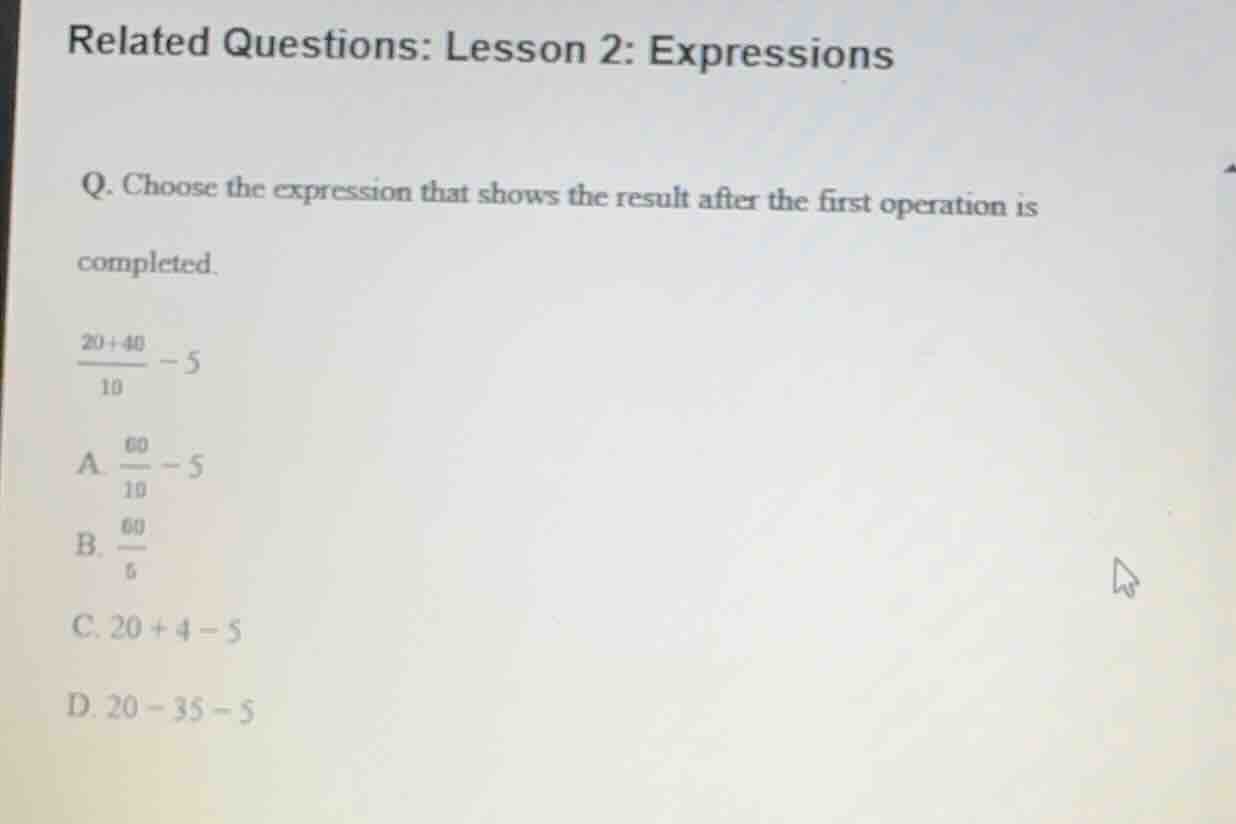
q. choose the expression that shows the result after the first operation is completed.
\\(\frac{20+40}{10}-5\\)
a. \\(\frac{60}{10}-5\\)
b. \\(\frac{60}{5}\\)
c. \\(20+4-5\\)
d. \\(20-35-5\\)
Identify the expression and operations
We are given the numerical expression:
Using the Numerical Expressions knowledge point, we must determine which operation to perform first according to the order of operations.
Analyze grouping in fractions
In mathematics, a fraction bar acts as a grouping symbol (like parentheses) for both the numerator and the denominator. This means we must evaluate the entire numerator and the entire denominator before performing the division.
- Numerator: \(20 + 40\)
- Denominator: \(10\)
Therefore, the addition in the numerator must be completed first.
Perform the first operation
We calculate the sum in the numerator:
Substituting this result back into our original expression gives:
Match with the given options
We compare our resulting expression, \(\frac{60}{10} - 5\), with the choices:
- Option A: \(\frac{60}{10} - 5\)
- Option B: \(\frac{60}{5}\)
- Option C: \(20 + 4 - 5\)
- Option D: \(20 - 35 - 5\)
The expression matches Option A.

Snap & solve any problem in the app
Get step-by-step solutions on Sovi AI
Photo-based solutions with guided steps
Explore more problems and detailed explanations
- (A) \(\frac{60}{10} - 5\) (Correct answer)
- (B) \(\frac{60}{5}\)
- (C) \(20 + 4 - 5\)
- (D) \(20 - 35 - 5\)