QUESTION IMAGE
Question
refer to the graph below to respond to the following prompts.
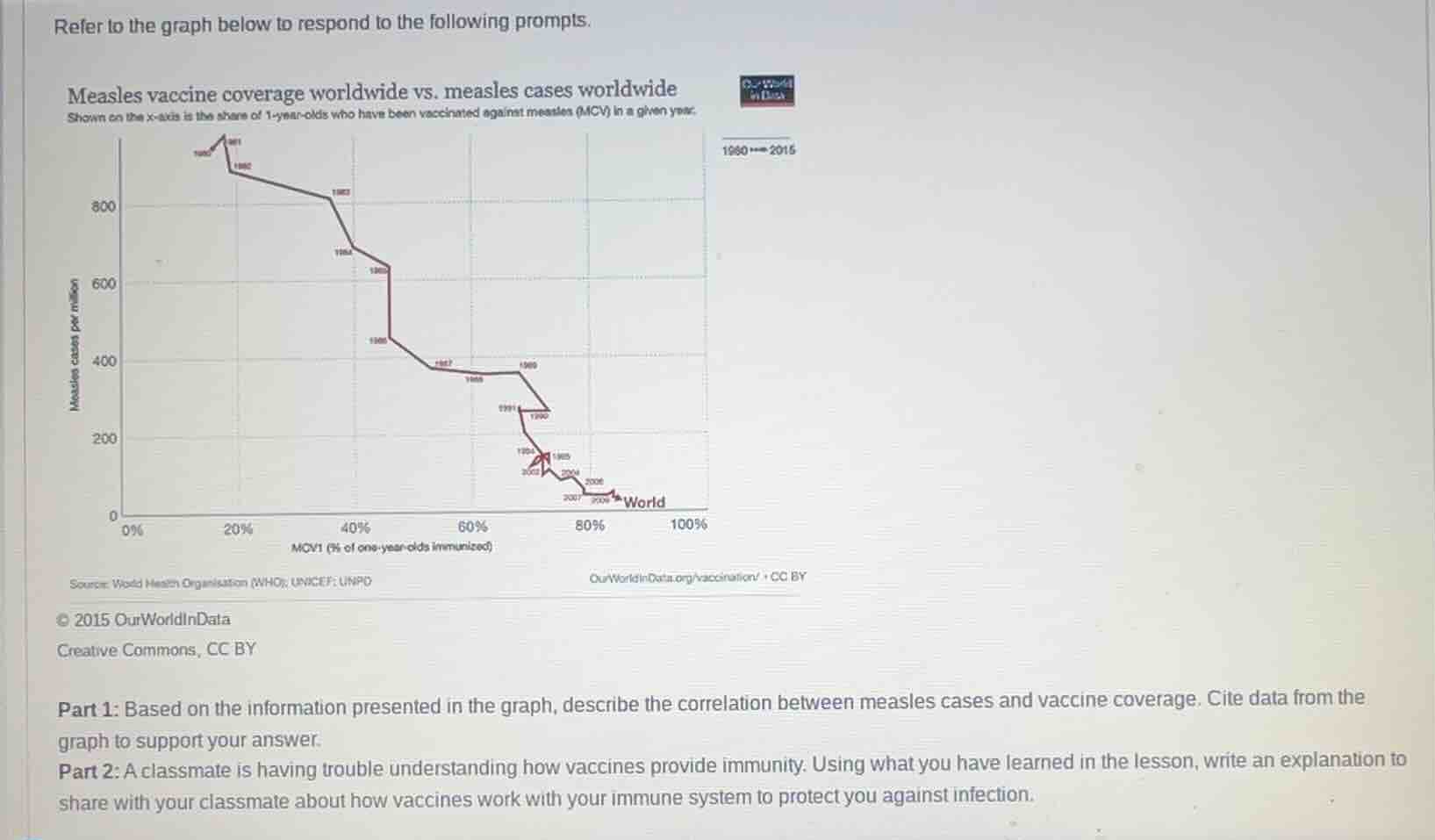
measles vaccine coverage worldwide vs. measles cases worldwide
shown on the x-axis is the share of 1-year-olds who have been vaccinated against measles (mcv) in a given year.
part 1: based on the information presented in the graph, describe the correlation between measles cases and vaccine coverage. cite data from the graph to support your answer.
part 2: a classmate is having trouble understanding how vaccines provide immunity. using what you have learned in the lesson, write an explanation to share with your classmate about how vaccines work with your immune system to protect you against infection.
🆕 New Concept Discovered: immunological memory and vaccine mechanics
How vaccines train your immune system to fight pathogens.
Step 1: Analyze the correlation in Part 1
To describe the correlation, we look at how the two variables behave relative to each other:
- X-axis (Independent variable): MCV1 (% of one-year-olds immunized against measles).
- Y-axis (Dependent variable): Measles cases per million people.
As we move from left to right along the x-axis (increasing vaccine coverage), the line generally moves downward along the y-axis (decreasing measles cases). This represents a strong negative correlation (or inverse relationship).
To support this with data from the graph:
- In 1980, when vaccine coverage was very low at approximately \(16\%\), the number of measles cases was extremely high, peaking near \(900\) cases per million.
- By 2015 (at the bottom right of the trend line), when vaccine coverage increased to approximately \(85\%\), the number of measles cases dropped dramatically to near \(30\) cases per million.
---
Step 2: Explain how vaccines work for Part 2
To explain vaccine-induced immunity simply to a classmate, we can break it down into how the body learns to defend itself without actually getting sick:
- The "Training" Antigen: A vaccine introduces a weakened, inactive, or harmless part of a pathogen (like a virus or bacterium) into the body. This is called an antigen. Because it is weakened or dead, it cannot cause the actual disease.
- The Immune Response: Your immune system recognizes this antigen as a foreign invader. White blood cells (specifically B-cells) respond by producing specialized proteins called antibodies that perfectly fit and neutralize the antigen.
- Immunological Memory: After defeating the harmless antigen, your immune system creates memory cells. These cells "remember" the specific pathogen.
- Real-world Protection: If you are ever exposed to the actual, active virus in the future, your memory cells recognize it instantly and produce a massive wave of antibodies to destroy it before you even feel sick.

Snap & solve any problem in the app
Get step-by-step solutions on Sovi AI
Photo-based solutions with guided steps
Explore more problems and detailed explanations
Part 1: Correlation and Data Support
There is a strong negative (inverse) correlation between measles vaccine coverage and the number of measles cases worldwide. As the percentage of one-year-olds vaccinated against measles increases, the number of measles cases per million decreases significantly.
- Data Support: In 1980, when global vaccine coverage was only about \(16\%\), measles cases were at their highest, near \(900\) cases per million. By 2015, as vaccine coverage rose to approximately \(85\%\), measles cases plummeted to around \(30\) cases per million.
---
Part 2: How Vaccines Work
Vaccines act like a "training camp" for your immune system:
- Introduction: The vaccine introduces a harmless, weakened, or inactive piece of the virus (an antigen) into your body. This cannot make you sick.
- Detection & Defense: Your immune system detects this harmless invader and produces specialized proteins called antibodies to fight it off.
- Memory: Once the threat is cleared, your body keeps specialized memory cells.
- Active Protection: If you ever encounter the real, dangerous virus in the future, these memory cells instantly recognize it and destroy it before it has a chance to make you ill.