QUESTION IMAGE
Question
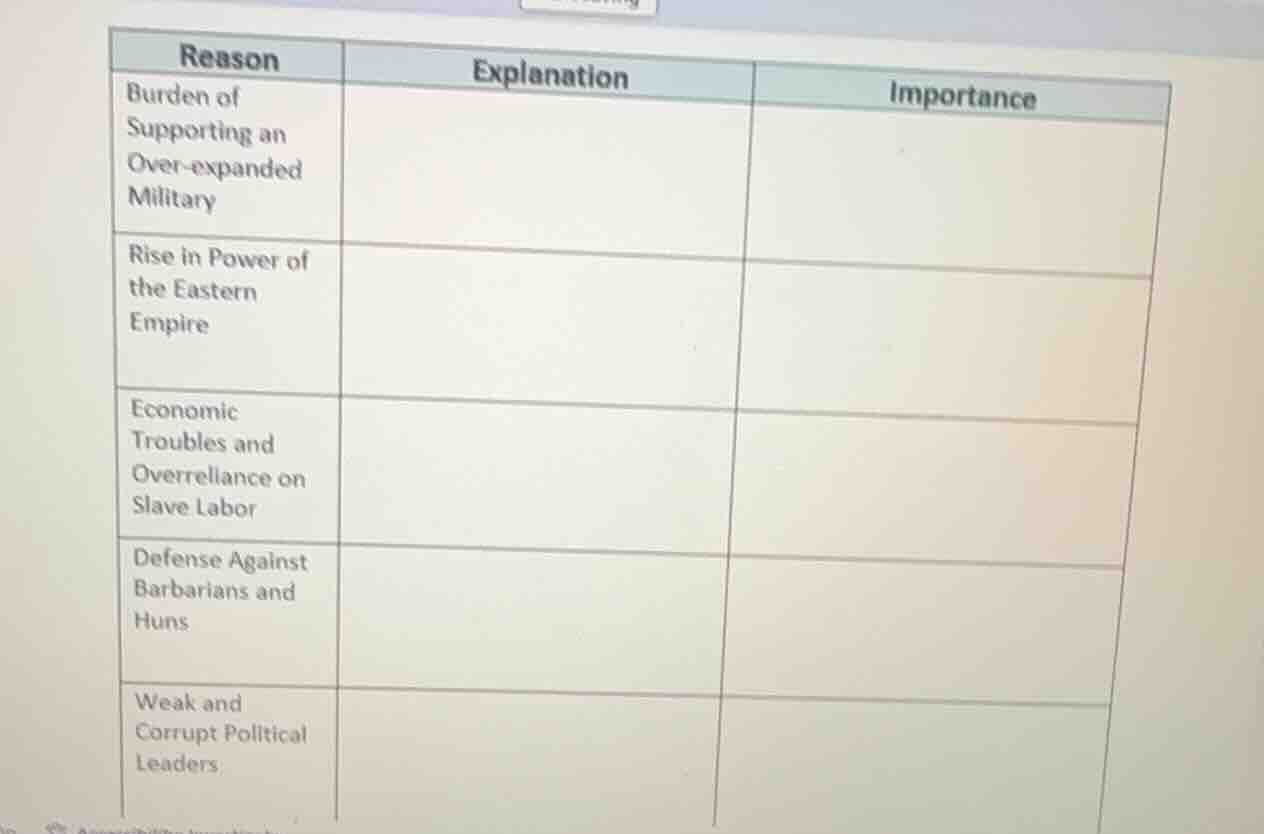
| reason | explanation | importance |
|---|---|---|
| rise in power of the eastern empire | ||
| economic troubles and overreliance on slave labor | ||
| defense against barbarians and huns | ||
| weak and corrupt political leaders |
Brief Explanations
This table is meant to detail key factors in the fall of the Western Roman Empire. Each row is completed with context and significance:
- Burden of Supporting an Over-expanded Military: The Western Empire maintained a massive army to control vast territories, draining state funds.
- Rise in Power of the Eastern Empire: The Eastern (Byzantine) Empire grew wealthier and more stable, diverting resources and leaving the Western Empire vulnerable.
- Economic Troubles and Overreliance on Slave Labor: A stagnant economy, inflation, and decline in slave populations (the core of agricultural production) collapsed the empire's economic base.
- Defense Against Barbarians and Huns: Migrations and invasions by groups like the Visigoths and Huns stretched military resources beyond capacity.
- Weak and Corrupt Political Leaders: Frequent coups, incompetent emperors, and corrupt officials eroded governance and public trust.

Snap & solve any problem in the app
Get step-by-step solutions on Sovi AI
Photo-based solutions with guided steps
Explore more problems and detailed explanations
| Reason | Explanation | Importance |
|---|---|---|
| Rise in Power of the Eastern Empire | The Eastern (Byzantine) Empire had a wealthier core, stronger trade, and more stable governance, which pulled resources and political focus away from the West. | Left the Western Empire without critical military and economic aid during crises, accelerating its collapse. |
| Economic Troubles and Overreliance on Slave Labor | A stagnant agrarian economy relied entirely on enslaved people; when slave supplies declined, agricultural output and tax revenue crashed, paired with rampant inflation. | Destroyed the empire's economic foundation, making it impossible to fund defense or governance. |
| Defense Against Barbarians and Huns | Migrations pushed Germanic tribes into the Empire, while Hunnic raids forced the Empire to divert all remaining military resources to border defense. | Overstretched the already weakened military, leaving internal territories undefended and allowing invaders to seize key lands. |
| Weak and Corrupt Political Leaders | Frequent imperial coups, incompetent rulers, and officials who embezzled funds or prioritized personal gain over the empire's stability were common. | Eroded centralized authority, made crisis response ineffective, and led to widespread public distrust in the government. |