QUESTION IMAGE
Question
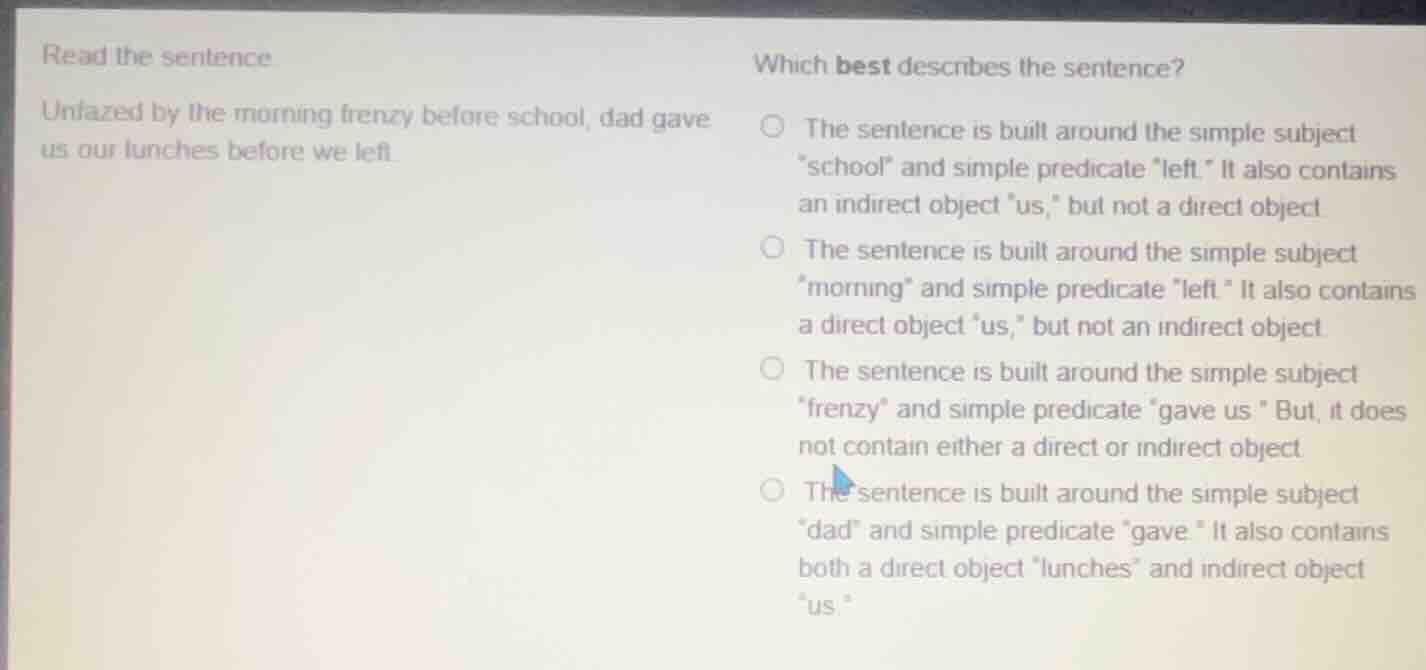
read the sentence.
unfazed by the morning frenzy before school, dad gave us our lunches before we left.
which best describes the sentence?
- the sentence is built around the simple subject \school\ and simple predicate \left.\ it also contains an indirect object \us,\ but not a direct object.
- the sentence is built around the simple subject \morning\ and simple predicate \left.\ it also contains a direct object \us,\ but not an indirect object.
- the sentence is built around the simple subject \frenzy\ and simple predicate \gave us.\ but, it does not contain either a direct or indirect object.
- the sentence is built around the simple subject \dad\ and simple predicate \gave.\ it also contains both a direct object \lunches\ and indirect object \us.\
Identify the main clause elements
Using the Sentence Structure knowledge point
The main independent clause is "dad gave us our lunches."
- Simple subject: "dad"
- Simple predicate: "gave"
Analyze objects of the verb
Using the Indirect Object knowledge point
The verb "gave" is a transitive verb that takes both a direct and an indirect object:
- Direct object (what was given): "lunches"
- Indirect object (to whom it was given): "us"
Evaluate the given options
- Option 1: Incorrectly identifies the subject as "school" and predicate as "left."
- Option 2: Incorrectly identifies the subject as "morning" and predicate as "left."
- Option 3: Incorrectly identifies the subject as "frenzy" and predicate as "gave us."
- Option 4: Correctly identifies the subject "dad," predicate "gave," direct object "lunches," and indirect object "us."

Snap & solve any problem in the app
Get step-by-step solutions on Sovi AI
Photo-based solutions with guided steps
Explore more problems and detailed explanations
- The sentence is built around the simple subject "school" and simple predicate "left." It also contains an indirect object "us," but not a direct object.
- The sentence is built around the simple subject "morning" and simple predicate "left." It also contains a direct object "us," but not an indirect object.
- The sentence is built around the simple subject "frenzy" and simple predicate "gave us." But, it does not contain either a direct or indirect object.
- The sentence is built around the simple subject "dad" and simple predicate "gave." It also contains both a direct object "lunches" and indirect object "us." (Correct answer)