QUESTION IMAGE
Question
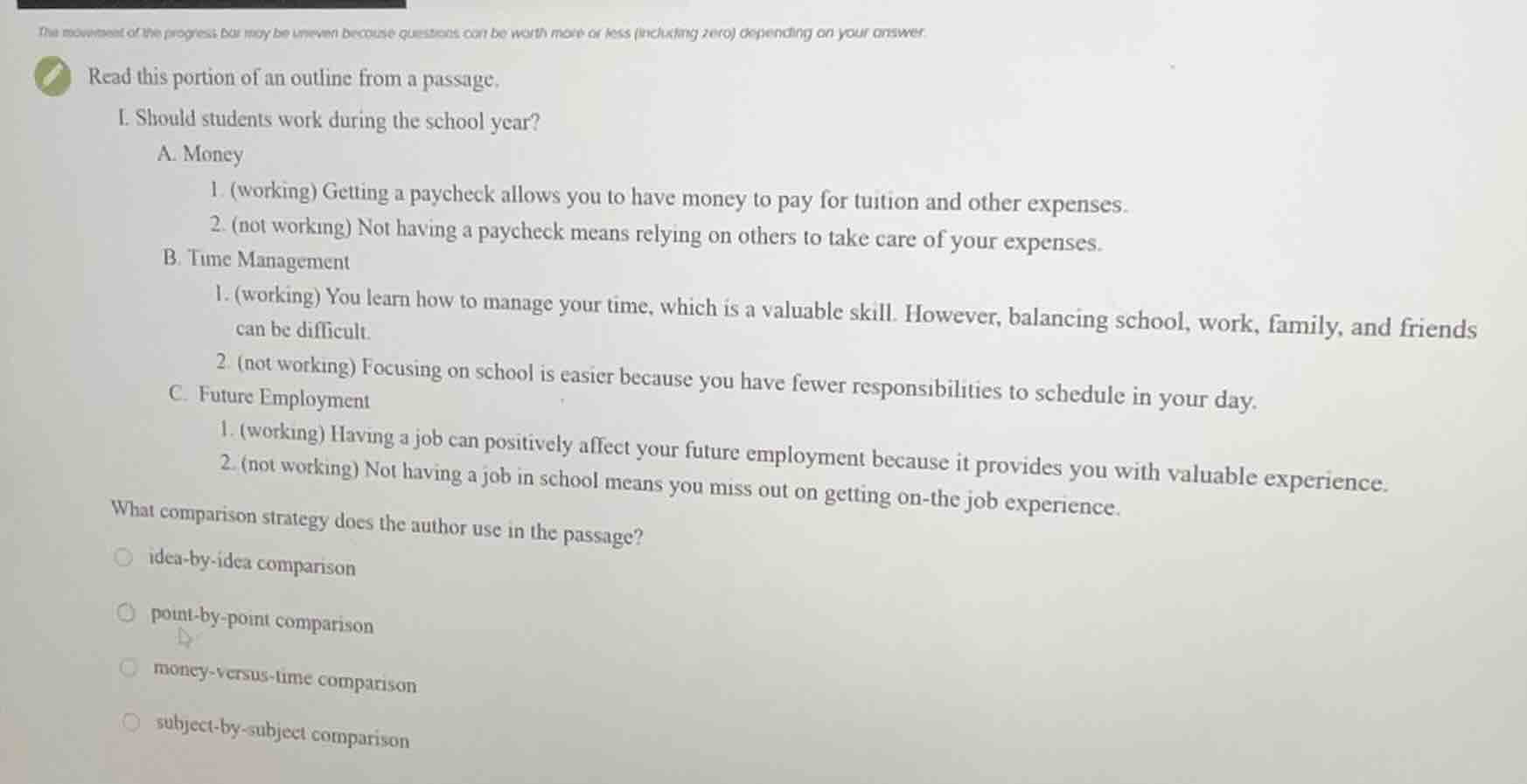
read this portion of an outline from a passage.
i. should students work during the school year?
a. money
- (working) getting a paycheck allows you to have money to pay for tuition and other expenses.
- (not working) not having a paycheck means relying on others to take care of your expenses.
b. time management
- (working) you learn how to manage your time, which is a valuable skill. however, balancing school, work, family, and friends can be difficult.
- (not working) focusing on school is easier because you have fewer responsibilities to schedule in your day.
c. future employment
- (working) having a job can positively affect your future employment because it provides you with valuable experience.
- (not working) not having a job in school means you miss out on getting on-the job experience.
what comparison strategy does the author use in the passage?
idea-by-idea comparison
point-by-point comparison
money-versus-time comparison
subject-by-subject comparison
Analyze the outline structure
The outline is organized under the main topic: "I. Should students work during the school year?"
It is divided into three main subheadings:
- A. Money
- B. Time Management
- C. Future Employment
These subheadings represent the specific points of comparison (criteria) being used to evaluate the two subjects (working vs. not working).
Examine the sub-points
Under each point of comparison (A, B, and C), the author directly compares the two subjects:
- (working)
- (not working)
For example, under A. Money, the author discusses the financial impact of working (1) and then the financial impact of not working (2). This pattern repeats for B. Time Management and C. Future Employment.
Identify the comparison strategy
Using Text Outline Analysis, we can determine how the comparison is structured:
- A subject-by-subject (or block) comparison would discuss everything about "working" first (Money, Time, Future), and then everything about "not working" second.
- A point-by-point comparison discusses one specific point or criterion (e.g., Money) and compares both subjects side-by-side under that point before moving on to the next criterion (Time Management).
Since the outline is structured by the criteria (Money, Time Management, Future Employment) and compares both subjects under each, the author is using Points of Comparison to execute a point-by-point comparison.
Evaluate the given options
- idea-by-idea comparison: Not a standard academic term for this structural pattern.
- point-by-point comparison: Matches the structure where each point of comparison (A, B, C) is used to analyze both subjects.
- money-versus-time comparison: Too narrow, as it ignores the third point (Future Employment).
- subject-by-subject comparison: Incorrect, as the main headings are not the subjects ("working" and "not working") themselves.

Snap & solve any problem in the app
Get step-by-step solutions on Sovi AI
Photo-based solutions with guided steps
Explore more problems and detailed explanations
- idea-by-idea comparison
- point-by-point comparison (Correct answer)
- money-versus-time comparison
- subject-by-subject comparison