QUESTION IMAGE
Question
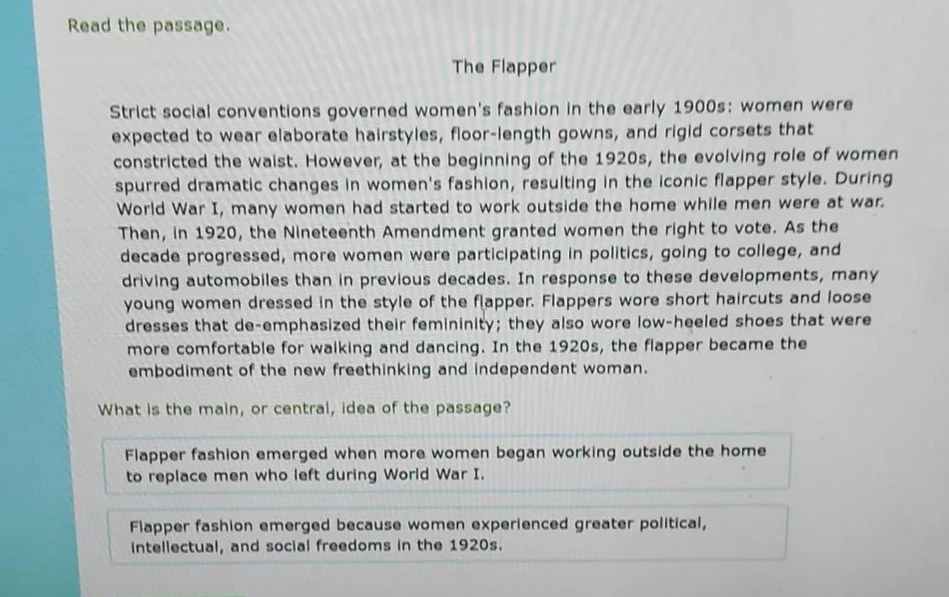
read the passage.
the flapper
strict social conventions governed womens fashion in the early 1900s: women were
expected to wear elaborate hairstyles, floor - length gowns, and rigid corsets that
constricted the waist. however, at the beginning of the 1920s, the evolving role of women
spurred dramatic changes in womens fashion, resulting in the iconic flapper style. during
world war i, many women had started to work outside the home while men were at war.
then, in 1920, the nineteenth amendment granted women the right to vote. as the
decade progressed, more women were participating in politics, going to college, and
driving automobiles than in previous decades. in response to these developments, many
young women dressed in the style of the flapper. flappers wore short haircuts and loose
dresses that de - emphasized their femininity; they also wore low - heeled shoes that were
more comfortable for walking and dancing. in the 1920s, the flapper became the
embodiment of the new freethinking and independent woman.
what is the main, or central, idea of the passage?
flapper fashion emerged when more women began working outside the home
to replace men who left during world war i.
flapper fashion emerged because women experienced greater political,
intellectual, and social freedoms in the 1920s.
The passage explains that in the 1920s, women's evolving roles (gaining right to vote, participating in politics, going to college, driving, etc.) led to the emergence of flapper fashion. The first option only focuses on women working during WWI, which is a part of the context, not the main reason. The second option correctly links the greater freedoms (political, intellectual, social) women had in the 1920s to the emergence of flapper fashion.

Snap & solve any problem in the app
Get step-by-step solutions on Sovi AI
Photo-based solutions with guided steps
Explore more problems and detailed explanations
Flapper fashion emerged because women experienced greater political, intellectual, and social freedoms in the 1920s.