QUESTION IMAGE
Question
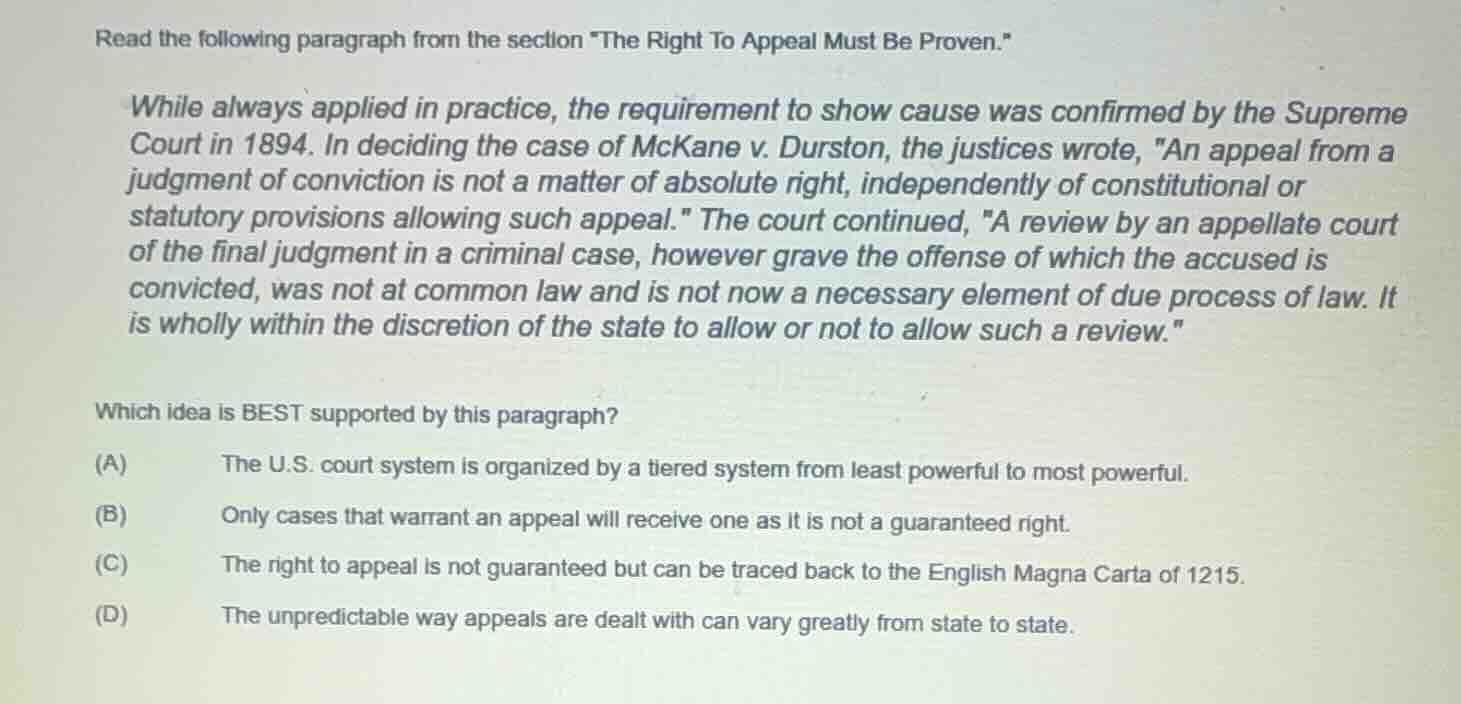
read the following paragraph from the section \the right to appeal must be proven.\ while always applied in practice, the requirement to show cause was confirmed by the supreme court in 1894. in deciding the case of mckane v. durston, the justices wrote, \an appeal from a judgment of conviction is not a matter of absolute right, independently of constitutional or statutory provisions allowing such appeal.\ the court continued, \a review by an appellate court of the final judgment in a criminal case, however grave the offense of which the accused is convicted, was not at common law and is not now a necessary element of due process of law. it is wholly within the discretion of the state to allow or not to allow such a review.\ which idea is best supported by this paragraph? (a) the u.s. court system is organized by a tiered system from least powerful to most powerful. (b) only cases that warrant an appeal will receive one as it is not a guaranteed right. (c) the right to appeal is not guaranteed but can be traced back to the english magna carta of 1215. (d) the unpredictable way appeals are dealt with can vary greatly from state to state.
The paragraph states that appeal from a conviction is not an absolute right, and appellate review of criminal judgments is within state discretion, meaning it is not guaranteed and only granted when justified. Option A is unsupported (no mention of court system tiering). Option C is incorrect (no reference to Magna Carta). Option D is not addressed (no discussion of state-to-state variability in appeal handling).

Snap & solve any problem in the app
Get step-by-step solutions on Sovi AI
Photo-based solutions with guided steps
Explore more problems and detailed explanations
(B) Only cases that warrant an appeal will receive one as it is not a guaranteed right.