QUESTION IMAGE
Question
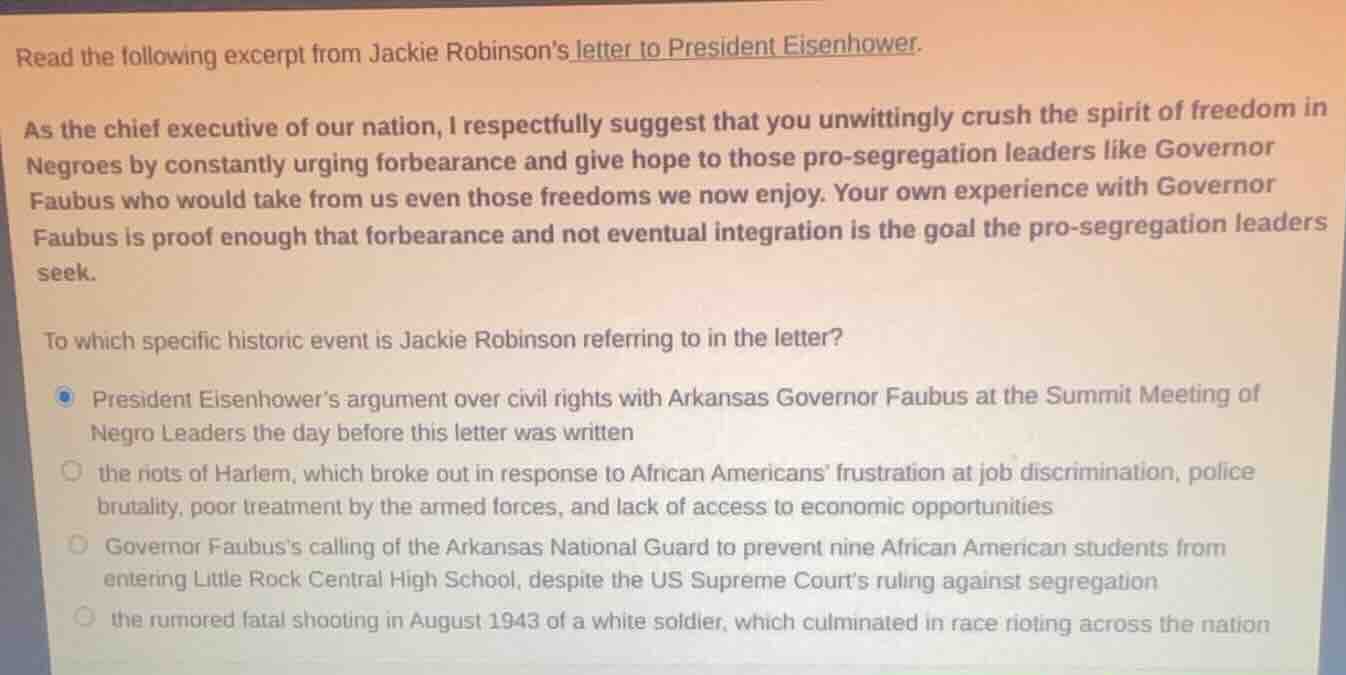
read the following excerpt from jackie robinsons letter to president eisenhower.
as the chief executive of our nation, i respectfully suggest that you unwittingly crush the spirit of freedom in negroes by constantly urging forbearance and give hope to those pro-segregation leaders like governor faubus who would take from us even those freedoms we now enjoy. your own experience with governor faubus is proof enough that forbearance and not eventual integration is the goal the pro-segregation leaders seek.
to which specific historic event is jackie robinson referring to in the letter?
- president eisenhowers argument over civil rights with arkansas governor faubus at the summit meeting of negro leaders the day before this letter was written
- the riots of harlem, which broke out in response to african americans frustration at job discrimination, police brutality, poor treatment by the armed forces, and lack of access to economic opportunities
- governor faubuss calling of the arkansas national guard to prevent nine african american students from entering little rock central high school, despite the us supreme courts ruling against segregation
- the rumored fatal shooting in august 1943 of a white soldier, which culminated in race rioting across the nation
Identify the historical figures and context
Using the Jackie Robinson Letter Analysis and Historical Context in Literature knowledge points
The excerpt from Jackie Robinson's letter to President Dwight D. Eisenhower explicitly mentions "Governor Faubus" of Arkansas and Robinson's criticism of urging "forbearance" in the face of pro-segregation actions.
Connect Governor Faubus to the correct historic event
Using the Historical Context in Literature knowledge point
Governor Orval Faubus of Arkansas is famously known in civil rights history for his resistance to the desegregation of Central High School in Little Rock, Arkansas, in 1957. He deployed the Arkansas National Guard to block nine African American students (the "Little Rock Nine") from entering the school, directly defying the federal Supreme Court ruling in Brown v. Board of Education. This event prompted President Eisenhower to eventually send federal troops to enforce integration, which is the "experience with Governor Faubus" Robinson references.
Evaluate the given multiple-choice options
Using the Jackie Robinson Letter Analysis knowledge point
- Option 1 mentions a "Summit Meeting of Negro Leaders the day before this letter was written." While Robinson did attend a meeting with Eisenhower, the specific reference to Governor Faubus's actions that "take from us even those freedoms we now enjoy" directly points to the physical blockage of school integration.
- Option 2 refers to the Harlem riots of 1943, which is unrelated to Governor Faubus of Arkansas.
- Option 3 correctly identifies Governor Faubus's deployment of the Arkansas National Guard to prevent nine African American students from entering Little Rock Central High School, defying the Supreme Court's desegregation ruling.
- Option 4 refers to a rumored shooting in 1943, which is historically unrelated to the 1957–1958 events involving Governor Faubus.

Snap & solve any problem in the app
Get step-by-step solutions on Sovi AI
Photo-based solutions with guided steps
Explore more problems and detailed explanations
- (A) President Eisenhower's argument over civil rights with Arkansas Governor Faubus at the Summit Meeting of Negro Leaders the day before this letter was written
- (B) the riots of Harlem, which broke out in response to African Americans' frustration at job discrimination, police brutality, poor treatment by the armed forces, and lack of access to economic opportunities
- (C) Governor Faubus's calling of the Arkansas National Guard to prevent nine African American students from entering Little Rock Central High School, despite the US Supreme Court's ruling against segregation (Correct answer)
- (D) the rumored fatal shooting in August 1943 of a white soldier, which culminated in race rioting across the nation