QUESTION IMAGE
Question
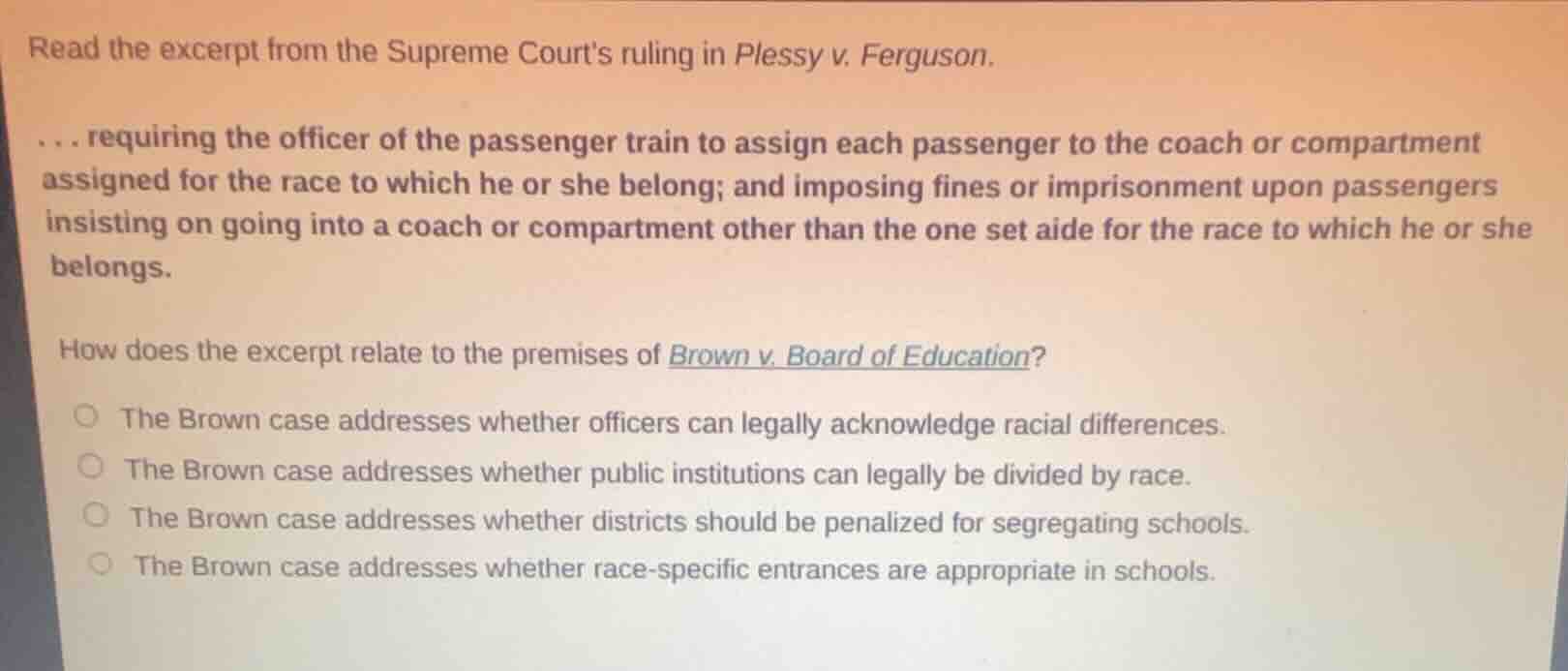
read the excerpt from the supreme courts ruling in plessy v. ferguson.
... requiring the officer of the passenger train to assign each passenger to the coach or compartment assigned for the race to which he or she belong; and imposing fines or imprisonment upon passengers insisting on going into a coach or compartment other than the one set aide for the race to which he or she belongs.
how does the excerpt relate to the premises of brown v. board of education?
- the brown case addresses whether officers can legally acknowledge racial differences.
- the brown case addresses whether public institutions can legally be divided by race.
- the brown case addresses whether districts should be penalized for segregating schools.
- the brown case addresses whether race-specific entrances are appropriate in schools.
Analyze the Plessy v. Ferguson excerpt
The excerpt describes a legal mandate requiring train officers to assign passengers to specific coaches or compartments based on their race, and imposing penalties (fines or imprisonment) for non-compliance. This represents the legal enforcement of racial segregation in public transportation, which was upheld by the "separate but equal" doctrine established in Plessy v. Ferguson.
Connect to Brown v. Board of Education
Using the Brown v. Board of Education knowledge point
- Brown v. Board of Education directly challenged the legal premise of Plessy v. Ferguson by questioning whether public institutions (specifically public schools) could legally be segregated by race.
- The Brown decision ultimately ruled that "separate educational facilities are inherently unequal," thereby overturning the legal basis for dividing public institutions by race.
Evaluate the given options
- Option 1: "The Brown case addresses whether officers can legally acknowledge racial differences." — Incorrect. The case was about state-mandated segregation in public facilities, not merely acknowledging racial differences.
- Option 2: "The Brown case addresses whether public institutions can legally be divided by race." — Correct. This directly addresses the core premise of state-enforced segregation in public education and other public spheres.
- Option 3: "The Brown case addresses whether districts should be penalized for segregating schools." — Incorrect. The case focused on the constitutionality of segregation itself, not the specific penalties for school districts.
- Option 4: "The Brown case addresses whether race-specific entrances are appropriate in schools." — Incorrect. While physical setups were part of segregation, the legal premise was much broader, focusing on the legality of dividing public institutions by race.

Snap & solve any problem in the app
Get step-by-step solutions on Sovi AI
Photo-based solutions with guided steps
Explore more problems and detailed explanations
- The Brown case addresses whether officers can legally acknowledge racial differences.
- The Brown case addresses whether public institutions can legally be divided by race. (Correct answer)
- The Brown case addresses whether districts should be penalized for segregating schools.
- The Brown case addresses whether race-specific entrances are appropriate in schools.