QUESTION IMAGE
Question
question
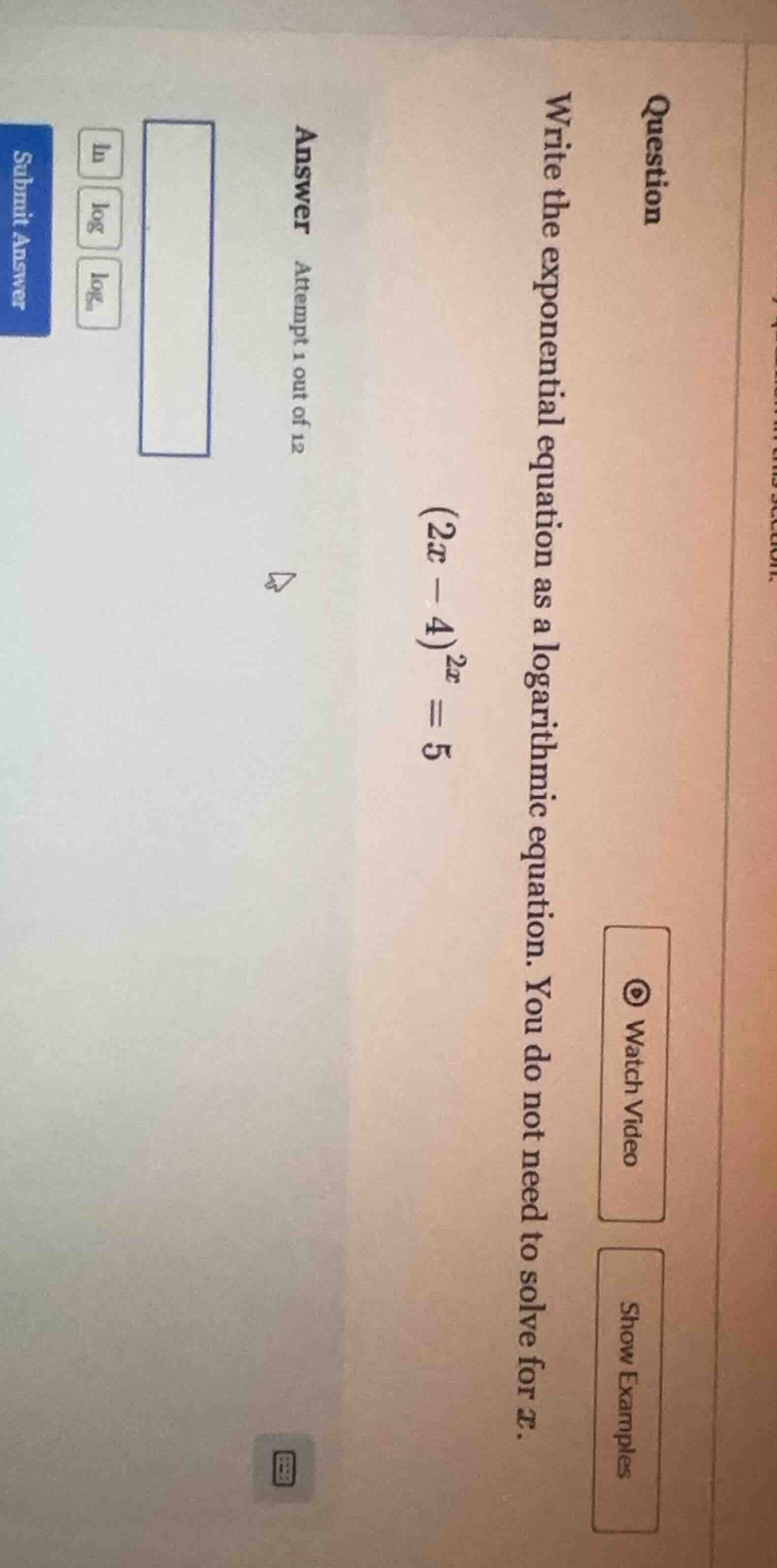
write the exponential equation as a logarithmic equation. you do not need to solve for x.
(2x - 4)^{2x} = 5
answer
attempt 1 out of 12
Step1: Recall the exponential - logarithmic conversion formula
The general formula for converting an exponential equation \(a^{b}=c\) (where \(a>0,a
eq1\)) to a logarithmic equation is \(\log_{a}c = b\). In our given equation \((2x - 4)^{2x}=5\), we can identify that \(a = 2x-4\), \(b = 2x\) and \(c = 5\) (assuming \(2x - 4>0\) and \(2x-4
eq1\) to be valid for the logarithmic form).
Step2: Apply the conversion formula
Using the formula \(\log_{a}c=b\) with \(a = 2x - 4\), \(b = 2x\) and \(c = 5\), we get \(\log_{2x - 4}5=2x\). We can also use the natural logarithm (ln) or common logarithm (log) for conversion. If we take the natural logarithm of both sides of the equation \((2x - 4)^{2x}=5\), we have \(\ln((2x - 4)^{2x})=\ln(5)\). Then, by the power rule of logarithms \(\ln(a^{b})=b\ln(a)\), we get \(2x\ln(2x - 4)=\ln(5)\), and we can also express it as \(\ln(5)=2x\ln(2x - 4)\) or solve for the logarithm of one side: \(\log(5)=2x\log(2x - 4)\) (using common logarithm) or \(\ln(5)=2x\ln(2x - 4)\). But the most direct conversion from exponential \(a^{b}=c\) to logarithmic \(\log_{a}c = b\) gives us \(\log_{2x - 4}5 = 2x\).

Snap & solve any problem in the app
Get step-by-step solutions on Sovi AI
Photo-based solutions with guided steps
Explore more problems and detailed explanations
\(\log_{2x - 4}5=2x\) (or equivalent forms using \(\ln\) or \(\log\) like \(2x=\frac{\ln(5)}{\ln(2x - 4)}\) or \(2x=\frac{\log(5)}{\log(2x - 4)}\))