QUESTION IMAGE
Question
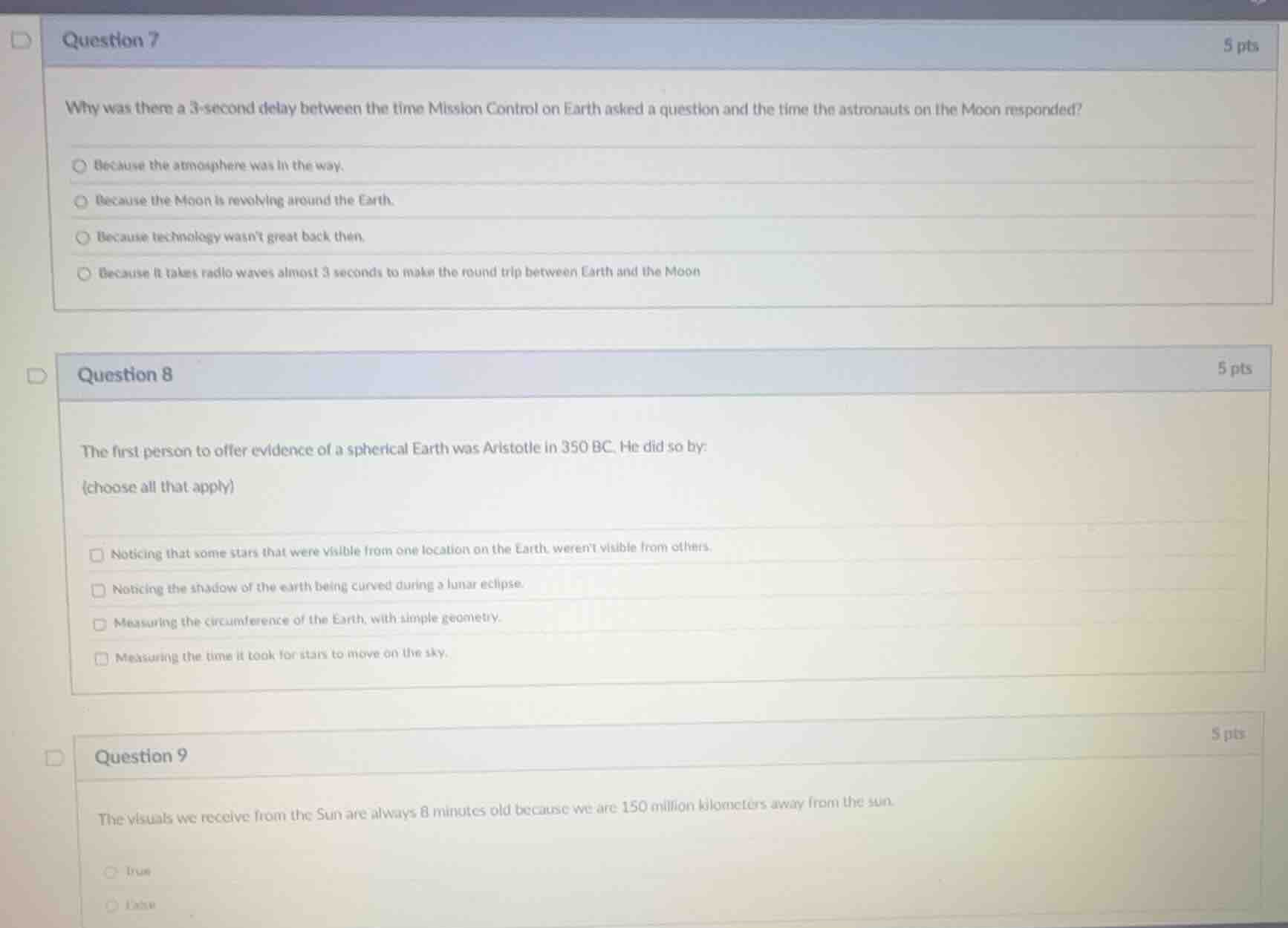
question 7
why was there a 3-second delay between the time mission control on earth asked a question and the time the astronauts on the moon responded?
because the atmosphere was in the way.
because the moon is revolving around the earth.
because technology wasnt great back then.
because it takes radio waves almost 3 seconds to make the round trip between earth and the moon
question 8
the first person to offer evidence of a spherical earth was aristotle in 350 bc. he did so by:
(choose all that apply)
noticing that some stars that were visible from one location on the earth, werent visible from others.
noticing the shadow of the earth being curved during a lunar eclipse.
measuring the circumference of the earth, with simple geometry.
measuring the time it took for stars to move on the sky.
question 9
the visuals we receive from the sun are always 8 minutes old because we are 150 million kilometers away from the sun.
true
false
Analyze Question 7
This question asks about the 3-second communication delay between Earth and the Moon. Radio waves travel at the speed of light \(c \approx 300,000\text{ km/s}\). The average distance between Earth and the Moon is about \(384,000\text{ km}\). A one-way signal takes about \(1.3\text{ seconds}\), making the round-trip travel time for a question and response approximately \(2.6\text{ seconds}\) (almost 3 seconds) due to the finite speed of light. Thus, the fourth option is correct.
Analyze Question 8
This question asks for the evidence Aristotle used in 350 BC to support a spherical Earth.
- Aristotle observed that certain stars visible in Egypt and Cyprus are not visible in more northern regions, which is only possible on a curved surface.
- He also observed that during a lunar eclipse, the shadow cast by the Earth onto the Moon is always circular/curved.
- Measuring the circumference of the Earth using simple geometry was done later by Eratosthenes (around 240 BC), not Aristotle.
- Measuring the time for stars to move does not directly prove a spherical shape.
Therefore, the first two options apply.
Analyze Question 9
This question asks if the visuals we receive from the Sun are 8 minutes old because we are 150 million kilometers away.
Using the speed of light \(c \approx 300,000\text{ km/s}\):
Converting to minutes:
Thus, the statement is True.

Snap & solve any problem in the app
Get step-by-step solutions on Sovi AI
Photo-based solutions with guided steps
Explore more problems and detailed explanations
Question 7
- Because the atmosphere was in the way.
- Because the Moon is revolving around the Earth.
- Because technology wasn't great back then.
- Because it takes radio waves almost 3 seconds to make the round trip between Earth and the Moon (Correct answer)
Question 8
- Noticing that some stars that were visible from one location on the Earth, weren't visible from others. (Correct answer)
- Noticing the shadow of the earth being curved during a lunar eclipse. (Correct answer)
- Measuring the circumference of the Earth, with simple geometry.
- Measuring the time it took for stars to move on the sky.
Question 9
- True (Correct answer)
- False