QUESTION IMAGE
Question
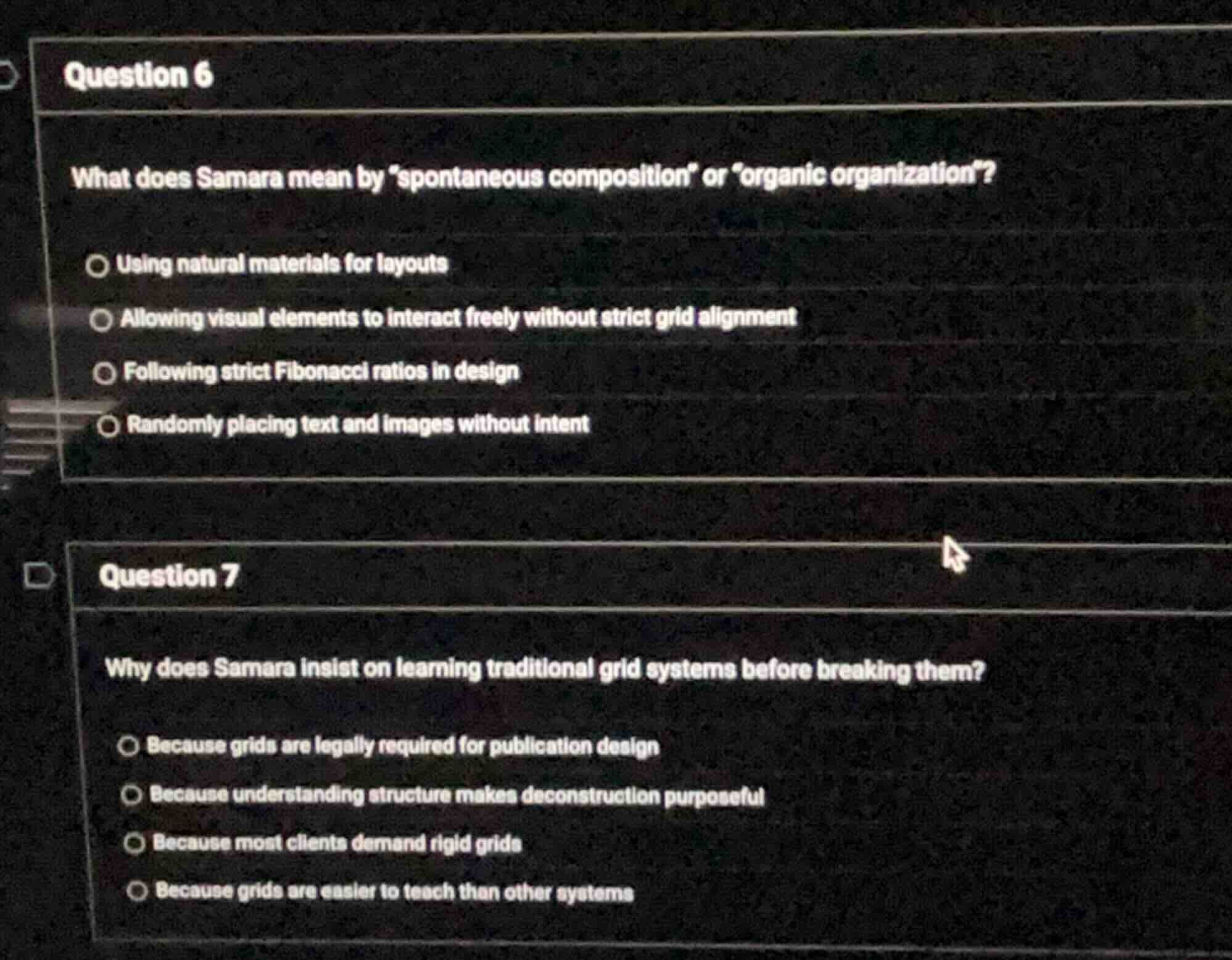
question 6
what does samara mean by \spontaneous composition\ or \organic organization\?
using natural materials for layouts
allowing visual elements to interact freely without strict grid alignment
following strict fibonacci ratios in design
randomly placing text and images without intent
question 7
why does samara insist on learning traditional grid systems before breaking them?
because grids are legally required for publication design
because understanding structure makes deconstruction purposeful
because most clients demand rigid grids
because grids are easier to teach than other systems
Define spontaneous composition and organic organization
In graphic design theory (specifically Timothy Samara's Making and Breaking the Grid), "spontaneous composition" or "organic organization" refers to Alternative Layout Methodologies where visual elements are positioned intuitively. Instead of relying on a pre-determined mathematical grid, elements are allowed to relate and interact dynamically with one another based on visual weight, tension, and narrative flow.
Evaluate Question 6 options
- Using natural materials for layouts: Incorrect. This refers to physical mediums, not layout structure.
- Allowing visual elements to interact freely without strict grid alignment: Correct. This aligns with Samara's definition of organic, intuitive composition.
- Following strict Fibonacci ratios in design: Incorrect. Fibonacci ratios represent a highly structured, mathematical approach.
- Randomly placing text and images without intent: Incorrect. Intuitive or organic design is still purposeful and guided by visual hierarchy, not purely random.
Analyze the rationale for learning traditional grids
Samara emphasizes that to break rules effectively, one must first master them. This concept of Grid Deconstruction relies on understanding the underlying structural order. Without a foundational knowledge of grids, attempts to break them result in chaotic, unorganized layouts rather than deliberate, expressive design.
Evaluate Question 7 options
- Because grids are legally required for publication design: Incorrect. There are no legal requirements for layout structures.
- Because understanding structure makes deconstruction purposeful: Correct. Knowing the rules of structure allows a designer to break them with intent and control.
- Because most clients demand rigid grids: Incorrect. Client demands vary and do not dictate pedagogical theory.
- Because grids are easier to teach than other systems: Incorrect. This does not address the conceptual relationship between structure and deconstruction.

Snap & solve any problem in the app
Get step-by-step solutions on Sovi AI
Photo-based solutions with guided steps
Explore more problems and detailed explanations
Question 6
- (A) Using natural materials for layouts
- (B) Allowing visual elements to interact freely without strict grid alignment (Correct answer)
- (C) Following strict Fibonacci ratios in design
- (D) Randomly placing text and images without intent
Question 7
- (A) Because grids are legally required for publication design
- (B) Because understanding structure makes deconstruction purposeful (Correct answer)
- (C) Because most clients demand rigid grids
- (D) Because grids are easier to teach than other systems