QUESTION IMAGE
Question
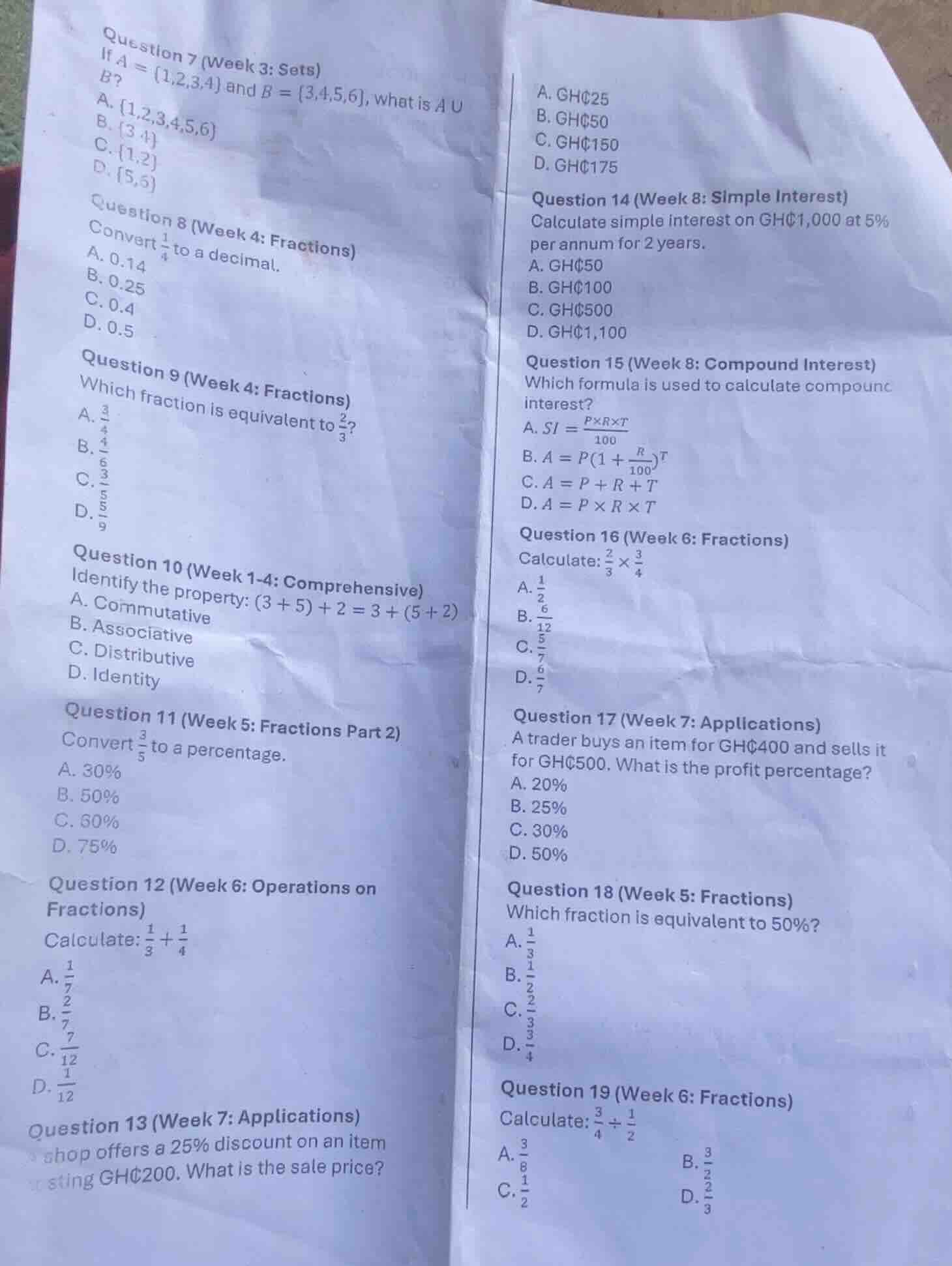
question 7 (week 3: sets)
if (a = \\{1,2,3,4\\}) and (b = \\{3,4,5,6\\}), what is (a \cup b)?
a. (\\{1,2,3,4,5,6\\})
b. (\\{3,4\\})
c. (\\{1,2\\})
d. (\\{5,6\\})
question 8 (week 4: fractions)
convert (\frac{1}{4}) to a decimal.
a. 0.14
b. 0.25
c. 0.4
d. 0.5
question 9 (week 4: fractions)
which fraction is equivalent to (\frac{2}{3})?
a. (\frac{3}{4})
b. (\frac{4}{6})
c. (\frac{3}{5})
d. (\frac{5}{9})
question 10 (week 1-4: comprehensive)
identify the property: ((3 + 5) + 2 = 3 + (5 + 2))
a. commutative
b. associative
c. distributive
d. identity
question 11 (week 5: fractions part 2)
convert (\frac{3}{5}) to a percentage.
a. 30%
b. 50%
c. 60%
d. 75%
question 12 (week 6: operations on fractions)
calculate: (\frac{1}{3} + \frac{1}{4})
a. (\frac{1}{7})
b. (\frac{2}{7})
c. (\frac{7}{12})
d. (\frac{1}{12})
question 13 (week 7: applications)
a shop offers a 25% discount on an item costing gh₵200. what is the sale price?
a. gh₵25
b. gh₵50
c. gh₵150
d. gh₵175
question 14 (week 8: simple interest)
calculate simple interest on gh₵1,000 at 5% per annum for 2 years.
a. gh₵50
b. gh₵100
c. gh₵500
d. gh₵1,100
question 15 (week 8: compound interest)
which formula is used to calculate compound interest?
a. (si = \frac{p \times r \times t}{100})
b. (a = p(1 + \frac{r}{100})^t)
c. (a = p + r + t)
d. (a = p \times r \times t)
question 16 (week 6: fractions)
calculate: (\frac{2}{3} \times \frac{3}{4})
a. (\frac{1}{2})
b. (\frac{6}{12})
c. (\frac{5}{7})
d. (\frac{6}{7})
question 17 (week 7: applications)
a trader buys an item for gh₵400 and sells it for gh₵500. what is the profit percentage?
a. 20%
b. 25%
c. 30%
d. 50%
question 18 (week 5: fractions)
which fraction is equivalent to 50%?
a. (\frac{1}{3})
b. (\frac{1}{2})
c. (\frac{2}{3})
d. (\frac{3}{4})
question 19 (week 6: fractions)
calculate: (\frac{3}{4} \div \frac{1}{2})
a. (\frac{3}{8})
b. (\frac{3}{2})
c. (\frac{1}{2})
d. (\frac{2}{3})
🆕 New Concept Discovered: Set Operations
Combining elements from multiple groups
Step 1: Identify the operation
The problem asks for \( A \cup B \), where:
The symbol \( \cup \) represents the union of two sets. This means we combine all elements from both sets, listing any shared elements only once.
Step 2: Combine the elements
List all unique elements that appear in set \( A \), set \( B \), or both:
- From \( A \): \( 1, 2, 3, 4 \)
- From \( B \): \( 3, 4, 5, 6 \)
Combining them without duplicates gives:

Snap & solve any problem in the app
Get step-by-step solutions on Sovi AI
Photo-based solutions with guided steps
Explore more problems and detailed explanations
A. {1,2,3,4,5,6}