QUESTION IMAGE
Question
question 1 of 5
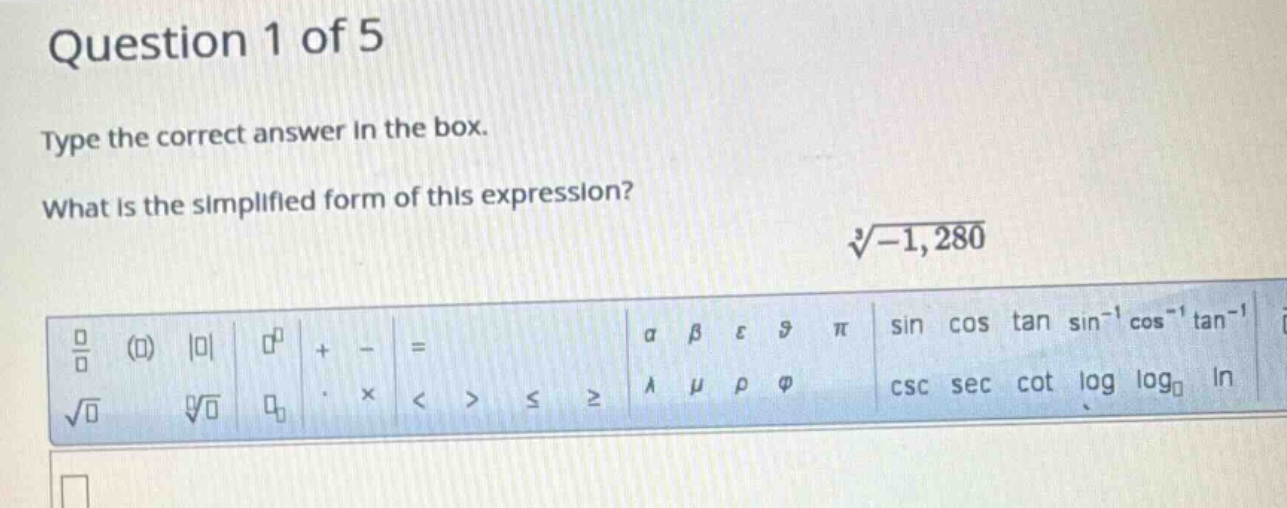
type the correct answer in the box.
what is the simplified form of this expression?
\\\sqrt5{-1,280}\\
⚡ Using what you learned: Simplifying Radical Expressions
Step 1: Factor out the negative sign
Since the index of the radical is odd (a cube root), we can pull the negative sign out of the radical:
$$ \sqrt[3]{-1,280} = -\sqrt[3]{1,280} $$
Step 2: Find the largest perfect cube factor
Find the prime factorization of \( 1,280 \) to identify perfect cubes:
$$ 1,280 = 128 \times 10 = 2^7 \times 2 \times 5 = 2^8 \times 5 $$
Group the factors into perfect cubes:
$$ 1,280 = 2^6 \times 2^2 \times 5 = 64 \times 4 \times 5 = 512 \times 2.5 \text{ (not integer)} $$
Alternatively, check perfect cubes directly:
$$ 8^3 = 512 $$
$$ 1,280 = 512 \times 2.5 \text{ (not an integer)} $$
$$ 4^3 = 64 $$
$$ 1,280 = 64 \times 20 $$
So, the largest perfect cube factor of \( 1,280 \) is \( 64 \):
$$ 1,280 = 64 \times 20 $$
Step 3: Simplify the radical
Apply the product property of radicals:
$$ -\sqrt[3]{1,280} = -\sqrt[3]{64 \times 20} $$
$$ -\sqrt[3]{64} \times \sqrt[3]{20} = -4\sqrt[3]{20} $$

Snap & solve any problem in the app
Get step-by-step solutions on Sovi AI
Photo-based solutions with guided steps
Explore more problems and detailed explanations
$$ -4\sqrt[3]{20} $$