QUESTION IMAGE
Question
question
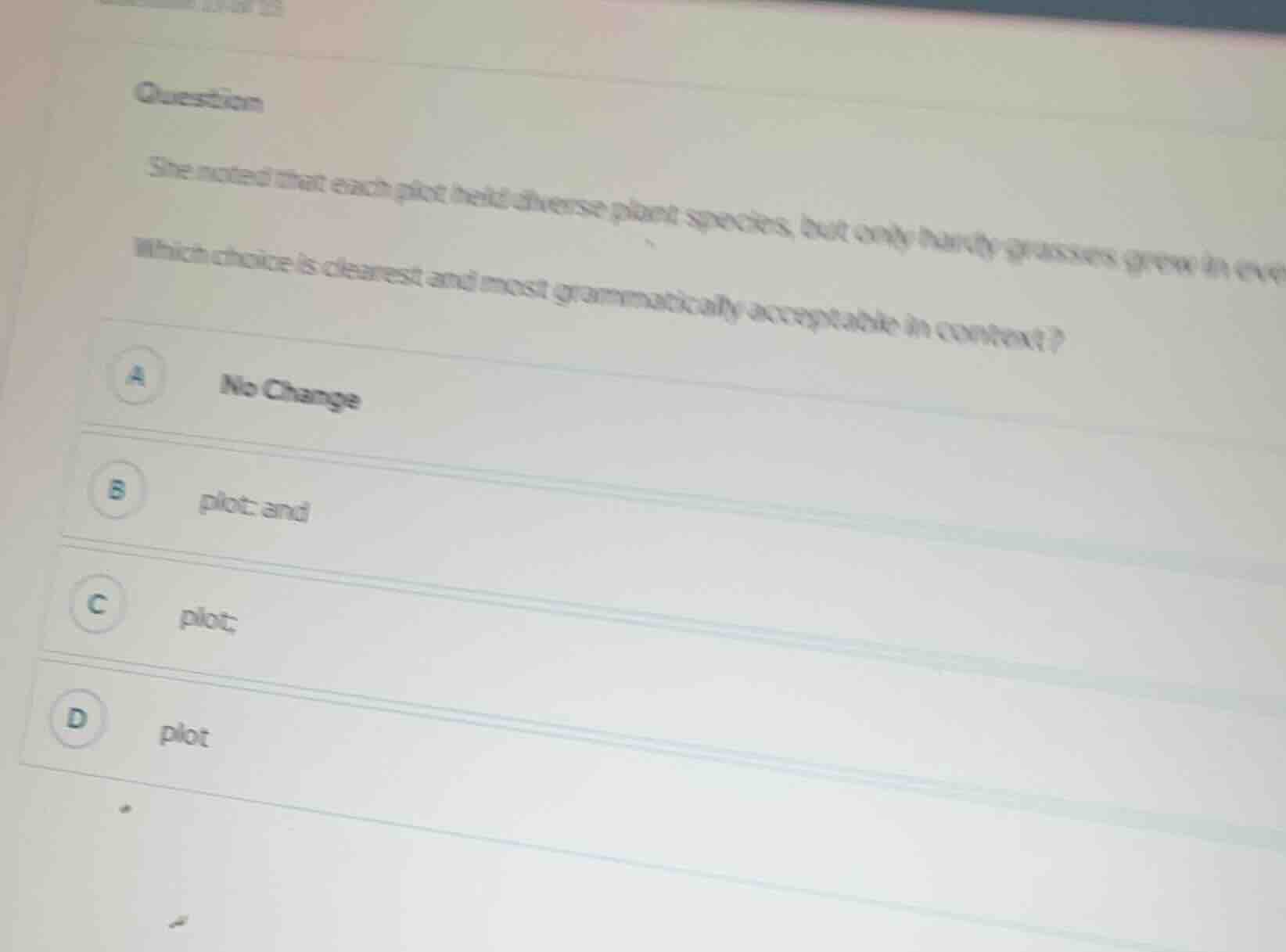
she noted that each plot held diverse plant species, but only hardy grasses grew in eve
which choice is clearest and most grammatically acceptable in context?
a no change
b plot: and
c plot;
d plot
To determine the correct option, we analyze the context and grammar. The original sentence has a contrast ("each plot held diverse plant species, but only hardy grasses..."). Option A has "held" which may be incorrect in tense or context? Wait, no—wait, the options are about punctuation. Wait, the original sentence: "She noted that each plot held diverse plant species, but only hardy grasses grow in eve..." Wait, maybe a typo, but the options are about the word after "plot". Wait, no, the options are A: No Change, B: plot: and, C: plot;, D: plot. Wait, the original sentence structure: "each plot held diverse plant species, but only hardy grasses grow..." Wait, maybe the original had a wrong punctuation or word. Wait, let's re - examine. The key is to find the clearest and grammatically acceptable. Let's consider the structure. If we have "each plot held diverse plant species, but only hardy grasses grow...", but the options are about the word/ punctuation after "plot". Wait, maybe the original sentence was "each plot held diverse plant species, but only hardy grasses grow in eve..." and the underlined part is "held"? No, the options are A: No Change, B: plot: and, C: plot;, D: plot. Wait, perhaps the original sentence is "She noted that each plot held diverse plant species, but only hardy grasses grow in eve..." and the question is about the correct punctuation or word after "plot". Wait, maybe the intended sentence is about the relationship between the two clauses. If we use a semicolon (option C: plot;), it can separate two independent clauses. But let's think again. Wait, maybe the original sentence has a mistake in the verb tense (held vs grow), but the options are about the word/punctuation after "plot". Wait, perhaps the correct answer is A? No, wait, maybe I misread. Wait, the options: A: No Change, B: plot: and, C: plot;, D: plot. Let's think about the context. The first part is "each plot held diverse plant species", the second part is "only hardy grasses grow...". These are two independent clauses? If so, a semicolon (option C) or a comma and a conjunction. But the original has a comma and "but" (a conjunction), which is correct. Wait, but the options are about the word after "plot". Wait, maybe the original sentence was "each plot held diverse plant species, but only hardy grasses grow in eve..." and the underlined part is "held"? No, the options are A: No Change, B: plot: and, C: plot;, D: plot. I think there might be a typo in the question, but assuming the correct grammatical structure, if we consider that "each plot held diverse plant species" and "only hardy grasses grow..." are two independent clauses, a semicolon (option C) could be used, but "but" is a conjunction that takes a comma. Wait, maybe the original sentence is correct as is, so option A? But I'm confused. Wait, maybe the correct answer is A. No, wait, let's check again. The question is "Which choice is clearest and most grammatically acceptable in context?". Let's analyze each option:
- Option A: "No Change"—if the original sentence is grammatically correct, this is good.
- Option B: "plot: and"—using a colon here is incorrect as a colon is for explanation or list, not for connecting clauses.
- Option C: "plot;"—a semicolon would be used between two independent clauses, but the second part starts with "but", which is a conjunction, so a semicolon is not needed here.
- Option D: "plot"—this would make the sentence ungrammatical, like "each plot diverse plant species..."
So the correct answer should be A: No Change. Wait, but maybe I made a mistake. Alter…

Snap & solve any problem in the app
Get step-by-step solutions on Sovi AI
Photo-based solutions with guided steps
Explore more problems and detailed explanations
A. No Change