QUESTION IMAGE
Question
question 2
1 pts
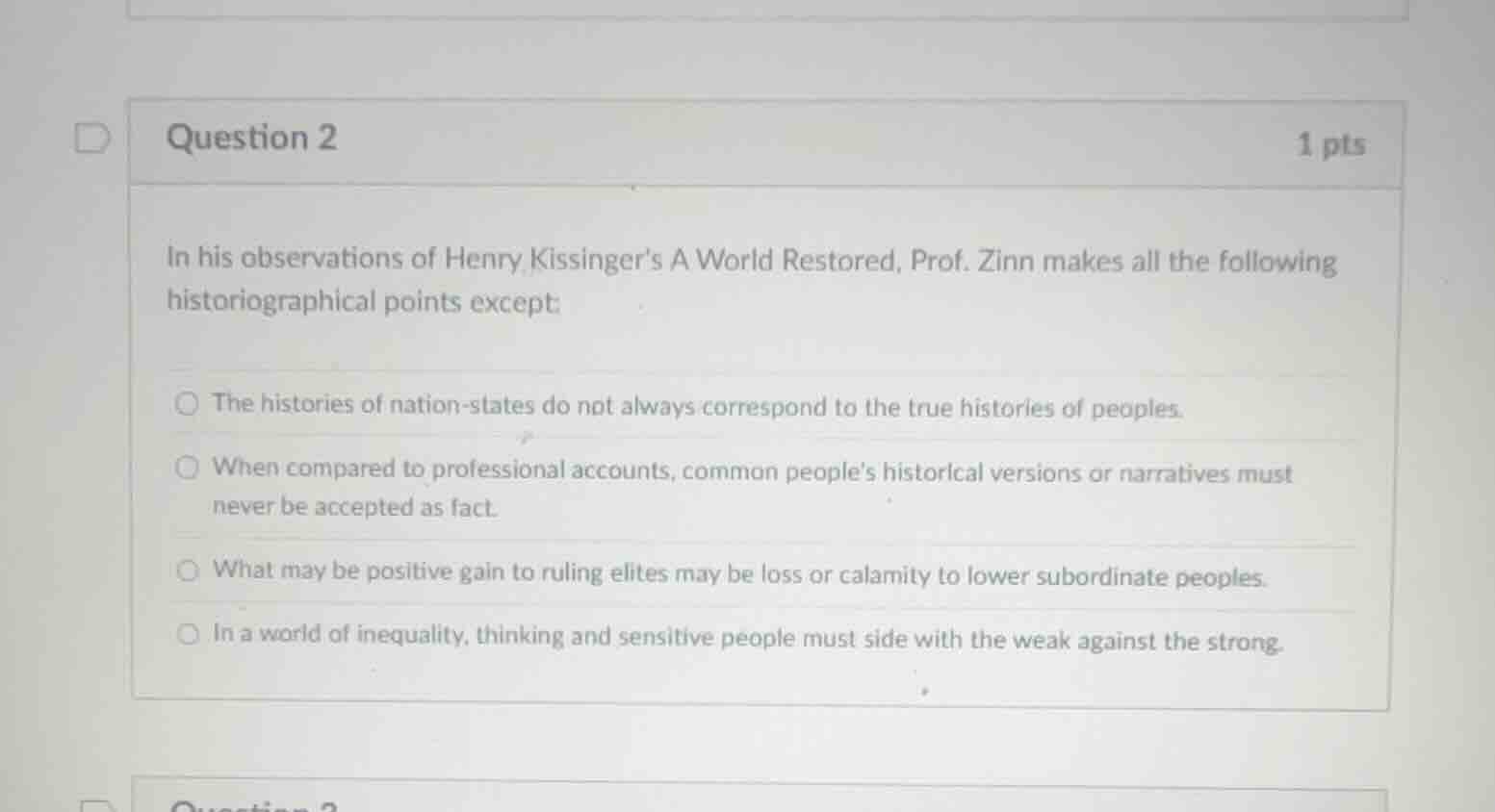
in his observations of henry kissingers a world restored, prof. zinn makes all the following historiographical points except:
the histories of nation-states do not always correspond to the true histories of peoples.
when compared to professional accounts, common peoples historical versions or narratives must never be accepted as fact.
what may be positive gain to ruling elites may be loss or calamity to lower subordinate peoples.
in a world of inequality, thinking and sensitive people must side with the weak against the strong.
Analyze Howard Zinn's historiographical perspective
In his famous work A People's History of the United States, Howard Zinn critiques traditional top-down histories, such as Henry Kissinger's A World Restored (which focuses on elite diplomacy and state stability). Zinn argues that the histories of nation-states (focused on leaders and elites) do not represent the true histories of common peoples.
Evaluate the options against Zinn's philosophy
- The histories of nation-states do not always correspond to the true histories of peoples: This is a core point of Zinn's critique.
- When compared to professional accounts, common people's historical versions or narratives must never be accepted as fact: This directly contradicts Zinn's entire methodology. Zinn advocates for elevating the voices and narratives of common people, workers, and marginalized groups, rather than dismissing them in favor of "professional" or elite accounts.
- What may be positive gain to ruling elites may be loss or calamity to lower subordinate peoples: This aligns with Zinn's view on how progress for the powerful often comes at the expense of the oppressed.
- In a world of inequality, thinking and sensitive people must side with the weak against the strong: This is a direct reflection of Zinn's explicit stance on historical neutrality; he famously argued that "you can't be neutral on a moving train" and that historians must choose a side.
Identify the exception
The statement claiming that common people's narratives "must never be accepted as fact" is the opposite of Zinn's historiographical approach, making it the correct "except" choice.

Snap & solve any problem in the app
Get step-by-step solutions on Sovi AI
Photo-based solutions with guided steps
Explore more problems and detailed explanations
- (A) The histories of nation-states do not always correspond to the true histories of peoples.
- (B) When compared to professional accounts, common people's historical versions or narratives must never be accepted as fact. (Correct answer)
- (C) What may be positive gain to ruling elites may be loss or calamity to lower subordinate peoples.
- (D) In a world of inequality, thinking and sensitive people must side with the weak against the strong.