QUESTION IMAGE
Question
question 7
1.5 points
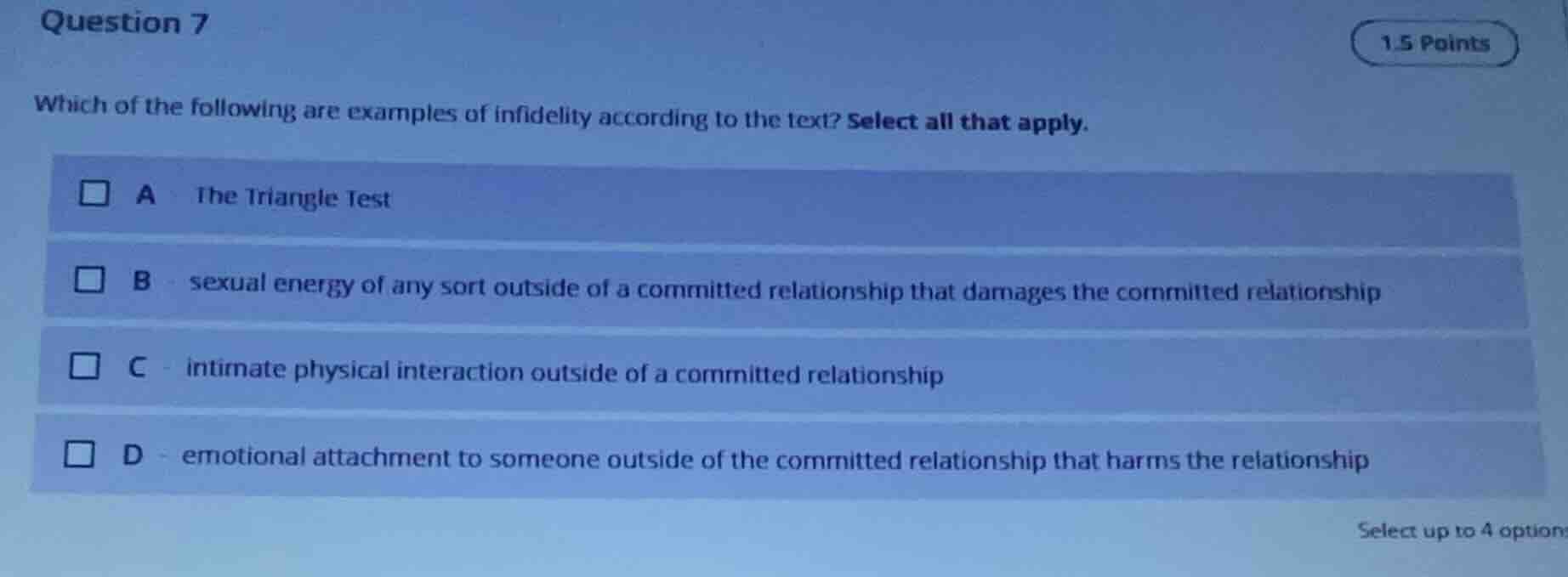
which of the following are examples of infidelity according to the text? select all that apply.
a the triangle test
b sexual energy of any sort outside of a committed relationship that damages the committed relationship
c intimate physical interaction outside of a committed relationship
d emotional attachment to someone outside of the committed relationship that harms the relationship
select up to 4 options
<pre_analysis>
{
"quality": "clear",
"question_count": 1,
"skills_matched": [
"direct_cot",
"multiple_choice_formatter",
"explain_then_answer",
"tutor"
],
"needs_drawing": false,
"concepts_used": [
"Secret Testing",
"Relationship Maintenance Strategies"
],
"new_concepts": [
"Infidelity Definitions",
"Relational Transgressions"
],
"current_concepts": [
"Secret Testing",
"Relationship Maintenance Strategies",
"Infidelity Definitions",
"Relational Transgressions"
]
}
</pre_analysis>
<reasoning>
Analyze the question and options
The question asks to identify examples of infidelity according to the text (typically referring to standard interpersonal communication or relationship studies literature). It is a "Select all that apply" multi-select question.
Let's evaluate each option:
- A: The Triangle Test: This is a type of Secret Testing (a strategy used to evaluate a partner's commitment, such as introducing a third party to see if the partner becomes jealous). It is a test of fidelity/commitment, not an example of infidelity itself.
- B: sexual energy of any sort outside of a committed relationship that damages the committed relationship: In interpersonal communication literature, infidelity is broadly defined to include sexual infidelity, which encompasses directing sexual energy, interest, or behaviors outside the primary relationship in a way that hurts the bond.
- C: intimate physical interaction outside of a committed relationship: This is the classic definition of physical/sexual infidelity.
- D: emotional attachment to someone outside of the committed relationship that harms the relationship: This represents emotional infidelity, where deep emotional resources and attachments are shared with an outside party, causing harm to the primary relationship.
Determine the correct selections
Options B, C, and D represent the multi-dimensional nature of infidelity (sexual, physical, and emotional dimensions) as defined in relationship studies. Option A is a method of testing a partner's fidelity, not an act of infidelity.
</reasoning>
<answer>
<mcq-option>(A) The Triangle Test</mcq-option>
<mcq-correct>(B) sexual energy of any sort outside of a committed relationship that damages the committed relationship</mcq-correct>
<mcq-correct>(C) intimate physical interaction outside of a committed relationship</mcq-correct>
<mcq-correct>(D) emotional attachment to someone outside of the committed relationship that harms the relationship</mcq-correct>
</answer>
<post_analysis>
{
"subject": "Social Science",
"question_type": "Multiple Choice",
"knowledge_point": [
"Social Science",
"Communication Studies",
"Relational Transgressions"
]
}
</post_analysis>
Snap & solve any problem in the app
Get step-by-step solutions on Sovi AI
Photo-based solutions with guided steps
Explore more problems and detailed explanations
<pre_analysis>
{
"quality": "clear",
"question_count": 1,
"skills_matched": [
"direct_cot",
"multiple_choice_formatter",
"explain_then_answer",
"tutor"
],
"needs_drawing": false,
"concepts_used": [
"Secret Testing",
"Relationship Maintenance Strategies"
],
"new_concepts": [
"Infidelity Definitions",
"Relational Transgressions"
],
"current_concepts": [
"Secret Testing",
"Relationship Maintenance Strategies",
"Infidelity Definitions",
"Relational Transgressions"
]
}
</pre_analysis>
<reasoning>
Analyze the question and options
The question asks to identify examples of infidelity according to the text (typically referring to standard interpersonal communication or relationship studies literature). It is a "Select all that apply" multi-select question.
Let's evaluate each option:
- A: The Triangle Test: This is a type of Secret Testing (a strategy used to evaluate a partner's commitment, such as introducing a third party to see if the partner becomes jealous). It is a test of fidelity/commitment, not an example of infidelity itself.
- B: sexual energy of any sort outside of a committed relationship that damages the committed relationship: In interpersonal communication literature, infidelity is broadly defined to include sexual infidelity, which encompasses directing sexual energy, interest, or behaviors outside the primary relationship in a way that hurts the bond.
- C: intimate physical interaction outside of a committed relationship: This is the classic definition of physical/sexual infidelity.
- D: emotional attachment to someone outside of the committed relationship that harms the relationship: This represents emotional infidelity, where deep emotional resources and attachments are shared with an outside party, causing harm to the primary relationship.
Determine the correct selections
Options B, C, and D represent the multi-dimensional nature of infidelity (sexual, physical, and emotional dimensions) as defined in relationship studies. Option A is a method of testing a partner's fidelity, not an act of infidelity.
</reasoning>
<answer>
<mcq-option>(A) The Triangle Test</mcq-option>
<mcq-correct>(B) sexual energy of any sort outside of a committed relationship that damages the committed relationship</mcq-correct>
<mcq-correct>(C) intimate physical interaction outside of a committed relationship</mcq-correct>
<mcq-correct>(D) emotional attachment to someone outside of the committed relationship that harms the relationship</mcq-correct>
</answer>
<post_analysis>
{
"subject": "Social Science",
"question_type": "Multiple Choice",
"knowledge_point": [
"Social Science",
"Communication Studies",
"Relational Transgressions"
]
}
</post_analysis>