QUESTION IMAGE
Question
question 5 of 5
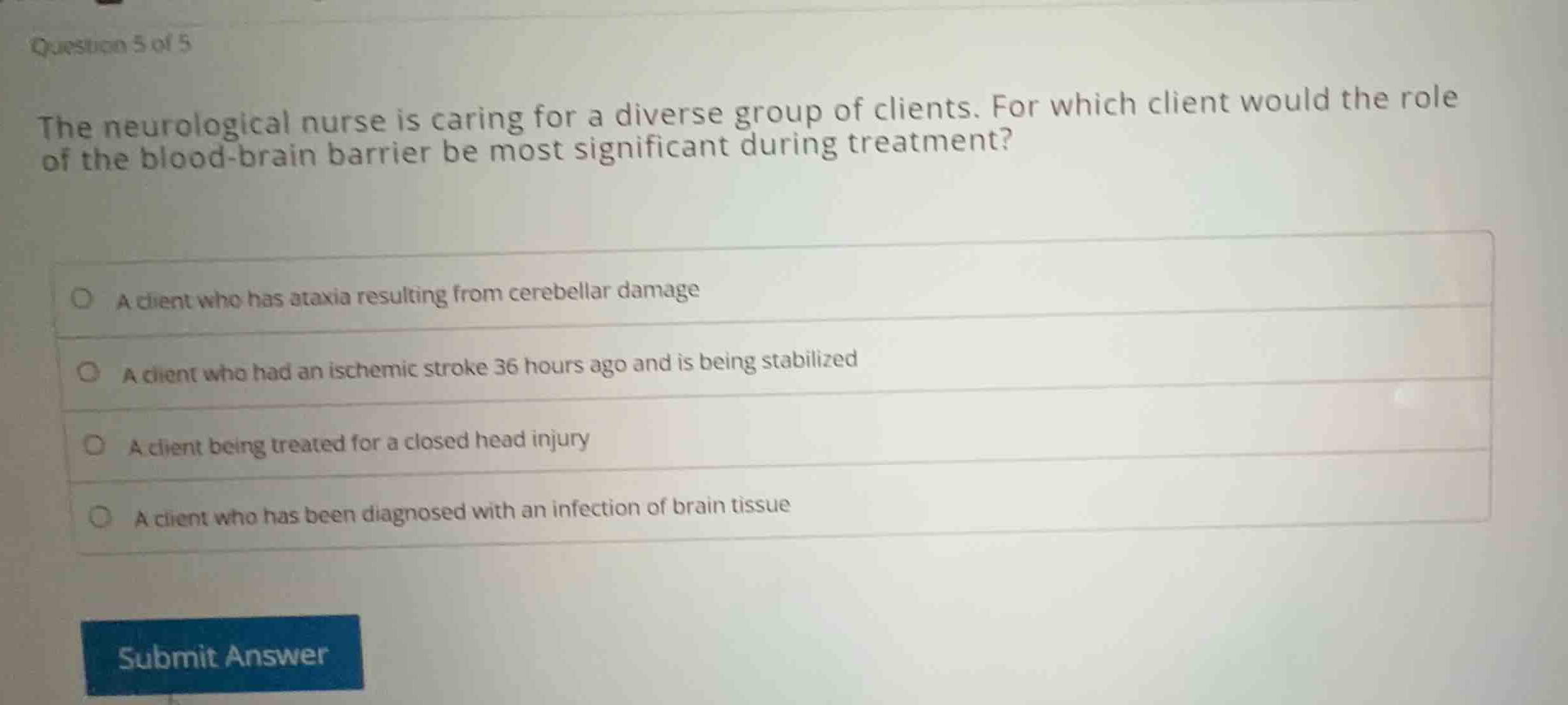
the neurological nurse is caring for a diverse group of clients. for which client would the role of the blood-brain barrier be most significant during treatment?
a client who has ataxia resulting from cerebellar damage
a client who had an ischemic stroke 36 hours ago and is being stabilized
a client being treated for a closed head injury
a client who has been diagnosed with an infection of brain tissue
<pre_analysis>
{
"quality": "clear",
"question_count": 1,
"skills_matched": [
"direct_cot",
"multiple_choice_formatter",
"explain_then_answer",
"tutor"
],
"needs_drawing": false,
"concepts_used": [
"Blood-Brain Barrier",
"Antibiotic Penetration"
],
"new_concepts": [],
"current_concepts": [
"Blood-Brain Barrier",
"Antibiotic Penetration",
"Pharmacotherapeutics"
]
}
</pre_analysis>
<reasoning>
Analyze the role of the blood-brain barrier
The Blood-Brain Barrier is a highly selective semipermeable border of endothelial cells that prevents solutes in the circulating blood from non-selectively crossing into the extracellular fluid of the central nervous system. This physiological barrier is a critical consideration in pharmacotherapy, as it restricts the entry of many therapeutic agents, particularly large, hydrophilic, or highly charged molecules, into the brain parenchyma.
Evaluate the clinical scenarios
- Ataxia from cerebellar damage: This is a structural/neurological deficit. Treatment focuses on physical therapy, occupational therapy, or addressing the underlying cause, where the barrier's daily drug-exclusion role is not the primary limiting factor of active treatment.
- Ischemic stroke stabilization: While the barrier is altered during ischemia, acute stabilization focuses on perfusion, blood pressure management, and supportive care rather than overcoming the barrier to deliver specific parenchymal drugs.
- Closed head injury: Treatment focuses on monitoring intracranial pressure, perfusion, and preventing secondary injury.
- Infection of brain tissue: Treating a parenchymal brain infection (such as encephalitis or abscess) requires systemic administration of anti-infective agents (antibiotics, antivirals, or antifungals). The Antibiotic Penetration across the blood-brain barrier is the primary determinant of treatment efficacy, as many potent antimicrobials cannot cross this barrier in therapeutic concentrations. Thus, the barrier's role is most significant here because it directly dictates which medications can be successfully used to treat the client.
</reasoning>
<answer>
<mcq-option>A client who has ataxia resulting from cerebellar damage</mcq-option>
<mcq-option>A client who had an ischemic stroke 36 hours ago and is being stabilized</mcq-option>
<mcq-option>A client being treated for a closed head injury</mcq-option>
<mcq-correct>A client who has been diagnosed with an infection of brain tissue</mcq-correct>
</answer>
<post_analysis>
{
"subject": "Natural Science",
"question_type": "Multiple Choice",
"knowledge_point": [
"Natural Science",
"Medicine",
"Pharmacology"
]
}
</post_analysis>
Snap & solve any problem in the app
Get step-by-step solutions on Sovi AI
Photo-based solutions with guided steps
Explore more problems and detailed explanations
<pre_analysis>
{
"quality": "clear",
"question_count": 1,
"skills_matched": [
"direct_cot",
"multiple_choice_formatter",
"explain_then_answer",
"tutor"
],
"needs_drawing": false,
"concepts_used": [
"Blood-Brain Barrier",
"Antibiotic Penetration"
],
"new_concepts": [],
"current_concepts": [
"Blood-Brain Barrier",
"Antibiotic Penetration",
"Pharmacotherapeutics"
]
}
</pre_analysis>
<reasoning>
Analyze the role of the blood-brain barrier
The Blood-Brain Barrier is a highly selective semipermeable border of endothelial cells that prevents solutes in the circulating blood from non-selectively crossing into the extracellular fluid of the central nervous system. This physiological barrier is a critical consideration in pharmacotherapy, as it restricts the entry of many therapeutic agents, particularly large, hydrophilic, or highly charged molecules, into the brain parenchyma.
Evaluate the clinical scenarios
- Ataxia from cerebellar damage: This is a structural/neurological deficit. Treatment focuses on physical therapy, occupational therapy, or addressing the underlying cause, where the barrier's daily drug-exclusion role is not the primary limiting factor of active treatment.
- Ischemic stroke stabilization: While the barrier is altered during ischemia, acute stabilization focuses on perfusion, blood pressure management, and supportive care rather than overcoming the barrier to deliver specific parenchymal drugs.
- Closed head injury: Treatment focuses on monitoring intracranial pressure, perfusion, and preventing secondary injury.
- Infection of brain tissue: Treating a parenchymal brain infection (such as encephalitis or abscess) requires systemic administration of anti-infective agents (antibiotics, antivirals, or antifungals). The Antibiotic Penetration across the blood-brain barrier is the primary determinant of treatment efficacy, as many potent antimicrobials cannot cross this barrier in therapeutic concentrations. Thus, the barrier's role is most significant here because it directly dictates which medications can be successfully used to treat the client.
</reasoning>
<answer>
<mcq-option>A client who has ataxia resulting from cerebellar damage</mcq-option>
<mcq-option>A client who had an ischemic stroke 36 hours ago and is being stabilized</mcq-option>
<mcq-option>A client being treated for a closed head injury</mcq-option>
<mcq-correct>A client who has been diagnosed with an infection of brain tissue</mcq-correct>
</answer>
<post_analysis>
{
"subject": "Natural Science",
"question_type": "Multiple Choice",
"knowledge_point": [
"Natural Science",
"Medicine",
"Pharmacology"
]
}
</post_analysis>