QUESTION IMAGE
Question
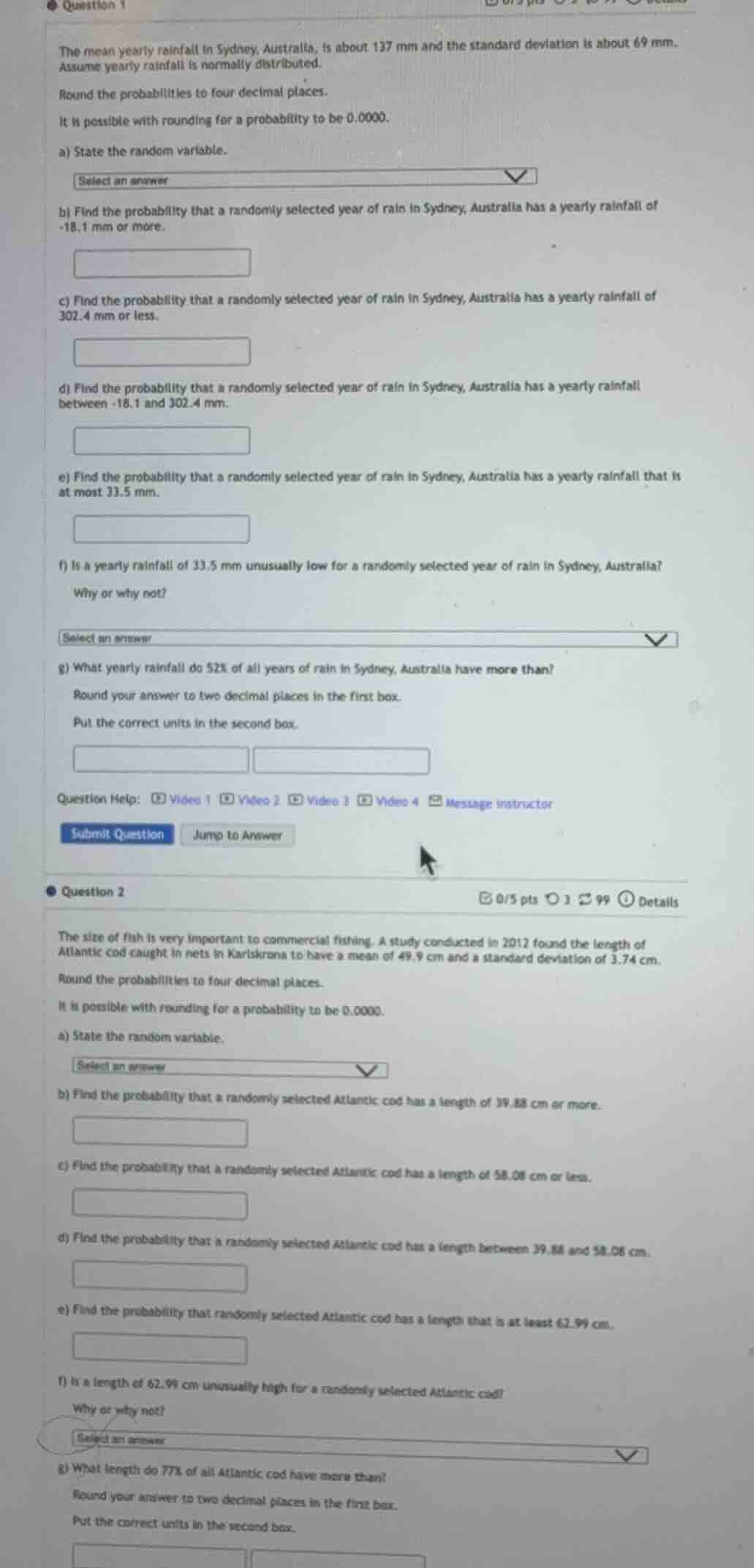
question 1
the mean yearly rainfall in sydney, australia, is about 137 mm and the standard deviation is about 69 mm. assume yearly rainfall is normally distributed.
round the probabilities to four decimal places.
it is possible with rounding for a probability to be 0.0000.
a) state the random variable.
b) find the probability that a randomly selected year of rain in sydney, australia has a yearly rainfall of -18.1 mm or more.
c) find the probability that a randomly selected year of rain in sydney, australia has a yearly rainfall of 302.4 mm or less.
d) find the probability that a randomly selected year of rain in sydney, australia has a yearly rainfall between -18.1 and 302.4 mm.
e) find the probability that a randomly selected year of rain in sydney, australia has a yearly rainfall that is at most 33.5 mm.
f) is a yearly rainfall of 33.5 mm unusually low for a randomly selected year of rain in sydney, australia? why or why not?
g) what yearly rainfall do 52% of all years of rain in sydney, australia have more than?
round your answer to two decimal places in the first box.
put the correct units in the second box.
question 2
the size of fish is very important to commercial fishing. a study conducted in 2012 found the length of atlantic cod caught in nets in karlskrona to have a mean of 49.9 cm and a standard deviation of 3.74 cm.
round the probabilities to four decimal places.
it is possible with rounding for a probability to be 0.0000.
a) state the random variable.
b) find the probability that a randomly selected atlantic cod has a length of 39.88 cm or more.
c) find the probability that a randomly selected atlantic cod has a length of 58.08 cm or less.
d) find the probability that a randomly selected atlantic cod has a length between 39.88 and 58.08 cm.
e) find the probability that a randomly selected atlantic cod has a length that is at least 62.99 cm.
f) is a length of 62.99 cm unusually high for a randomly selected atlantic cod?
why or why not?
g) what length do 77% of all atlantic cod have more than?
round your answer to two decimal places in the first box.
put the correct units in the second box.
Define the random variable and parameters for Question 1
The random variable \(X\) represents the yearly rainfall in Sydney, Australia (in mm).
We are given:
- Mean \(\mu = 137\) mm
- Standard deviation \(\sigma = 69\) mm
- \(X \sim N(137, 69^2)\)
The random variable is defined as:
\(X =\) the yearly rainfall in Sydney, Australia in a randomly selected year.
Calculate probabilities for Question 1 (b to f)
- Part b: Find \(P(X \ge -18.1)\).
Calculate the z-score:
Using the standard normal distribution:
Using precise values:
- Part c: Find \(P(X \le 302.4)\).
Calculate the z-score:
Using the standard normal distribution:
- Part d: Find \(P(-18.1 \le X \le 302.4)\).
Using the cumulative probabilities:
- Part e: Find \(P(X \le 33.5)\).
Calculate the z-score:
Using the standard normal distribution:
- Part f: Is \(33.5\text{ mm}\) unusually low?
A value is typically considered unusual if its probability of being that extreme (or more extreme) is less than \(0.05\).
Since \(P(X \le 33.5) \approx 0.0668 > 0.05\), it is not unusually low.
- Part g: Find the rainfall value \(x\) such that \(52\%\) of years have more than \(x\).
This means \(P(X > x) = 0.52\), which implies \(P(X \le x) = 0.48\).
Find the z-score corresponding to a cumulative probability of \(0.48\):
Calculate \(x\):
Define the random variable and parameters for Question 2
The random variable \(Y\) represents the length of an Atlantic cod caught in nets in Karlskrona (in cm).
We are given:
- Mean \(\mu = 49.9\) cm
- Standard deviation \(\sigma = 3.74\) cm
- \(Y \sim N(49.9, 3.74^2)\)
The random variable is defined as:
\(Y =\) the length of a randomly selected Atlantic cod caught in nets in Karlskrona.
Calculate probabilities for Question 2 (b to f)
- Part b: Find \(P(Y \ge 39.88)\).
Calculate the z-score:
Using the standard normal distribution:
- Part c: Find \(P(Y \le 58.08)\).
Calculate the z-score:
Using the standard normal distribution:
- Part d: Find \(P(39.88 \le Y \le 58.08)\).
Using cumulative probabili…

Snap & solve any problem in the app
Get step-by-step solutions on Sovi AI
Photo-based solutions with guided steps
Explore more problems and detailed explanations
Question 1
a) Random Variable: The yearly rainfall in Sydney, Australia in a randomly selected year.
b) \(0.9877\)
c) \(0.9917\)
d) \(0.9794\)
e) \(0.0668\)
f) Unusually low?: No, because the probability of obtaining a value of 33.5 mm or less is \(0.0668\), which is greater than \(0.05\).
g) Value: \(133.54\), Units: mm
Question 2
a) Random Variable: The length of a randomly selected Atlantic cod caught in nets in Karlskrona.
b) \(0.9963\)
c) \(0.9856\)
d) \(0.9819\)
e) \(0.0002\)
f) Unusually high?: Yes, because the probability of obtaining a value of 62.99 cm or more is \(0.0002\), which is less than or equal to \(0.05\).
g) Value: \(47.14\), Units: cm