QUESTION IMAGE
Question
question
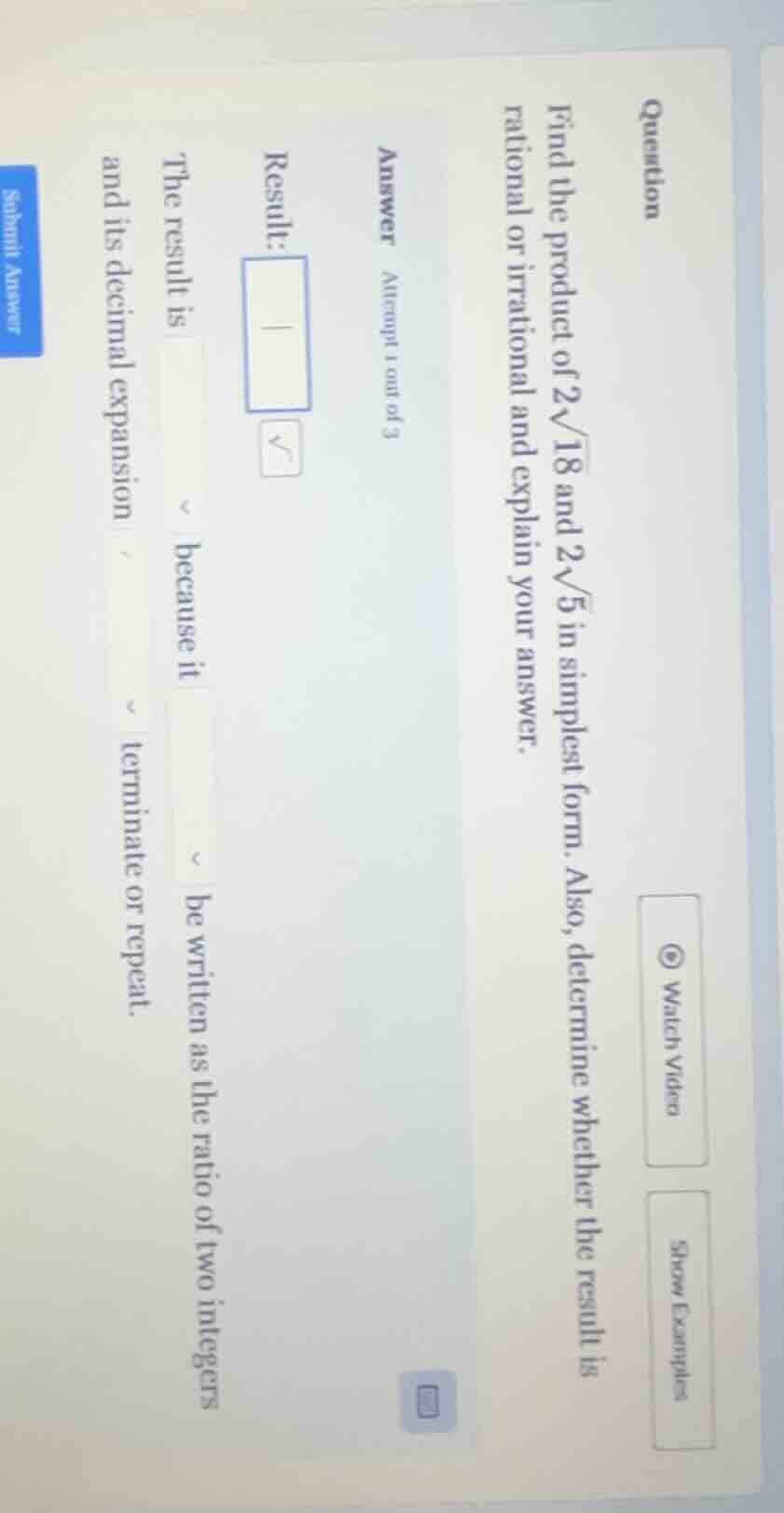
find the product of 2√18 and 2√5 in simplest form. also, determine whether the result is rational or irrational and explain your answer.
answer attempt 1 out of 3
result:
the result is
because it
be written as the ratio of two integers
and its decimal expansion
terminate or repeat.
submit answer
Step1: Simplify the square roots
First, simplify \(\sqrt{18}\). We know that \(18 = 9\times2\), so \(\sqrt{18}=\sqrt{9\times2}=\sqrt{9}\times\sqrt{2}=3\sqrt{2}\). Now the expression becomes \(2\times3\sqrt{2}\times2\sqrt{5}\).
Step2: Multiply the coefficients and the square roots
Multiply the coefficients: \(2\times3\times2 = 12\). Multiply the square roots: \(\sqrt{2}\times\sqrt{5}=\sqrt{10}\) (using the property \(\sqrt{a}\times\sqrt{b}=\sqrt{ab}\)). So the product is \(12\sqrt{10}\).
Step3: Determine if it's rational or irrational
A rational number can be written as \(\frac{p}{q}\) where \(p\) and \(q\) are integers and \(q
eq0\). \(\sqrt{10}\) is irrational (since 10 is not a perfect square), and multiplying a non - zero rational number (12) by an irrational number (\(\sqrt{10}\)) gives an irrational number. Also, the decimal expansion of an irrational number is non - terminating and non - repeating.

Snap & solve any problem in the app
Get step-by-step solutions on Sovi AI
Photo-based solutions with guided steps
Explore more problems and detailed explanations
The product is \(12\sqrt{10}\). The result is irrational because it cannot be written as the ratio of two integers and its decimal expansion is non - terminating and non - repeating.