Sovi.AI - AI Math Tutor

Scan to solve math questions

QUESTION IMAGE

question 8 the correct definition of gonorrhea is: a multistage sti cau…

Question

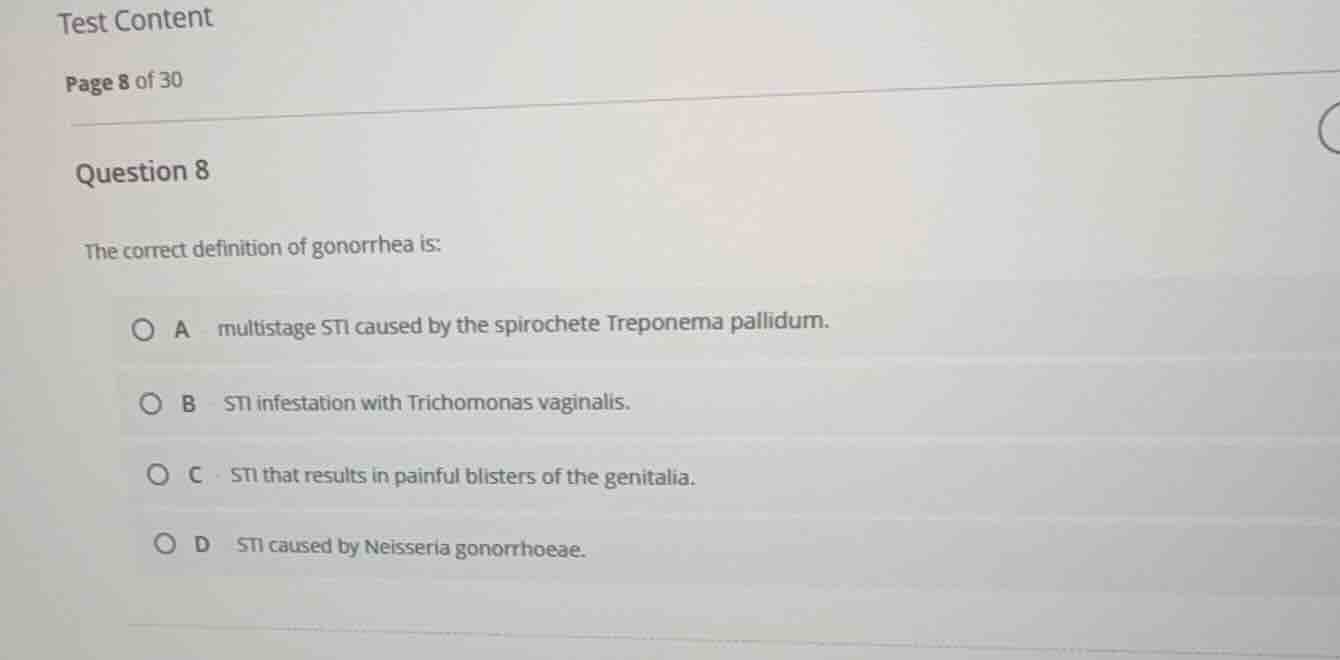
question 8

the correct definition of gonorrhea is:

a multistage sti caused by the spirochete treponema pallidum.
b sti infestation with trichomonas vaginalis.
c sti that results in painful blisters of the genitalia.
d sti caused by neisseria gonorrhoeae.

Explanation:

Response

<pre_analysis>
{
"quality": "clear",
"question_count": 1,
"skills_matched": [
"direct_cot",
"multiple_choice_formatter",
"explain_then_answer",
"tutor"
],
"needs_drawing": false,
"concepts_used": [
"Sexually Transmitted Infections"
],
"new_concepts": [
"Gonorrhea Definition"
],
"current_concepts": [
"Sexually Transmitted Infections",
"Gonorrhea Definition"
]
}
</pre_analysis>

<reasoning>

Analyze the question

The question asks for the correct definition of gonorrhea from the given multiple-choice options. This relates to our understanding of Sexually Transmitted Infections.

Evaluate Option A

Option A describes a "multistage STI caused by the spirochete Treponema pallidum." This is the definition of syphilis, not gonorrhea.

Evaluate Option B

Option B describes an "STI infestation with Trichomonas vaginalis." This is the definition of trichomoniasis, which is a protozoan infection.

Evaluate Option C

Option C describes an "STI that results in painful blisters of the genitalia." This typically describes genital herpes, caused by the herpes simplex virus (HSV).

Evaluate Option D

Option D describes an "STI caused by Neisseria gonorrhoeae." This is the correct medical definition of gonorrhea, which is a bacterial infection caused by the Gram-negative diplococcus Neisseria gonorrhoeae.
</reasoning>

<answer>
<mcq-option>A multistage STI caused by the spirochete Treponema pallidum.</mcq-option>
<mcq-option>B STI infestation with Trichomonas vaginalis.</mcq-option>
<mcq-option>C STI that results in painful blisters of the genitalia.</mcq-option>
<mcq-correct>D STI caused by Neisseria gonorrhoeae.</mcq-correct>
</answer>

<post_analysis>
{
"subject": "Natural Science",
"question_type": "Multiple Choice",
"knowledge_point": [
"Natural Science",
"Medicine",
"Infectious Diseases"
]
}
</post_analysis>

Answer:

<pre_analysis>
{
"quality": "clear",
"question_count": 1,
"skills_matched": [
"direct_cot",
"multiple_choice_formatter",
"explain_then_answer",
"tutor"
],
"needs_drawing": false,
"concepts_used": [
"Sexually Transmitted Infections"
],
"new_concepts": [
"Gonorrhea Definition"
],
"current_concepts": [
"Sexually Transmitted Infections",
"Gonorrhea Definition"
]
}
</pre_analysis>

<reasoning>

Analyze the question

The question asks for the correct definition of gonorrhea from the given multiple-choice options. This relates to our understanding of Sexually Transmitted Infections.

Evaluate Option A

Option A describes a "multistage STI caused by the spirochete Treponema pallidum." This is the definition of syphilis, not gonorrhea.

Evaluate Option B

Option B describes an "STI infestation with Trichomonas vaginalis." This is the definition of trichomoniasis, which is a protozoan infection.

Evaluate Option C

Option C describes an "STI that results in painful blisters of the genitalia." This typically describes genital herpes, caused by the herpes simplex virus (HSV).

Evaluate Option D

Option D describes an "STI caused by Neisseria gonorrhoeae." This is the correct medical definition of gonorrhea, which is a bacterial infection caused by the Gram-negative diplococcus Neisseria gonorrhoeae.
</reasoning>

<answer>
<mcq-option>A multistage STI caused by the spirochete Treponema pallidum.</mcq-option>
<mcq-option>B STI infestation with Trichomonas vaginalis.</mcq-option>
<mcq-option>C STI that results in painful blisters of the genitalia.</mcq-option>
<mcq-correct>D STI caused by Neisseria gonorrhoeae.</mcq-correct>
</answer>

<post_analysis>
{
"subject": "Natural Science",
"question_type": "Multiple Choice",
"knowledge_point": [
"Natural Science",
"Medicine",
"Infectious Diseases"
]
}
</post_analysis>