QUESTION IMAGE
Question
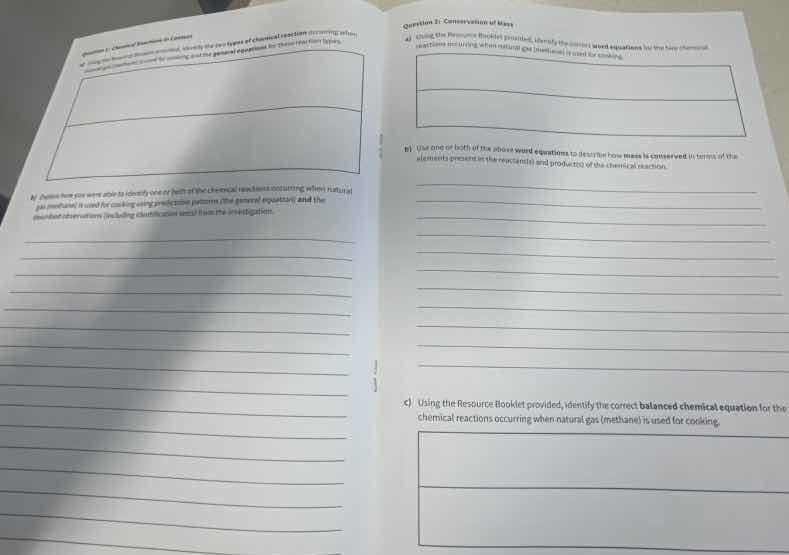
question 1: chemical reactions in context
a) using the resource booklet provided, identify the two types of chemical reaction occurring when natural gas (methane) is used for cooking and the general equations for these reaction types.
b) explain how you were able to identify one or both of the chemical reactions occurring when natural gas (methane) is used for cooking using predictive patterns (the general equation) and the described observations (including identification tests) from the investigation.
question 2: conservation of mass
a) using the resource booklet provided, identify the correct word equations for the two chemical reactions occurring when natural gas (methane) is used for cooking.
b) use one or both of the above word equations to describe how mass is conserved in terms of the elements present in the reactant(s) and product(s) of the chemical reaction.
c) using the resource booklet provided, identify the correct balanced chemical equation for the chemical reactions occurring when natural gas (methane) is used for cooking.
Identify reaction types and general equations
Using the Combustion Reactions concept, when natural gas (methane) burns, it undergoes two types of combustion depending on oxygen availability:
- Complete combustion:
- Incomplete combustion:
Explain identification using observations
Using Combustion Reactions and Chemical Equations, we identify these reactions through specific observations:
- Complete combustion produces a clean blue flame, and the presence of carbon dioxide can be confirmed if it turns limewater cloudy.
- Incomplete combustion produces a yellow/orange smoky flame, leaving a black soot deposit (carbon) on surfaces.
Write word equations for methane combustion
Using Chemical Equations, we write the specific word equations for methane:
- Complete combustion:
- Incomplete combustion:
Describe conservation of mass
Using the Conservation of Mass concept, mass is conserved because the total number of atoms of each element (carbon, hydrogen, and oxygen) in the reactants is exactly equal to the total number of atoms of those same elements in the products. No atoms are created or destroyed; they are simply rearranged.
Write balanced chemical equations
Using Chemical Equations and Conservation of Mass, we balance the chemical equations:
- Complete combustion:
- Incomplete combustion (producing carbon monoxide):
(Or producing soot/carbon):

Snap & solve any problem in the app
Get step-by-step solutions on Sovi AI
Photo-based solutions with guided steps
Explore more problems and detailed explanations
Question 1: Chemical Reactions in Context
a) Two types of chemical reactions and their general equations:
- Complete Combustion:
- Incomplete Combustion:
b) Explanation of identification:
- Complete Combustion is identified by a clean, hot blue flame. The production of carbon dioxide can be verified by bubbling the exhaust gas through limewater, which turns cloudy.
- Incomplete Combustion is identified by a cooler, yellow-orange flame. The production of solid carbon (soot) is observed as a black deposit on glassware or cooking utensils.
---
Question 2: Conservation of Mass
a) Word equations for methane cooking:
- Complete Combustion:
- Incomplete Combustion:
b) How mass is conserved:
Mass is conserved because the total number of atoms of each element (Carbon, Hydrogen, and Oxygen) present in the reactants is exactly equal to the total number of atoms of those same elements present in the products. During the chemical reaction, chemical bonds are broken and new ones are formed, but no atoms are created or destroyed.
c) Balanced chemical equations:
- Complete Combustion:
- Incomplete Combustion: