QUESTION IMAGE
Question
question 1
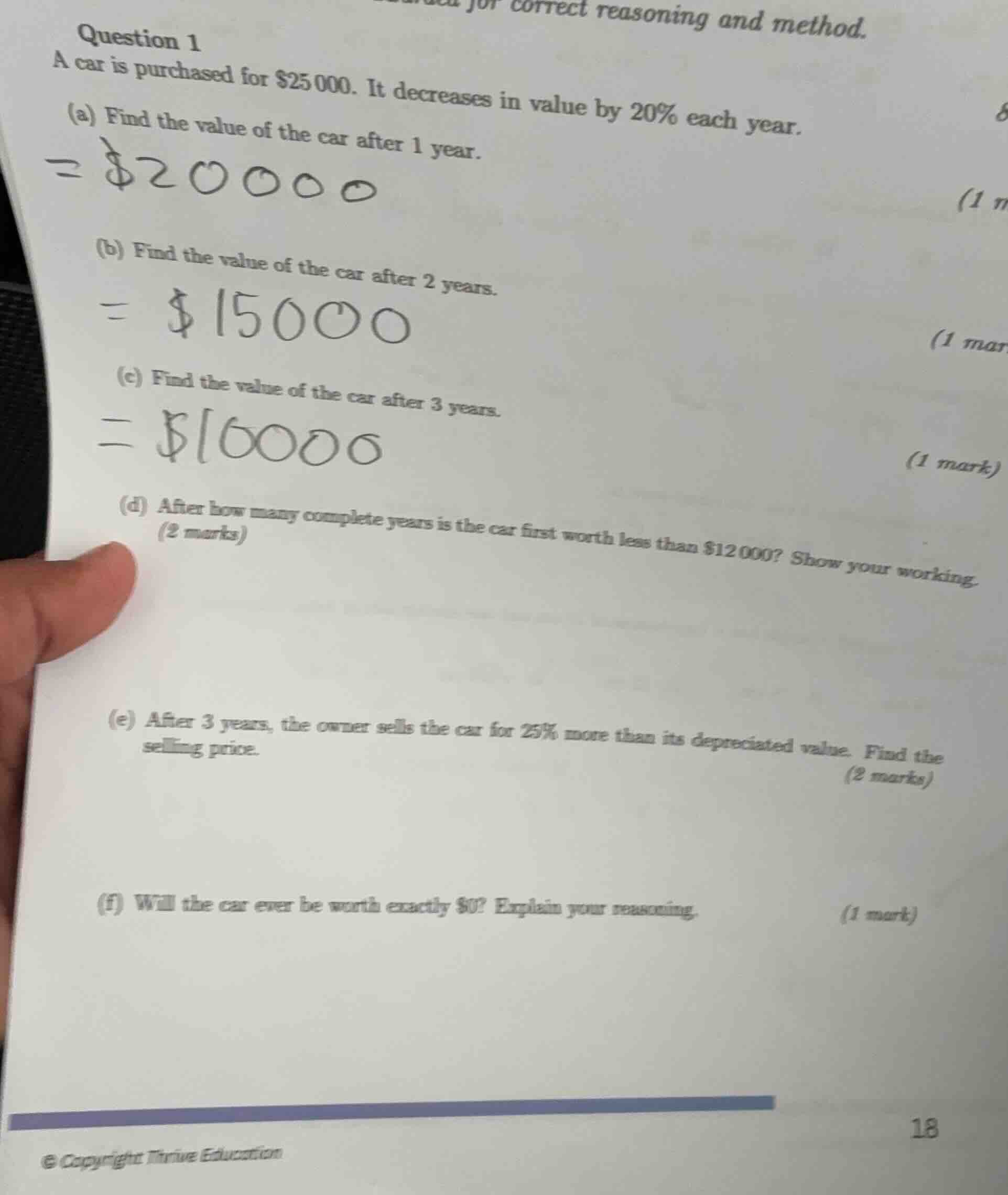
a car is purchased for \\$25,000. it decreases in value by 20\\% each year.
(a) find the value of the car after 1 year.
(b) find the value of the car after 2 years.
(c) find the value of the car after 3 years.
(d) after how many complete years is the car first worth less than \\$12,000? show your working.
(e) after 3 years, the owner sells the car for 25\\% more than its depreciated value. find the selling price.
(f) will the car ever be worth exactly \\$0? explain your reasoning.
Calculate the value after 1 year
The car is purchased for \(\$25\,000\) and decreases in value by \(20\%\) each year. This is modeled by Exponential Decay.
The value after 1 year is:
Calculate the value after 2 years
The value after 2 years is calculated by applying the \(20\%\) decrease to the value at the end of year 1:
Calculate the value after 3 years
The value after 3 years is calculated by applying the \(20\%\) decrease to the value at the end of year 2:
Determine when the value is less than $12,000
We calculate the value after 4 years to see if it drops below \(\$12\,000\):
Since \(V_3 = \$12\,800\) (which is greater than \(\$12\,000\)) and \(V_4 = \$10\,240\) (which is less than \(\$12\,000\)), the car is first worth less than \(\$12\,000\) after 4 complete years.
Calculate the selling price after 3 years
After 3 years, the depreciated value is \(V_3 = \$12\,800\). The owner sells it for \(25\%\) more than this value:
Analyze if the value will ever reach exactly $0
The value of the car after \(n\) years is modeled by:
Since the base \(0.8\) is positive, \( (0.8)^n > 0 \) for all finite values of \(n\). Therefore, the mathematical model will never reach exactly \(0\), though it will approach \(0\) as \(n\) becomes very large.

Snap & solve any problem in the app
Get step-by-step solutions on Sovi AI
Photo-based solutions with guided steps
Explore more problems and detailed explanations
(a) \(\$20\,000\)
(b) \(\$16\,000\)
(c) \(\$12\,800\)
(d) 4 years. Working:
Since \(V_3 > \$12\,000\) and \(V_4 < \$12\,000\), it takes 4 complete years.
(e) \(\$16\,000\). Working:
(f) No. The value is multiplied by \(0.8\) each year. Since a positive number multiplied by \(0.8\) is always positive, the value \(V_n = 25\,000 \times (0.8)^n\) will approach \(0\) but never equal exactly \(\$0\).