QUESTION IMAGE
Question
question 3
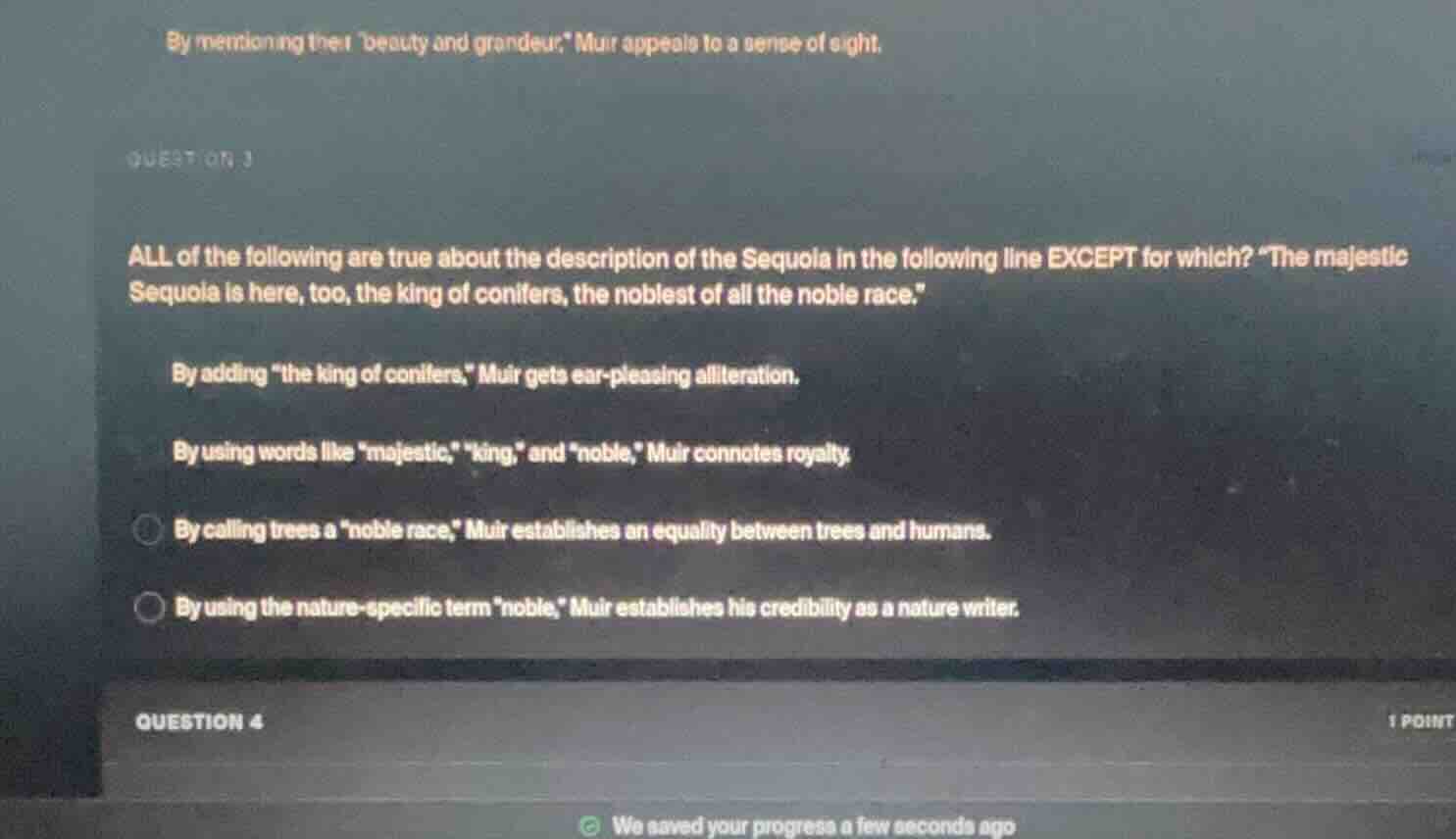
all of the following are true about the description of the sequoia in the following line except for which? \the majestic sequoia is here, too, the king of conifers, the noblest of all the noble race.\
by adding \the king of conifers,\ muir gets ear-pleasing alliteration.
by using words like \majestic,\ \king,\ and
oble,\ muir connotes royalty.
by calling trees a
oble race,\ muir establishes an equality between trees and humans.
by using the nature-specific term
oble,\ muir establishes his credibility as a nature writer.
Analyze the quote and options
The question asks which statement is NOT true (EXCEPT) about the description: "The majestic Sequoia is here, too, the king of conifers, the noblest of all the noble race."
Let's evaluate each option using Literary Analysis:
- "By adding 'the king of conifers,' Muir gets ear-pleasing alliteration."
- Alliteration is the repetition of the same consonant sounds at the beginning of adjacent or closely connected words.
- In "the king of conifers," the words "king" and "conifers" both begin with the hard /k/ sound. This creates alliteration, which is indeed ear-pleasing. Thus, this statement is true.
- "By using words like 'majestic,' 'king,' and 'noble,' Muir connotes royalty."
- Words like "majestic," "king," and "noble" are directly associated with royalty, sovereignty, and high social standing. This statement is true.
- "By calling trees a 'noble race,' Muir establishes an equality between trees and humans."
- Referring to trees as a "race" (especially a "noble race") uses personification to elevate the status of the trees, attributing human-like social structures or qualities to them. However, the primary purpose of this romanticized language in nature writing is to express deep reverence and elevate nature's grandeur, not to establish literal socio-political or biological equality between trees and humans. This statement is a misinterpretation of the literary device.
- "By using the nature-specific term 'noble,' Muir establishes his credibility as a nature writer."
- The word "noble" is not a "nature-specific term" (it is a moral, social, or royal descriptor applied metaphorically to nature here). Therefore, claiming "noble" is a "nature-specific term" is factually incorrect.
Let's re-evaluate the options carefully to see which one is the intended "EXCEPT" (false statement) in standard high school/AP English curriculum:
- "king of conifers" has /k/ alliteration. (True)
- "majestic, king, noble" connotes royalty. (True)
- "noble race" establishing equality between trees and humans is a common distractor; personification elevates nature but does not literally establish "equality."
- However, "noble" is definitely not a "nature-specific term." A nature-specific term would be something botanical or ecological (like "conifers"). Calling "noble" a nature-specific term is a clear factual error. Therefore, this option is the false statement.

Snap & solve any problem in the app
Get step-by-step solutions on Sovi AI
Photo-based solutions with guided steps
Explore more problems and detailed explanations
- By adding "the king of conifers," Muir gets ear-pleasing alliteration.
- By using words like "majestic," "king," and "noble," Muir connotes royalty.
- By calling trees a "noble race," Muir establishes an equality between trees and humans.
- By using the nature-specific term "noble," Muir establishes his credibility as a nature writer. (Correct answer)