QUESTION IMAGE
Question
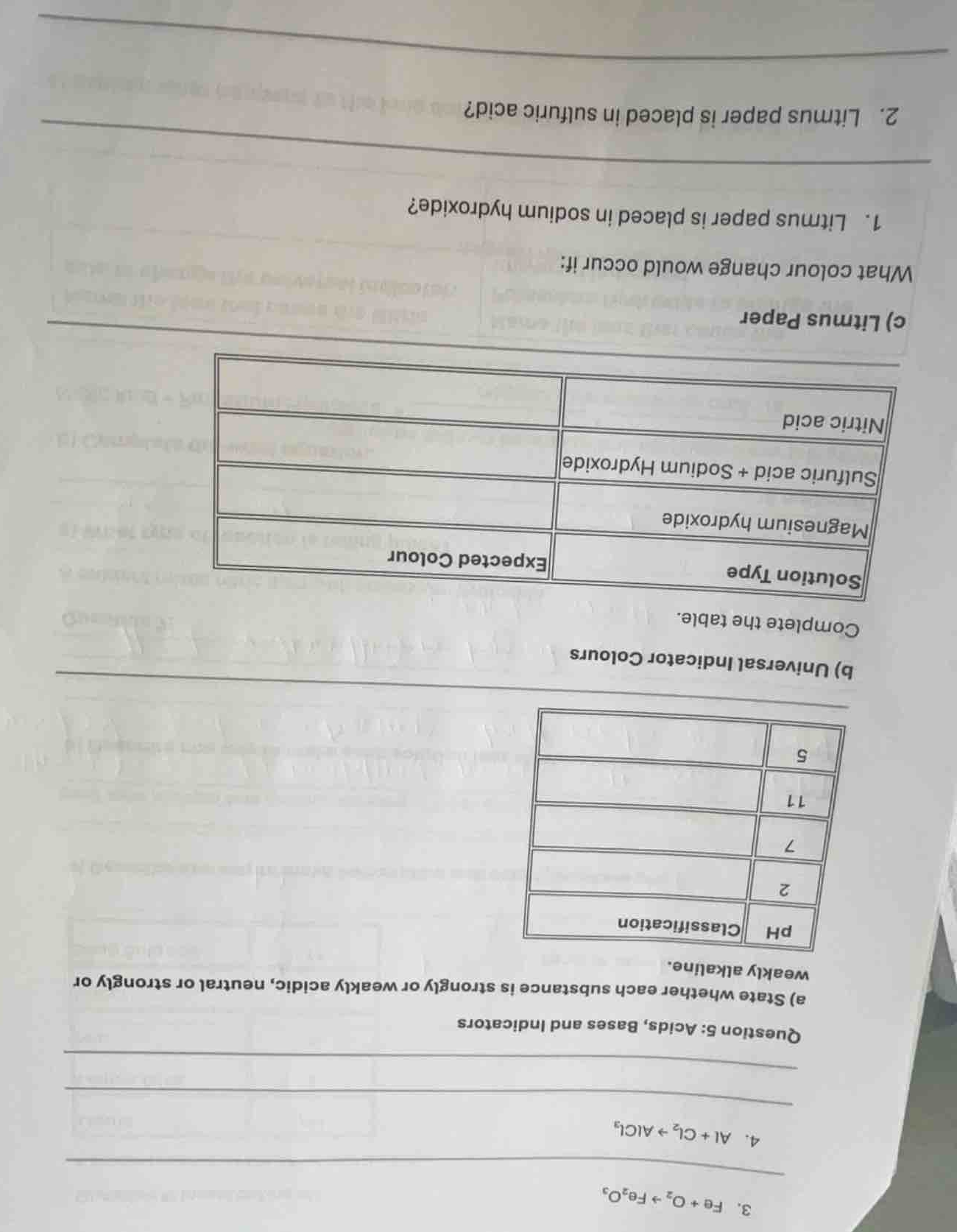
question 5: acids, bases and indicators
a) state whether each substance is strongly or weakly acidic, neutral or strongly or weakly alkaline.
\
$$\begin{tabular}{|c|c|}
\\hline ph & classification \\\\
\\hline 5 & \\\\
\\hline 11 & \\\\
\\hline 7 & \\\\
\\hline 2 & \\\\
\\hline
\\end{tabular}$$
b) universal indicator colours
complete the table.
\
$$\begin{tabular}{|l|l|}
\\hline solution type & expected colour \\\\
\\hline magnesium hydroxide & \\\\
\\hline sulfuric acid + sodium hydroxide & \\\\
\\hline nitric acid & \\\\
\\hline
\\end{tabular}$$
c) litmus paper
what colour change would occur if:
- litmus paper is placed in sodium hydroxide?
- litmus paper is placed in sulfuric acid?
Analyze pH classifications
The pH scale measures acidity or alkalinity:
- pH 1–2: Strongly acidic
- pH 3–6: Weakly acidic
- pH 7: Neutral
- pH 8–11: Weakly alkaline
- pH 12–14: Strongly alkaline
Applying this to the given values:
- pH 5 is weakly acidic.
- pH 11 is weakly alkaline.
- pH 7 is neutral.
- pH 2 is strongly acidic.
Determine Universal Indicator colors
Universal indicator changes color based on pH:
- Nitric acid is a strong acid (pH ~1–2), turning red.
- Sulfuric acid + Sodium Hydroxide is a neutralization reaction yielding a neutral salt solution (pH ~7), turning green.
- Magnesium hydroxide is a weak base (pH ~10), turning blue.
Determine Litmus paper color changes
Litmus paper is an indicator:
- In basic/alkaline solutions (like sodium hydroxide), litmus turns blue.
- In acidic solutions (like sulfuric acid), litmus turns red.

Snap & solve any problem in the app
Get step-by-step solutions on Sovi AI
Photo-based solutions with guided steps
Explore more problems and detailed explanations
Question 5a
| pH | Classification |
|---|---|
| 11 | Weakly alkaline |
| 7 | Neutral |
| 2 | Strongly acidic |
Question 5b
| Solution Type | Expected Colour |
|---|---|
| Sulfuric acid + Sodium Hydroxide | Green |
| Magnesium hydroxide | Blue |
Question 5c
- Blue
- Red