QUESTION IMAGE
Question
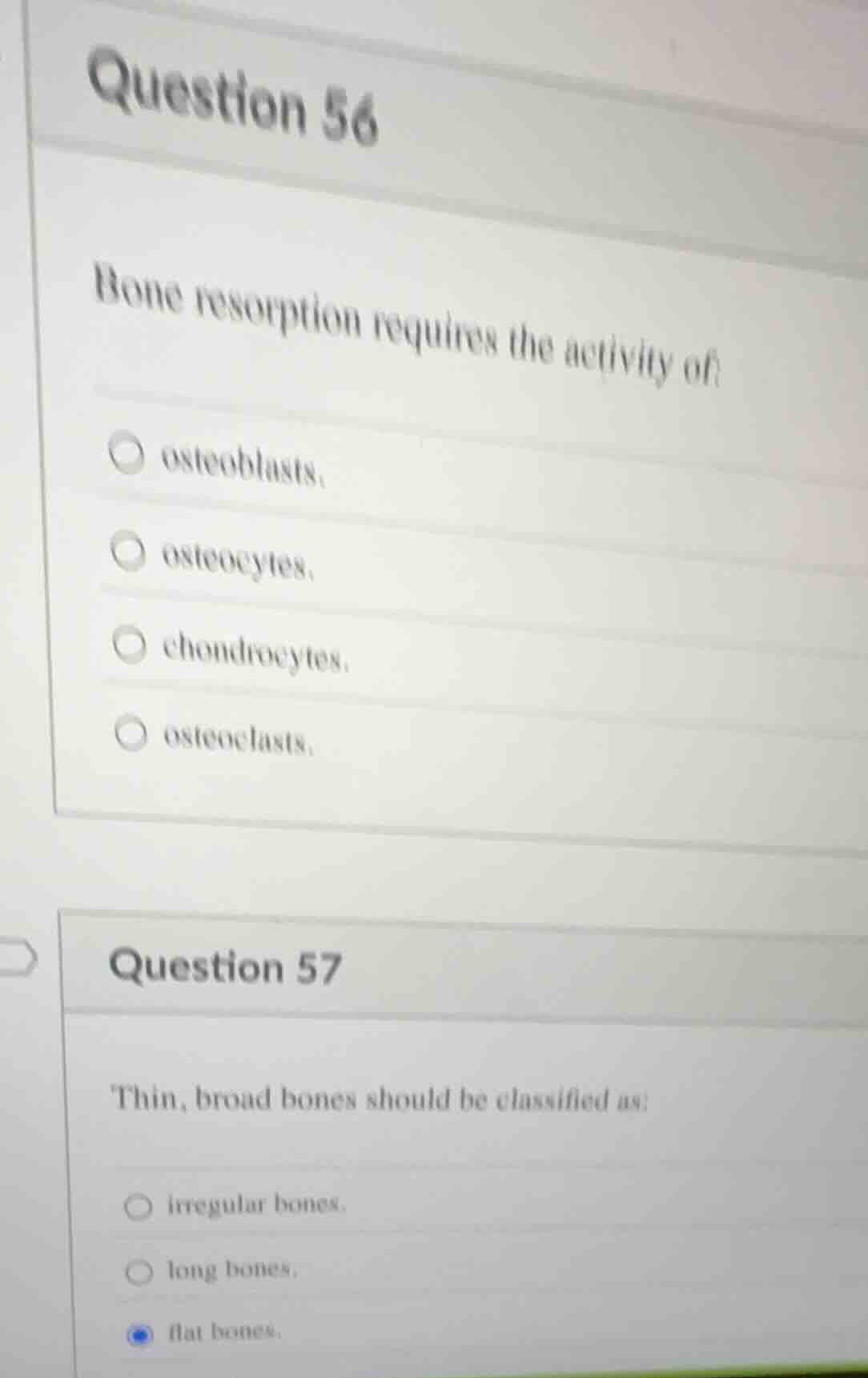
question 56
bone resorption requires the activity of:
osteoblasts.
osteocytes.
chondrocytes.
osteoclasts.
question 57
thin, broad bones should be classified as:
irregular bones.
long bones.
flat bones.
Analyze Question 56
Using the Bone Cells knowledge point
- Osteoblasts are bone-building cells that synthesize and secrete the organic components of the bone matrix (osteoid) and initiate calcification.
- Osteocytes are mature bone cells derived from osteoblasts that become trapped in the matrix they secrete. They maintain daily bone metabolism and act as strain sensors.
- Chondrocytes are mature cells found in cartilage, not bone tissue.
- Osteoclasts are large, multinucleated cells derived from the fusion of hematopoietic stem cells. They release lysosomal enzymes and acids to digest the mineral and organic components of the bone matrix, a process known as bone resorption.
Therefore, bone resorption requires the activity of osteoclasts.
Analyze Question 57
Using the Bone Classification knowledge point
- Irregular bones have complex shapes that do not fit into other categories (e.g., vertebrae, hip bones).
- Long bones are longer than they are wide, consisting of a shaft (diaphysis) and two ends (epiphyses) (e.g., femur, humerus).
- Flat bones are thin, roughly parallel, and broad. They provide protection for underlying soft tissues and offer extensive areas for muscle attachment (e.g., cranial bones, sternum, ribs, scapulae).
Therefore, thin, broad bones are classified as flat bones.

Snap & solve any problem in the app
Get step-by-step solutions on Sovi AI
Photo-based solutions with guided steps
Explore more problems and detailed explanations
Question 56
- (A) osteoblasts.
- (B) osteocytes.
- (C) chondrocytes.
- (D) osteoclasts. (Correct answer)
Question 57
- (A) irregular bones.
- (B) long bones.
- (C) flat bones. (Correct answer)