QUESTION IMAGE
Question
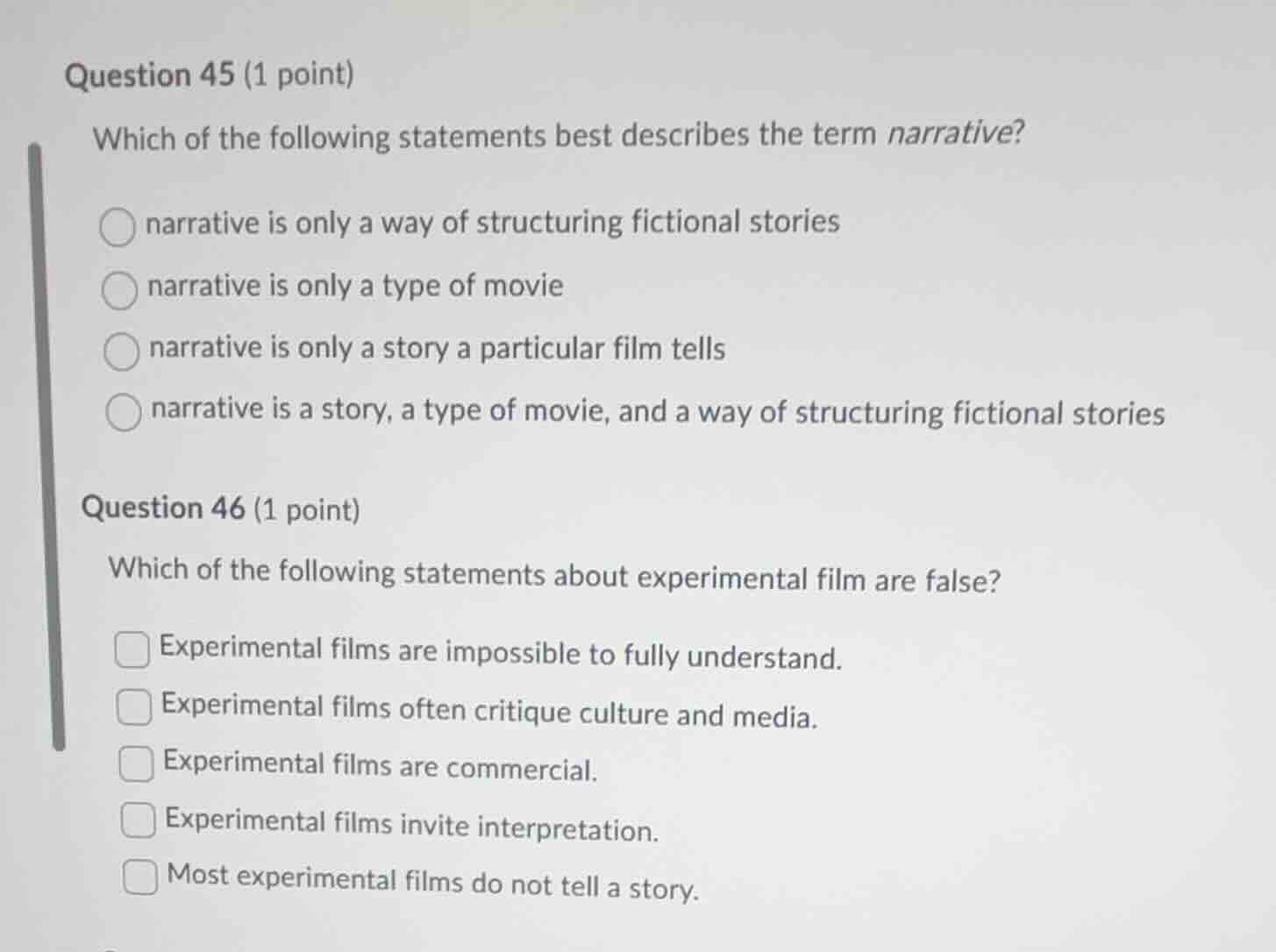
question 45 (1 point)
which of the following statements best describes the term narrative?
narrative is only a way of structuring fictional stories
narrative is only a type of movie
narrative is only a story a particular film tells
narrative is a story, a type of movie, and a way of structuring fictional stories
question 46 (1 point)
which of the following statements about experimental film are false?
experimental films are impossible to fully understand.
experimental films often critique culture and media.
experimental films are commercial.
experimental films invite interpretation.
most experimental films do not tell a story.
Analyze Question 45
The question asks for the statement that best describes the term "narrative" in film studies.
- The first three options limit "narrative" to only one aspect: "only a way of structuring fictional stories," "only a type of movie," or "only a story a particular film tells."
- In film studies, Narrative Cinema is understood broadly. A narrative is a story (the content), a type of movie (narrative films as opposed to documentaries or experimental films), and a way of structuring fictional stories (narrative structure/form).
- Therefore, the fourth option, which combines all three aspects, is the most comprehensive and accurate definition.
Analyze Question 46
The question asks which statements about experimental film are false. This is a multi-select style question (indicated by checkboxes) asking for false statements.
- "Experimental films are impossible to fully understand": While they are abstract, they are not objectively "impossible" to understand; they simply invite different modes of interpretation. However, in academic film studies, labeling them as strictly "impossible to understand" is a common misconception or false claim.
- "Experimental films often critique culture and media": This is true. Many experimental films (like avant-garde or essay films) actively critique mainstream culture and media conventions.
- "Experimental films are commercial": This is false. Experimental films are almost by definition non-commercial, low-budget, and produced outside the mainstream studio system.
- "Experimental films invite interpretation": This is true. They are open-ended and encourage active viewer interpretation.
- "Most experimental films do not tell a story": This is true. They prioritize form, texture, rhythm, or association over traditional narrative storytelling.
Thus, the false statements are "Experimental films are impossible to fully understand" and "Experimental films are commercial."

Snap & solve any problem in the app
Get step-by-step solutions on Sovi AI
Photo-based solutions with guided steps
Explore more problems and detailed explanations
Question 45
- (A) narrative is only a way of structuring fictional stories
- (B) narrative is only a type of movie
- (C) narrative is only a story a particular film tells
- (D) narrative is a story, a type of movie, and a way of structuring fictional stories (Correct answer)
Question 46
- [X] Experimental films are impossible to fully understand. (Correct answer)
- [ ] Experimental films often critique culture and media.
- [X] Experimental films are commercial. (Correct answer)
- [ ] Experimental films invite interpretation.
- [ ] Most experimental films do not tell a story.