QUESTION IMAGE
Question
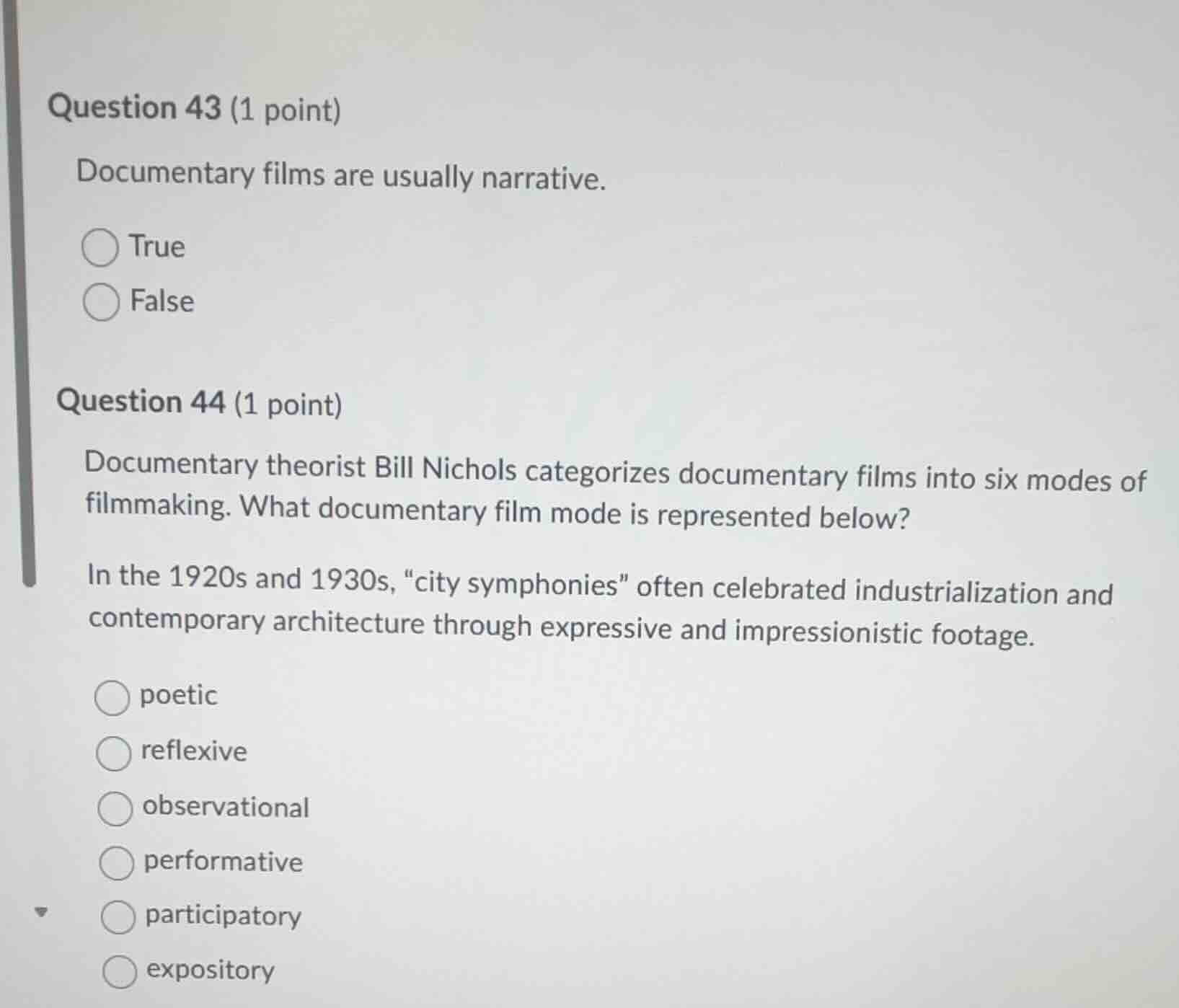
question 43 (1 point)
documentary films are usually narrative.
true
false
question 44 (1 point)
documentary theorist bill nichols categorizes documentary films into six modes of filmmaking. what documentary film mode is represented below?
in the 1920s and 1930s, \city symphonies\ often celebrated industrialization and contemporary architecture through expressive and impressionistic footage.
poetic
reflexive
observational
performative
participatory
expository
Analyze narrative structure in documentaries
We evaluate Question 43. Narrative Cinema typically relies on cause-and-effect storytelling with fictional characters. While some documentaries use narrative arcs, documentaries as a broad category are primarily non-narrative, focusing instead on rhetorical, expository, or poetic structures to present factual information. Therefore, the statement "Documentary films are usually narrative" is false.
Identify Bill Nichols' documentary modes
We evaluate Question 44. Bill Nichols identifies six documentary modes: poetic, expository, observational, participatory, reflexive, and performative. The prompt describes "city symphonies" from the 1920s and 1930s that used expressive, impressionistic footage to celebrate industrialization and architecture.
Match city symphonies to the poetic mode
The poetic mode emphasizes visual associations, tonal or rhythmic qualities, and impressionistic representation over narrative continuity or rhetorical argument. "City symphonies" (like Man with a Movie Camera or Berlin: Symphony of a Metropolis) are classic examples of the poetic mode.

Snap & solve any problem in the app
Get step-by-step solutions on Sovi AI
Photo-based solutions with guided steps
Explore more problems and detailed explanations
Question 43
- True
- False (Correct answer)
Question 44
- poetic (Correct answer)
- reflexive
- observational
- performative
- participatory
- expository