QUESTION IMAGE
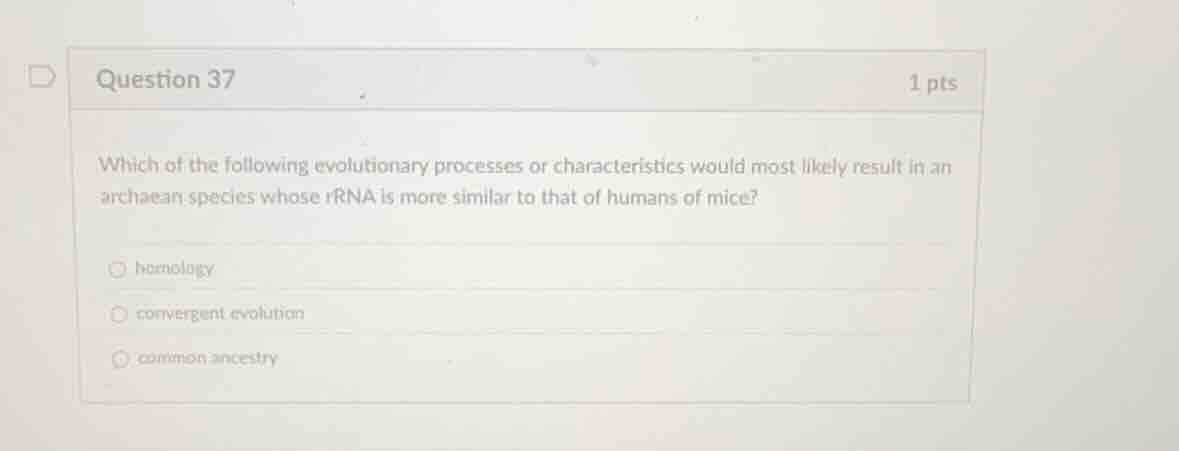
Question
question 37
1 pts
which of the following evolutionary processes or characteristics would most likely result in an archaean species whose rrna is more similar to that of humans of mice?
homology
convergent evolution
common ancestry
Analyze the biological relationships
The question asks what would explain an archaean species having rRNA more similar to humans than to mice. Humans and mice are both mammals. They share a very recent common ancestor compared to Archaea. Under normal evolutionary relationships, human and mouse rRNA should be nearly identical compared to any archaean.
Evaluate the options
- Common ancestry: If similarity were due to common ancestry, humans and mice must be much more similar to each other than either is to an archaean. Common ancestry cannot explain why an archaean is more similar to a human than a mouse is to a human.
- Homology: Homology refers to traits inherited from a common ancestor. Since the shared ancestry of humans and mice is much more recent, homologous rRNA sequences would keep humans and mice more similar to each other.
- Convergent evolution: This occurs when species independently evolve similar traits due to similar selective pressures, rather than shared ancestry. If an archaean's rRNA is unexpectedly more similar to a human's than a mouse's is, this anomalous similarity is best explained by independent, parallel changes (convergence) in the nucleotide sequences.
Apply student profile concepts
Using the Three Domains of Life and Evolutionary Relationships knowledge points, we know that Eukarya (including humans and mice) and Archaea are distinct domains. Within Eukarya, humans and mice share a highly conserved evolutionary history. Any unexpected sequence similarity between a specific archaean and a human that bypasses the mouse must be due to independent convergence.

Snap & solve any problem in the app
Get step-by-step solutions on Sovi AI
Photo-based solutions with guided steps
Explore more problems and detailed explanations
- homology
- convergent evolution (Correct answer)
- common ancestry